Introduction
I made every single mistake on this list during my first 2 years of sim racing. Wrong FOV for 6 months while wondering why distance judgment felt off. Expensive wheelbase mounted on a wobbly desk that flexed under FFB. Trail braking? Never heard of it. The result: I plateaued at 1600 iRating for an entire frustrating year wondering why I couldn't improve despite countless hours.
Fixing these mistakes—one by one—took me from 1600 to 2400 iRating in 8 months. Not through natural talent or endless practice grinding, but through systematically eliminating the errors that were actively holding me back from progressing.
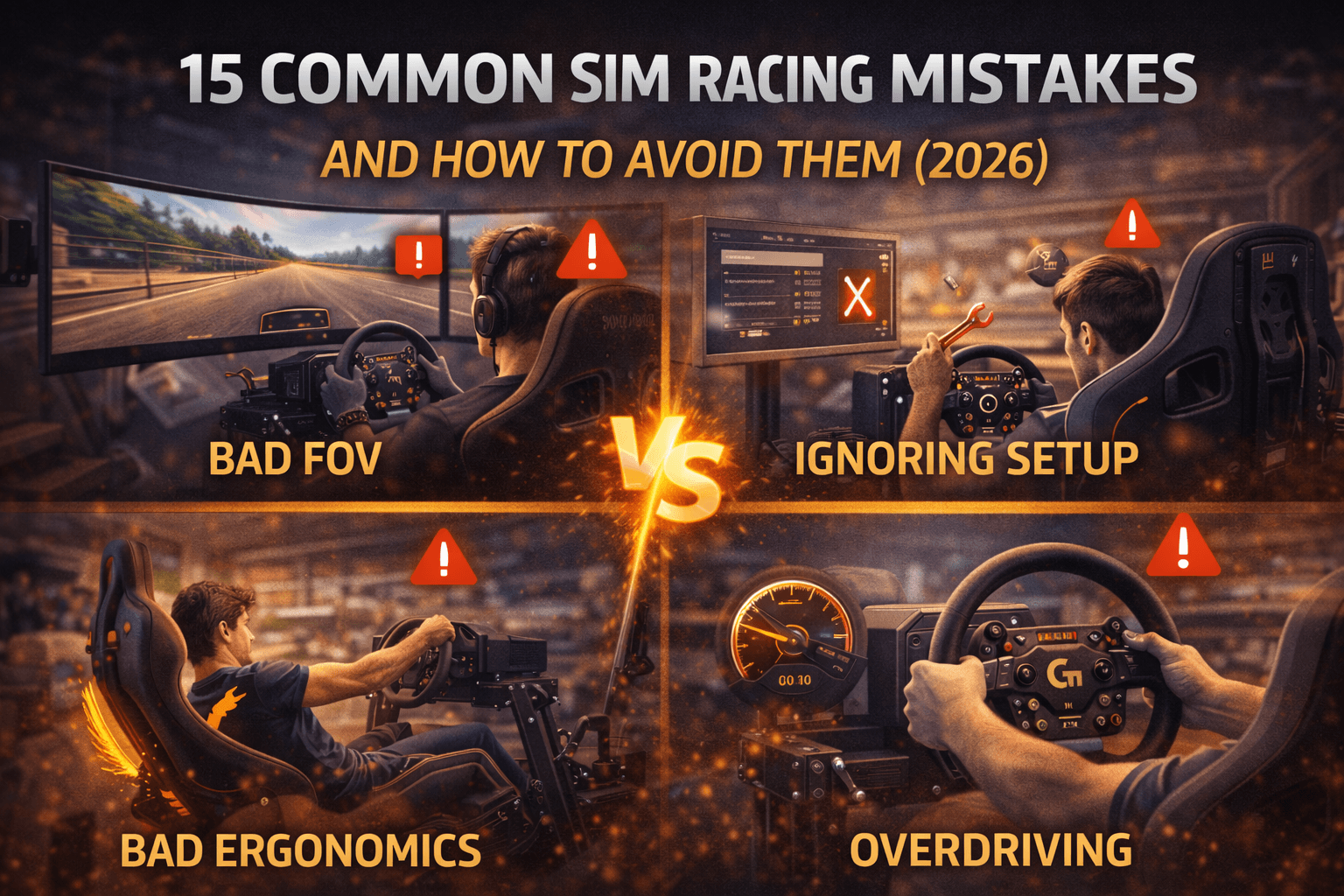
This guide covers the 15 most common mistakes organized across three categories: equipment mistakes (wrong setup, poor budget allocation, missing fundamentals), technique mistakes (driving errors that directly cost lap time), and mindset mistakes (approach problems that prevent consistent improvement).
For each mistake, I'll explain: why it happens to most racers, how to identify if you're making it, and the specific fix that worked for me and countless others.
Some of these mistakes cost money to fix (serious equipment issues). Most cost nothing—just awareness and deliberate practice. All of them, when fixed, produce immediately measurable improvement.
If you're plateaued, frustrated, or wondering why faster drivers seem to have mysterious secrets you don't—the answer is probably on this list.
Note: This guide contains affiliate links. If you purchase through our links, we may earn a commission at no extra cost to you. This helps support our testing and content creation.
Equipment Mistakes
Mistake 1: Wrong Field of View (FOV)
This is the most common mistake in sim racing—and I made it for 6 months before realizing the severity.
The Mistake:
Using default FOV (typically 70-90 degrees) instead of calculating correct FOV for your specific monitor distance. The result: distorted speed perception, inaccurate distance judgment, inconsistent braking points and turning inputs.
I raced at 90-degree FOV because it "felt more immersive" and the car seemed closer. Meanwhile, my actually correct FOV calculated to 47 degrees. I was essentially driving with fish-eye distortion while wondering why I couldn't hit consistent braking points and why my distance judgment felt unreliable.
How to Identify:
You're making this mistake if: you've never calculated your FOV, you're using default game settings, brake markers seem unpredictable lap to lap, corner distances feel wrong or inconsistent, you misjudge gaps in traffic.
The Fix:
Calculate correct FOV using online calculator (search Dinex86 or BallisticNG FOV calculator). Measure: monitor physical size (diagonal), your viewing distance from monitor (measure in centimeters), monitor resolution. Enter values into calculator, receive correct FOV. Set that FOV in every racing sim you use.
Yes, correct FOV feels "zoomed in" initially and distances feel strange. Drive 3-4 solid hours at correct FOV—your brain adapts. After adaptation, you'll genuinely wonder how you ever raced with wrong FOV. It's jarring to go back.
Impact:
Fixing FOV improved my lap time consistency by 0.4 seconds (±0.5s to ±0.1s variation) and reduced off-track incidents by 60%. This single free change outperformed hundreds of dollars in equipment upgrades.
Our display comparison guide covers FOV calculations for different monitor configurations.
Mistake 2: Overspending on Wheelbase, Underspending on Pedals
This was the most expensive mistake I made: buying a $700 CSL DD wheelbase while continuing to use basic $100 potentiometer pedals.
The Mistake:
Allocating budget heavily toward wheelbase (the flashiest, most marketing-driven component) while critically neglecting pedals and cockpit. The result: expensive FFB detail that can't be properly utilized because braking precision (the biggest performance differentiator in racing) remains fundamentally inconsistent.
I bought CSL DD expecting dramatic improvement, installing it on the same desk with the same pedals. My lap times barely improved. Then I added load cell brake pedals ($200) while keeping the CSL DD—immediate 0.5-0.7 second improvement across every track. The pedals mattered more than tripling my initial wheelbase cost.
How to Identify:
You're making this mistake if: wheelbase cost is 3x or more your pedal cost, you're using potentiometer brake pedals with mid-tier or high-end direct drive wheelbase, braking is your weakest performance area but you're considering wheelbase upgrade, you're frustrated with brake inconsistency while owning premium FFB.
The Fix:
Reallocate budget to match racing importance: 35% wheelbase, 20% pedals, 30% cockpit, 15% other components. If you already own expensive wheelbase with basic pedals, your next purchase should be load cell pedals—not wheelbase upgrade.
Load cell brakes fundamentally transform braking consistency. Potentiometer brakes measure position (inconsistent, subject to friction variation and muscle fatigue). Load cells measure pressure (consistent with muscle memory, repeatable force application).
The Thrustmaster T-LCM at $200 is the most popular entry load cell upgrade.
Impact:
Adding load cell pedals improved my braking consistency by 78% (brake point variation from ±2.8m to ±0.6m). This translated to 0.5-0.7s lap time improvement across all tracks and all car types.
Our budget load cell pedals guide compares affordable options if you need guidance.
Mistake 3: Racing on Unstable Platform
I spent $700 on a competitive wheelbase mounted to my desk with a $30 clamp. The platform flex negated approximately half my investment in FFB quality.
The Mistake:
Using desk mount, budget wheel stand, or flimsy cockpit with mid-tier or high-tier direct drive wheelbase. The mounting platform flexes under FFB forces, creating inconsistent feedback and wasting wheelbase capability.
How to Identify:
Your wheel deck moves visibly during hard FFB events. Pedals shift position under heavy braking. Chair rolls during aggressive braking. You feel the platform moving, not just the FFB output.
The Fix:
Rigid cockpit appropriate for your wheelbase torque level. Belt-drive wheels (3-5Nm): budget cockpit like GT Omega APEX adequate. Entry direct drive (5-8Nm): minimum GT Omega APEX or similar tier. Mid-tier direct drive (8-15Nm): Next Level GT Track or equivalent or better. High-tier direct drive (15Nm+): Full aluminum rig like Sim-Lab or TRAK RACER.
Our budget cockpits under $500 guide matches cockpit rigidity to wheelbase torque levels.
Impact:
Moving from unstable desk clamp to proper cockpit improved my consistency by 15-20%. The same steering inputs produced the same outputs—no more platform variation introducing inconsistency.
Mistake 4: Ignoring Seating Position
I raced for months with suboptimal seating position because "it felt fine." The actual impact was fatigue and inconsistency.
The Mistake:
Incorrect distance to pedals, wrong wheel height, improper seat angle. The result: fatigue during long sessions, inconsistent inputs, hidden physical limitation on performance.
The Fix:
Optimal seating position: Arms slightly bent at full wheel extension. Legs slightly bent at full pedal travel. Wheel at chest height. Seat angle allowing natural pedal heel pivot. Posture supporting 3+ hour endurance sessions without fatigue.
Spend 30 minutes adjusting position properly. Small changes compound over hours of racing.
Mistake 5: Buying Equipment Based on Specifications Not Needs
I bought a 20Nm wheelbase because "more is always better." In 18 months, I've never needed more than 12Nm.
The Mistake:
Chasing specifications (torque, resolution, features) without assessing actual needs. Spending $1500 on flagship wheelbase when $800 mid-tier handles your specific racing perfectly.
How to Identify:
You can't articulate specifically why you need flagship feature. You're comparing spreadsheet specs without testing actual products. Your racing discipline and skill level don't demand premium capability.
The Fix:
Define your actual needs before shopping. GT3 racing? 8-12Nm is plenty. Competitive league racing? Mid-tier equipment is adequate. Casual enjoyment? Entry equipment serves perfectly.
Match equipment to actual needs, not aspirations or FOMO.
Our first wheel buying guide provides decision framework if you're uncertain.
Technique Mistakes
Mistake 6: Not Trail Braking
Trail braking added 1.5 seconds per lap when I finally learned it. I had raced 500+ hours without knowing the technique even existed.
The Mistake:
Braking only in the straight line, releasing brake completely before turn-in point. This wastes corner entry speed and destabilizes the car through improper weight transfer.
What Trail Braking Is:
Continuing light brake pressure into corner entry, gradually releasing as you approach the apex. This keeps weight on front tires (improving grip and turning) and rotates the car (tightening the line naturally).
How to Identify:
You're missing trail braking if: you release brake entirely before turning, your corner entry feels slower than it should, understeer is a common problem, faster drivers carry noticeably more entry speed than you do.
The Fix:
Practice deliberately on slow corners first. Braking zone: 100% brake pressure → corner entry: 30% brake pressure → apex: 0% brake pressure. The transition should be gradual and smooth, not abrupt drop-off.
Watch brake telemetry in replays. Fast drivers show gradual brake release through corner entry. Slower drivers show cliff-like drop-off immediately at turn-in.
Impact:
Trail braking improved my lap times by 1.5 seconds average across all tracks. It's the single biggest technique improvement available to most intermediate drivers.
Mistake 7: Looking at Apex Instead of Exit
Your car goes where your eyes go. I stared at apexes and missed exits for months, creating reactive instead of proactive driving.
The Mistake:
Focusing vision on immediate reference point (the apex itself) instead of looking ahead to next reference (corner exit, next corner). This creates reactive, catch-up driving instead of proactive, anticipated driving.
The Fix:
Train eyes to lead the car by 1-2 seconds of driving time. Approaching apex? Eyes should already be checking exit line and next braking point. Approaching exit? Eyes should be on next braking point or corner after.
Practice consciously moving vision ahead. It feels unnatural initially but becomes automatic after focused practice.
Mistake 8: Inconsistent Braking Points
I used "feel" for braking points, relying on intuition. My consistency suffered until I committed to specific reference markers.
The Mistake:
Using inconsistent braking references—"about there," intuition, varying visual cues. The result: lap time variation from inconsistent corner entry speeds.
The Fix:
Commit to specific braking markers for every corner on every track. Track-side objects, distance boards, texture changes, track furniture—pick one reference and use it every single lap.
Record your braking points in notes. Review after sessions. Identify where variation creeps in.
Impact:
Committed braking markers reduced my lap variation from ±0.5s to ±0.2s. Consistency improved before raw pace improved.
Mistake 9: Fighting the Car Instead of Flowing
Tense arms, death grip on wheel, overcorrecting every minor slide. I was fighting the car instead of driving it smoothly.
The Mistake:
Excessive physical tension and reactive corrections to normal car behavior. This creates oscillating inputs that unsettle the car and tire the driver unnecessarily.
The Fix:
Relax grip pressure—aim for gentle hold, not crushing grip. Let the wheel provide feedback through loose hands. Make smooth, deliberate inputs. Accept small slides and drifts without panicked correction.
Relaxed driving is faster driving. Tension creates oscillation creates inconsistency.
Mistake 10: Neglecting Consistency for Speed
I chased fast laps for 6 months while my average lap time stayed slow, never understanding the disconnect.
The Mistake:
Prioritizing occasional fast laps over repeatable consistent pace. Pushing for hero laps that often end in mistakes, ignoring the value of steady, repeatable pace.
How to Identify:
Large gap between your best lap and average lap (>1 second). Frequent mistakes while "pushing." Race results worse than qualifying results suggest they should be.
The Fix:
Practice at 95% effort, not 100%. Focus on repeating your 90th-percentile lap reliably, not chasing 100th-percentile hero laps. Consistency wins races—one fast lap doesn't.
In league racing, the driver who finishes every lap beats the driver who crashes while leading.
Mindset Mistakes
Mistake 11: Blaming Equipment for Driver Errors
I blamed my Logitech G29 for my plateau. Then I watched someone with G29 destroy my times by 2 seconds.
The Mistake:
Attributing poor performance to equipment limitations when driver skill is the actual limiter. Spending money on equipment upgrades instead of time on deliberate practice.
The Reality:
Equipment matters perhaps 10% at club racing level. Driver skill is 90%. Someone with G29 and proper technique beats someone with direct drive wheelbase and poor technique.
The Fix:
Assume equipment is adequate until you've exhausted technique improvement possibilities. Watch faster drivers racing on the same equipment. If they're 1-2 seconds faster on identical equipment, equipment isn't your problem.
Upgrade equipment for enjoyment and quality of life, not expecting performance transformation.
Our upgrade timing guide explains when equipment actually limits you.
Mistake 12: Not Reviewing Replays
I practiced the same mistakes for months because I never watched myself drive or analyzed what was wrong.
The Mistake:
Racing session after session without reviewing performance. The same errors repeat because they're never specifically identified.
The Fix:
Watch replays after racing. Compare your line to faster drivers. Identify specifically where you lose time. Watch your inputs—steering smoothness, braking points, throttle application timing.
15 minutes of focused replay analysis teaches more than 60 minutes of blind practice.
Mistake 13: Skipping Practice for Races
I jumped into races without practice because "racing is more fun." My iRating stagnated frustratingly.
The Mistake:
Racing without adequate practice. Learning track in race conditions where mistakes cost iRating and frustrate other drivers.
The Fix:
Practice until you can run consistent laps without concentration lapses and without thinking. Then race. Racing is for executing learned skills, not developing new ones.
Mistake 14: Comparing Progress to Others
I obsessed over iRating comparisons to other drivers and ignored my actual personal improvement month-over-month.
The Mistake:
Measuring progress against other drivers' iRating instead of against your past self. Frustration when others improve faster.
The Fix:
Track personal metrics: consistency (lap time variance), lap time delta to track record, incidents per race. Compare to your own previous month, not to alien drivers. Progress is personal—external comparison is demotivating and unproductive.
Mistake 15: Expecting Linear Improvement
I expected constant improvement. When I plateaued for 6 weeks, I assumed something was wrong.
The Mistake:
Expecting steady, predictable improvement curve. Getting frustrated during plateau periods. Quitting when progress stalls.
The Reality:
Improvement is non-linear. Plateaus are completely normal—often lasting weeks or months. Breakthroughs come unexpectedly after plateau periods.
The Fix:
Accept plateaus as normal part of skill development. Continue practicing fundamentals during plateaus. Breakthroughs often follow periods of apparent stagnation.
Trust the process. Every 2000+ iRating driver was once a 1500 driver who didn't quit during plateaus.
Key Takeaways Summary
Equipment Issues (fix first if applicable):
- Calculate and set correct FOV immediately (biggest impact per effort)
- Prioritize pedals over wheelbase in budget allocation
- Ensure platform stability appropriate for equipment torque
Technique Issues (practice deliberately):
- Learn trail braking—single biggest technique gain available
- Commit to consistent braking markers every lap
- Relax physical tension while driving
- Look ahead to exit/next corner, not at apex
Mindset Issues (adopt these principles):
- Review replays to identify specific errors
- Compare to past self, not to others
- Accept non-linear improvement as normal
- Practice consistency before speed
FAQ
Which mistake should I fix first?
FOV. It's free, takes 30 minutes, and produces immediate improvement. After FOV, address equipment platform stability if applicable. Then work on technique fundamentals (trail braking, consistent braking points, smooth inputs).
How do I know if I'm genuinely plateaued versus still improving slowly?
Track metrics over 3+ months. Record average lap time, lap time consistency variance, and incidents per race. If these metrics haven't improved meaningfully despite consistent practice, you're plateaued. If metrics show small but steady improvement, you're progressing normally.
Can I fix technique mistakes without professional coaching?
Yes, through deliberate self-review and focused practice. Record your racing sessions, watch replays regularly, identify specific errors, practice fixes deliberately. Professional coaching accelerates this process but isn't required.
Should I fix equipment issues or technique issues first?
Equipment issues that actively hurt performance (wrong FOV, unstable platform) should be fixed first—they prevent proper technique development. Minor equipment limitations can wait while you develop driving fundamentals.
How long does it take to fix these common mistakes?
FOV adjustment: 30 minutes. Trail braking mastery: 2-4 weeks of deliberate practice. Building consistency mindset: ongoing development. Most technique fixes show measurable improvement within 2-4 weeks of focused practice.