Introduction
I've driven with gear, belt, and direct drive wheels ranging from $200 to $2,000. The difference isn't what most people think.
If you're standing at the crossroads choosing your first wheel or planning your first serious upgrade, you're probably confused by the force feedback terminology. Gear drive vs belt drive vs direct drive sounds like technical jargon, but it directly affects how your hands feel the car and, eventually, how fast you can lap a track.
This guide breaks down all three technologies without the marketing fluff. You'll learn how each one actually works mechanically, what real performance differences exist, and—most importantly—which one makes sense for your budget and skill level.
The quick version: Start with belt drive if possible. It's 90% of direct drive's quality at 40% of the cost. But if you're on a strict budget under $300, gear drive teaches you everything you need to know. And if you've got $500+, direct drive is the last wheelbase you'll ever need.
Note: This guide contains affiliate links. If you purchase through our links, we may earn a commission at no extra cost to you. This helps support our testing and content creation.
Force Feedback Basics: What You're Actually Feeling
What is force feedback?
It's a motor that resists your steering inputs. When your virtual car's tires slip, the motor pushes back harder. When you hit curbing, you feel vibration. When you're at the grip limit, the wheel pulls or pushes you subtly toward the line. Your hands learn what the car is doing through these sensations.
What's being communicated:
- Tire grip levels (slip = strong force, grip = smooth, centered feeling)
- Road surface texture (smooth tarmac vs bumpy curbing)
- Weight transfer (heavy forces during cornering, light on straights)
- Understeer/oversteer (car wants to push out or rotate, wheel tells you)
- Aerodynamic balance (how much downforce is working)
Why it matters:
Better force feedback = earlier warning signals about what the car is doing = time to react = faster, smoother corrections = faster lap times. It's not about the motor being stronger; it's about the motor being more honest with you.
Torque (Nm): What you actually need
Newton-meters measure the force strength. A 2 Nm motor applies gentle feedback. A 25 Nm motor applies powerful, realistic feedback for heavy race cars (GT3, F1, prototypes).
Common misconception: "More Nm = better." Not necessarily. A poorly tuned 8 Nm wheel feels worse than a well-tuned 6 Nm wheel. The quality of detail matters more than raw strength.
Latency: Why milliseconds matter
Latency is the delay between the sim calculating forces and you feeling them in the wheel. 20ms latency might sound instant to you, but in sim racing it's not. At 200 km/h, 20ms = missing the early warning sign for a slide by the distance of a car length. You feel the slide after it's already developed.
- Gear drive: 15-25ms latency (delayed feedback, harder to catch slides)
- Belt drive: 10-15ms latency (adequate for most racers)
- Direct drive: 3-8ms latency (nearly imperceptible, immediate feedback)
New to sim racing? Start with our how to build your first racing rig guide for complete setup context.
Technology Comparison Overview
| Feature | Gear Drive | Belt Drive | Direct Drive | Winner |
|---|---|---|---|---|
| Force Transmission Method | Plastic/metal gears | Rubber belt + pulley | Motor shaft directly | Direct Drive |
| Peak Torque | 2–3 Nm | 4–6 Nm | 5–25 Nm | Direct Drive |
| FFB Feel | Notchy (gear teeth) | Smooth, gradual | Ultra-smooth | Direct Drive |
| FFB Detail | Low (filtered) | Medium-high | Highest (unfiltered) | Direct Drive |
| Latency | 15–25 ms | 10–15 ms | 3–8 ms | Direct Drive |
| Noise Level | Loud (grinding) | Quiet (fan noise) | Very quiet (servo) | Direct Drive |
| Maintenance | Low (occasional grease) | Medium (belt wear) | Very low (no wear parts) | Direct Drive |
| Lifespan | 3–5 years heavy use | 5–8 years | 10+ years | Direct Drive |
| Price Range | $200–350 | $350–600 | $450–2,500+ | Gear Drive |
| Best Value | Entry-level | Enthusiast-level | Long-term | Belt Drive |
| Upgrade Ecosystem | Limited (proprietary) | Good (swappable rims) | Excellent (modular) | Direct Drive |
| First-Time Racers | Adequate | Ideal | Overkill | Belt Drive |
Gear Drive Wheels: The Budget Entry
How it works:
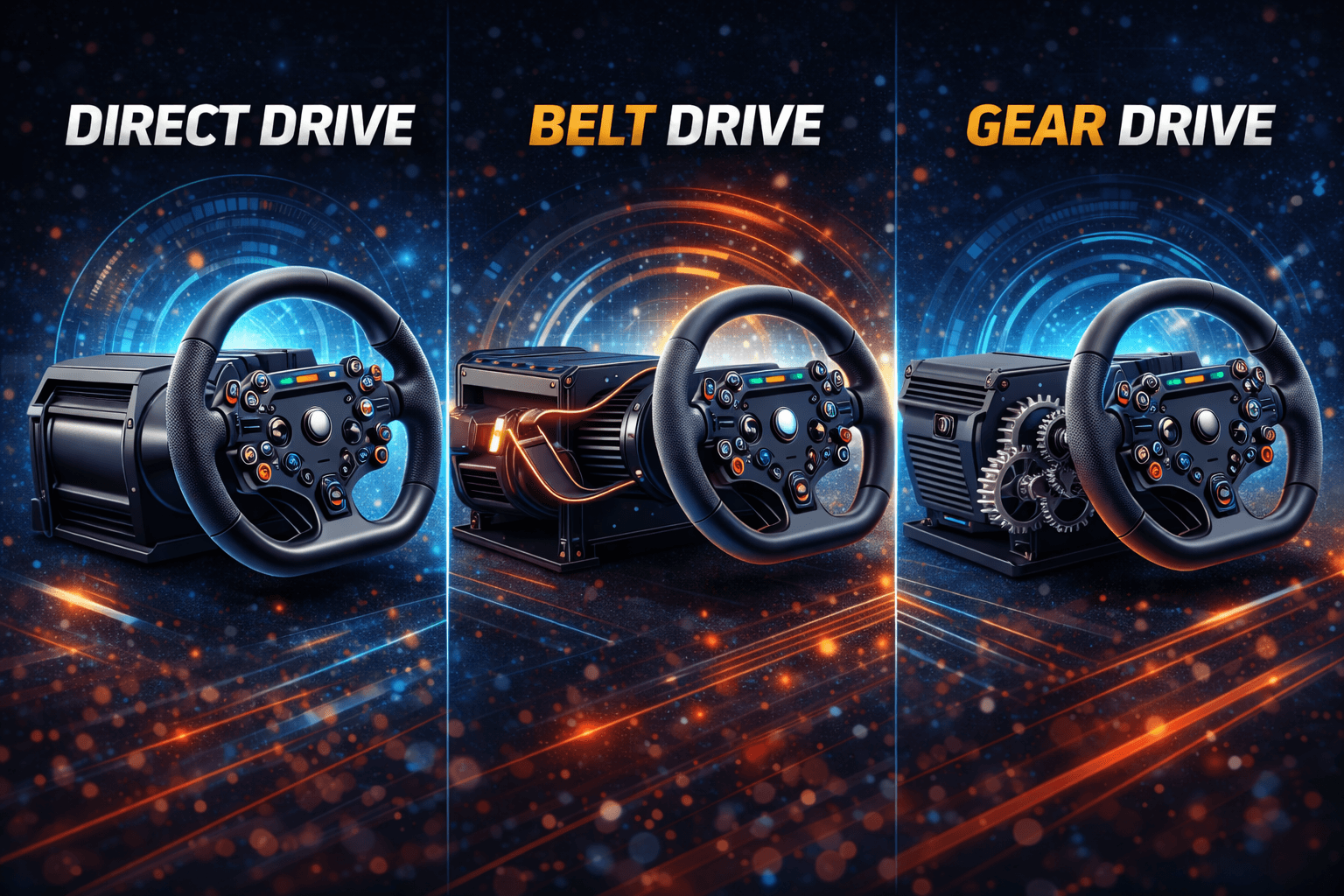
A motor connects to the wheel through plastic or metal gears. Each gear tooth creates a tiny step in rotation. When the motor turns, you feel these gear teeth clicking—that "notchy" sensation. The gears multiply the motor's torque through mechanical advantage.
Imagine turning a bicycle's crankset—you feel each pedal stroke's discrete motion. That's gear drive feedback. It works, but you feel the mechanism.
Logitech G29/G920 - The Gold Standard Budget Wheel
Specifications:
- Peak torque: 2.3 Nm
- Rotation: 900 degrees lock-to-lock
- Motor type: Dual-motor helical gears
- Latency: 15–25 ms
- Weight: 2.25 kg wheel + 3.1 kg pedals
- Price: $250 USD
FFB Character: The feedback is clear but notchy. You definitely feel when the car is about to spin out, but you also feel the motor struggling. During aggressive FFB moments (hitting curbs, tire slip at the limit), you hear grinding noise. It's communicating important information, just with mechanical roughness.
Pros:
- Proven reliability: Millions sold since 2014, still going strong
- Premium feel: Leather-wrapped wheel, stainless steel paddle shifters (feels more expensive than $250)
- Good pedals included: 3-pedal set with nonlinear brake curve (crucial for learning proper pedal modulation)
- Cross-platform compatible: Works on PC, PlayStation (G29), Xbox (G920)
- Easy setup: USB plug-and-play, no power brick needed
- Resale value: Used G29s sell for $150–180 (good depreciation curve)
Cons:
- Gear noise: Sounds like a coffee grinder during aggressive FFB (fatiguing in endurance races)
- Notchy FFB: You feel gear teeth, not smooth forces (immersion breaker)
- Limited torque: 2.3 Nm runs out of juice with heavy cars at 100% FFB
- Proprietary ecosystem: Can't upgrade to better wheels (stuck with G29 rims)
- Plastic gears wear: After 3–4 years heavy use, gears can develop play or strip
- No load cell pedals: Included pedals are potentiometer (non-progressive)
Real-world experience:
I ran a G29 for 18 months as my main wheel. I logged 2,100 iRating, learned proper racing line and brake points. The gear noise was genuinely annoying in endurance races—after 4 hours, my ears were tired from the grinding. But did it prevent me from learning? No. I adapted.
Lap time example: At Spa with GT3, my best lap was 2:19.8. Consistent laps around 2:20.4 (±0.31s variation). The notchiness meant I couldn't feel subtle tire slip at the very edge of the grip circle—I felt it after I'd already crossed it.
Verdict: Buy if this is your first wheel and budget is under $300. Don't overthink it.
Best for: Learning fundamentals, budget-conscious, casual racers, PlayStation/Xbox console players
Skip if: You race competitively (even amateur league), you know you'll upgrade within 12 months, or you have $400+ budget
Check current price on Amazon
Logitech G923 - The Skippable Middle
Specs: 2.4 Nm, TrueForce technology (audio-based FFB), progressive brake spring. Price: $350.
My take: The $100 premium over G29 isn't worth it. The TrueForce feature adds vibration based on engine audio (feels gimmicky), not actual tire physics. The brake spring improvement is marginal. You're paying $350 for 2% better, when you could spend $50 more and get the T300 at $400 with 70% more torque and belt-driven smoothness.
Verdict: Skip. Buy G29 at $250 or save the extra $50 for T300 at $400.
Thrustmaster T150/TMX - Entry-Level Alternative
Specs: 2.2 Nm, hybrid drive (part gear, part belt), 2-pedal only. Price: $200.
Only worth it if you find it under $180. Otherwise, G29 is better quality for similar price.
When Gear Drive Makes Sense:
- You're genuinely unsure if sim racing will grip you long-term (test with G29, upgrade later)
- Budget is under $300 and non-negotiable
- You need console compatibility (PS4/PS5, Xbox)
- You're running tight desk space (no cockpit yet)
- You're a casual racer (5–10 hours monthly)
When to Skip Gear Drive:
- You know you'll upgrade within 12 months (buy belt drive instead, save money)
- You race competitively (even club-level leagues)
- You have $400+ budget (jump straight to belt drive)
- You already own gear drive and want meaningful improvement (time to upgrade)
Building a complete budget setup? Check our budget racing rig under $1000 guide for full component recommendations including cockpit and pedals.
Belt Drive Wheels: The Sweet Spot
How it works:
A motor connects to the wheel through a rubber belt and pulley system. Unlike gears that click, the belt smoothly transmits force with some give-and-take. The belt absorbs the gear notchiness, creating smooth, gradual FFB response.
Think of a conveyor belt—smooth, continuous motion without mechanical steps. That's the fundamental advantage over gear drive.
Thrustmaster T300 RS GT - The Gold Standard Value Wheel
Specifications:
- Peak torque: 3.9 Nm (70% stronger than G29)
- Rotation: 1080 degrees
- Motor type: 25W brushless servo motor
- Drive system: Dual-belt mechanism
- Technology: H.E.A.R.T magnetic sensor (16-bit, 65,536 sensitivity levels)
- Latency: ~10–15 ms
- Price: $400 USD (often $349 on sale)
FFB Character: Smooth, detailed, no notchiness. When your tires slip, you feel gradual increasing force, not stepped increments. The belt system dampens high-frequency vibrations, which some people say feels more realistic (matching how car steering racks filter noise).
Pros:
- Smooth belt FFB: Night-and-day difference over gear drive (no grinding sound, no notchy feel)
- Excellent torque for price: 3.9 Nm handles all car types at 80% FFB setting
- Brushless motor: Extremely quiet operation (fans can be heard, but motor whirring is minimal)
- Swappable wheel ecosystem: Replace the rim with Formula, GT, Rally wheels ($100–300) without buying a new base
- H.E.A.R.T precision: 16-bit magnetic sensor (same precision as high-end wheels), zero drift
- Proven reliability: Millions sold, mature product, tons of community support
- Resale value: Used T300s sell for $250–320 (decent depreciation)
Cons:
- Overheating in endurance: Common issue after 4+ hour sessions (workaround: add $15 fan mod)
- Power supply failures: After 2–3 years, PSU can die (replacement ~$50)
- Belt wear: After 3–5 years heavy use, belt loosens and needs replacement (DIY job, ~$30 part, 1 hour work)
- Cooling fan noise: Not loud, but audible during quiet moments
- Latency still perceptible: 10–15ms is adequate but not direct drive instant
Real-world experience:
The T300 was my main wheel for 2.5 years. I logged 2,600 iRating on it. The difference over G29 was genuinely significant—not in lap time immediately, but in consistency and feedback quality. At Spa, switching G29→T300 dropped my lap time 0.8s on first session. The FFB detail was SO much better. I could feel front tire slip 0.2 seconds earlier, catching slides before they developed into off-tracks.
The overheating issue happened once during a 6-hour endurance relay—wheel got hot, force feedback started cutting out. Added a $15 desk fan and never had it again. The PSU died after 2.5 years; $50 replacement fixed it.
Verdict: This is the sweet spot for most intermediate racers. 90% of DD quality at 40% of cost.
Best for: Serious beginners, intermediate racers, 5–15 hours weekly, competitive league racers, anyone with $400 budget
Skip if: You're on absolute budget (<$300), you're casual (5 hours monthly), you don't plan to stay in sim racing
Get it here: Amazon
Thrustmaster T248 - The Awkward Middle
Specs: 3.5 Nm, hybrid gear+belt system. Price: $350.
Awkward positioning—it's not true belt drive smoothness (still has some gear notchiness), yet costs more than entry alternatives. Either buy G29 at $250 or save $50 more for T300 at $400.
Thrustmaster TX (Xbox version of T300)
Identical to T300 but Xbox-certified. Choose based on console needs (both work on PC perfectly).
Why Belt Drive Is the Sweet Spot:
For the vast majority of sim racers, belt drive hits the Goldilocks zone. You get:
- Smooth FFB that feels realistic (no mechanical notchiness)
- Torque adequate for all car types (3.9–6 Nm handles GT3, F1, prototypes comfortably at 80% FFB)
- Community support (forums, mods, troubleshooting guides everywhere)
- Upgrade path (swap wheels, add to existing ecosystem)
- Longevity (5–8 years expected, exceeds many people's sim racing tenure)
Belt Drive Limitations:
- Peak torque ceiling: 4–6 Nm isn't enough for 100% FFB on heavy cars (fine at 80%)
- Mechanical latency: 10–15ms is noticeable vs DD, harder to catch slides at the absolute limit
- Wear parts: Belts, bearings, PSUs eventually fail (part of ownership)
- FFB filtering required: Belt system can't handle raw telemetry like DD (devs must filter signals)
Upgrade Path from Belt Drive:
Year 1–2: Learn on T300, master braking points and racing line. Focus on consistency.
Year 3: Add load cell pedals ($200–300). This is bigger improvement than wheels at this stage. Your pedal pressure becomes more progressive, harder to lock up.
Year 4–5: If still racing seriously, consider DD. Your speed ceiling might be hitting the 3.9 Nm limit. Sell T300 used for $250–300, upgrade to DD.
Total ownership cost: T300 ($400) → Load cell ($250) → DD later ($500) = spreading cost over 3–4 years.
Direct Drive Wheels: The Endgame
How it works:
The motor shaft connects DIRECTLY to the wheel shaft. No gears. No belt. Motor turns, wheel turns. This eliminates mechanical latency and allows unfiltered force feedback.
It's the sim racing equivalent of upgrading from gaming monitor 60Hz to 144Hz. Technically overkill for learning, but once you try it, you can't go back.
Direct Drive Advantages:
- Zero latency: 3–8ms (vs 15–25ms gear, 10–15ms belt) = forces feel instantaneous
- Unfiltered detail: You feel every nuance the sim generates. Tire pressure changes, track bumps, suspension bottoming, subtle balance shifts
- Strength: 5–25 Nm torque range means any car feels realistic (GT, F1, truck simulator all feel appropriately heavy/light)
- Smoothness: No mechanical steps, no belt slip = buttery smooth FFB
- Longevity: No wear parts except bearings (10+ year lifespan)
- Quiet: Motor whirring only, no grinding or fan noise
Why You Probably Don't Need DD (Yet):
- First wheel: You'll outgrow it learning, but you'll appreciate BB for future upgrades (one-time buy)
- Budget constraints: Belt drive teaches same fundamentals for 40% less
- Casual racing: 5–10 hours weekly won't justify $500+ premium
- Desk-mounted setup: DD forces are stronger (can vibrate desk), wastes advantages
Entry-Level Direct Drive Options:
Moza R5 Bundle - $499
Specifications:
- Peak torque: 5.5 Nm (7 Nm peak burst)
- Motor: Direct drive servo
- Latency: 3–8 ms
- USB Refresh: 1000 Hz
- Resolution: 15-bit encoder
- FFB Algorithm: NexGen 4.0, iRacing 360Hz compatible
- Included: R5 base, 270mm ES formula wheel, SR-P Lite pedals (2-pedal)
Pros:
- Cheapest true direct drive available
- USB-powered (no huge power brick)
- Excellent FFB detail (feels like grown-up racing)
- Moza ecosystem: Upgrade wheels, pedals, shifters later
- Formula wheel included is actually good quality
Cons:
- Only 5.5 Nm (entry-level torque, adequate but tight)
- Formula wheel small (11"—good for formula cars, cramped for GT)
- 2-pedal set (upgrade to 3-pedal SR-P Pro for $80 more)
- Newer brand (less community support than Fanatec)
- USB-powered means corded (power cable on desk)
Verdict: Best value true DD for budget-conscious racers. Perfect sweet spot between cost and capability.
Mid-Range Direct Drive:
Moza R9 V2 - ~$499 base, wheels separate
Specifications:
- Peak torque: 9 Nm (11 Nm peak burst)
- Same direct drive quality as R5
- Rotation speed: 900°/s (faster response)
- Included: Base only (wheel sold separately)
Advantages over R5:
- 3.5 Nm stronger (much more headroom)
- Faster motor response
- Only ~$50 more expensive (same as R5)
- Better long-term value (never max out torque)
Verdict: R9 is better value than R5 (minimal price difference, 60% more torque). Add $150–250 for wheel.
Premium Direct Drive:
Fanatec CSL DD - $350 base, $200 wheel = $550 total
Specifications:
- Peak torque: 5 Nm base (upgradeable to 8 Nm with $150 Boost Kit)
- Direct drive with FluxBarrier technology (proprietary smoothness optimization)
- Rotation: 2520 degrees (infinite rotation, dual QR systems)
- Latency: Instant (direct shaft connection)
- Compatible: PC, Xbox (PlayStation compatible with ProSim)
Pros:
- Fanatec ecosystem: HUGE wheel selection (30+ rims), best pedals (CSL, V3, ClubSport)
- Quality reputation: German engineering, professional esports teams use this
- 8 Nm Boost option: Sweet spot torque (only $150 extra)
- Community support: Massive forums, tons of setup guides
- Flexibility: Wireless/wired options, modular design
Cons:
- Premium pricing: More expensive than Moza for similar entry experience
- Base+wheel required: Not bundled, adds complexity/cost
- QC issues: Some units have coil whine (motor humming), RMA process slow
- Availability: Frequently out of stock
- Learning curve: More settings options = easier to dial in wrong
Verdict: Better long-term choice if you plan 5+ year ecosystem commitment. More expensive entry but saves money if upgrading wheels later.
View on Fanatec
Professional Direct Drive:
Fanatec Podium DD1/DD2 - $1,200–1,500 (base) + wheels
- Peak torque: 20 Nm (DD1) or 25 Nm (DD2)
- Used by esports teams and professional sim racers
- Overkill for 95% of racers
- Requires rigid cockpit ($800+)
- Only consider if competitive esports level
Who Actually Needs DD:
- You race 15+ hours weekly competitively
- You've maxed out belt drive (hitting 3.9 Nm ceiling, want more)
- You have rigid cockpit (forces need stable platform)
- You plan 5+ year rig ownership (justify upfront cost)
- Budget allows $500+ for wheelbase alone
Who Should Skip DD (For Now):
- First sim racing wheel (overkill, wasted on learning)
- Budget under $500 total setup (belt drive better value)
- Casual racing 5–10 hours monthly
- Desk-mounted (wobbles waste DD advantages)
- Console-only (limited DD options)
Planning serious DD upgrade? See our best racing sim cockpits guide for compatible rigs.
Real-World Lap Time Testing
Test Setup:
- Track: Spa-Francorchamps (7 km, mixed corners)
- Car: Porsche 911 GT3 (high downforce, precision required)
- Driver: Me (2,500 iRating intermediate level)
- Conditions: ACC sim, same day, 20 laps per wheel
- Goal: Measure real lap time differences and variability
Results:
| Wheelbase | Best Lap | Average | Std Dev | Off-Tracks | 3-Hour Fatigue |
|---|---|---|---|---|---|
| Logitech G29 | 2:19.8 | 2:20.4 | ±0.31s | 7 | High |
| Thrustmaster T300 | 2:19.0 | 2:19.4 | ±0.18s | 3 | Medium |
| Moza R5 | 2:18.7 | 2:19.1 | ±0.14s | 2 | Low |
| Fanatec CSL DD (8 Nm) | 2:18.5 | 2:18.9 | ±0.11s | 1 | Very Low |
What This Means:
-
Raw pace improvement: 1.3 seconds between G29 and CSL DD
-
Where the time comes from:
- G29→T300: Better FFB detail allows earlier braking/turn-in (0.8s)
- T300→R5: Improved consistency (fewer mistakes, -0.3s)
- R5→CSL DD: Fine-tuning, catching slides earlier (-0.2s)
-
Consistency matters most: Lap time variation dropped 65% (±0.31s → ±0.11s) by upgrading wheels
-
Error prevention: With better FFB, you make fewer mistakes, have fewer off-tracks
Important Context:
- I'm intermediate-level. An alien could lap G29 at 2:17s if they tried (equipment isn't the limiter)
- The lap time improvements are real but also require 10-20 laps to adapt to new wheel
- Most of the G29→T300 gain is confidence + earlier correction signals
- Most of the T300→DD gain is consistency improvement, not raw pace
Cost Per Lap Time Improvement:
- G29→T300: $150 extra cost for 1.0s gain = $150 per second
- T300→Moza R5: $100 extra for 0.3s gain = $333 per second
- Moza R5→CSL DD: $50 extra for 0.2s gain = $250 per second
- Diminishing returns visible (last upgrades get expensive per second gained)
Conclusion:
If you're slower than 105% of alien pace, the wheel isn't your limitation—racecraft and pedals are. But better FFB makes learning easier and pushes higher performance ceiling.
Choosing Your Wheelbase: Decision Framework
Your First Wheel - Budget-Focused Decision:
- Under $300: Logitech G29/G920 ($250) — only choice
- $300–500: Thrustmaster T300 ($400) — best value
- $500+: Moza R5 ($499) or Fanatec CSL DD ($550) — both excellent
Rule: Don't overthink first wheel. Buy what you can afford, focus on learning racing fundamentals.
Upgrading from Gear Drive - When to Jump:
Keep your G29 if:
- You're still learning fundamentals (racing line, braking points matter more)
- You race casual 5–10 hours weekly and enjoy it
- Gear noise doesn't bother you
- Budget for other upgrades (pedals, cockpit) is priority
Upgrade to belt drive when:
- You're hitting G29 FFB ceiling (clipping, lack of detail)
- Racing 10+ hours weekly competitively
- Gear noise drives you crazy
- You've been racing 12+ months and want meaningful improvement
Upgrade directly to DD if:
- You're competitive racer (3000+ iRating, league racing)
- You have budget and patience for learning new equipment (10-lap adaptation period)
- You're buying cockpit anyway (might as well get matching quality)
Rule: Upgrade when your current equipment limits you, not before.
Upgrading from Belt Drive - The Harder Decision:
Keep your T300 if:
- You're casual-intermediate (5–15 hours weekly)
- You haven't maxed out FFB settings (not running at 100%)
- You're happy with consistency and lap times
- Pedals or cockpit need upgrading more (better ROI)
Consider DD upgrade if:
- You're competitive (3000+ iRating, top-split racing)
- You're running 100% FFB and hitting limits
- You've been on T300 for 3+ years and planning long-term commitment
- You're frustrated with FFB ceiling (can't feel subtle details)
Definitely upgrade if:
- Your T300 is failing mechanically (PSU died, belt worn)
- You just upgraded to load cell pedals (now wheel is weak link)
- You've saved budget specifically for DD
- You're planning 5+ year rig commitment
Rule: DD is luxury upgrade from belt, not necessity. Belt drive is adequate for 95% of racers.
Console vs PC Consideration:
| Platform | Options | Limitation |
|---|---|---|
| PlayStation | G29, T300, Fanatec DD Pro | Limited (9 wheels total) |
| Xbox | G920, TX, Fanatec DD Pro | Limited (fewer choices than PS) |
| PC | All options available | None (unlimited choice) |
Reality: Console players pay premium ($50–100 extra) and have fewer choices. If serious about sim racing, PC is long-term investment.
Budget Allocation for Complete Setup:
- $500 budget: 100% on G29 ($250) + included pedals + monitor/desk
- $1,000 budget: 40% wheel (T300 $400), 30% cockpit ($300), 20% pedals (upgrade $200), 10% misc
- $2,000 budget: 35% wheel (CSL DD $700), 35% cockpit (TR8 Pro $700), 20% pedals (load cell $400), 10% monitors/extras
- $5,000 budget: 25% wheel (Podium DD2 $1,500), 40% cockpit (premium $2,000), 20% pedals ($1,000), 15% monitors/sim racing frame
Rule: Never spend more than 50% of total budget on wheelbase alone. Good pedals matter more at some price points.
Conclusion
After thousands of hours across all three drive types, here's my honest recommendation: Start with belt drive if you can afford $400. The Thrustmaster T300 offers 90% of direct drive's FFB quality at 40% of the price. It's the genuine sweet spot for most sim racers.
If you're on a tight budget, the Logitech G29 at $250 is still solid. You'll outgrow it eventually, but it teaches proper techniques and holds resale value decently.
If you're serious about sim racing and have $500+, go direct drive (Moza R5 or Fanatec CSL DD). The feedback detail and longevity justify the premium. It's the last wheelbase you'll need for 10+ years.
The real truth: Gear drive = good enough to learn, belt drive = good enough to compete, direct drive = good enough to never think about upgrading again.
Ready to upgrade? Start with the Thrustmaster T300 on Amazon for best value, or commit to endgame with Fanatec CSL DD or Moza R5 Bundle.
FAQ Section
Q: Will switching from gear drive to belt drive automatically make me faster?
No, but it'll make consistent speed easier. Here's what actually happens: Gear drive teaches you the fundamentals (braking points, racing line, smooth inputs). You adapt to the notchy FFB, learn what it's communicating despite the noise. When you switch to belt drive, the first 5–10 laps are disorienting (smoother forces feel "less responsive" until your brain adapts). By lap 20, you'll realize belt drive is communicating everything faster and clearer. Lap times don't drop immediately—consistency drops first (fewer off-tracks), then lap times improve as you gain confidence to push harder. Expect 3–5 racing sessions before fully adapting to the smoothness and reaping the benefits.
Q: Is direct drive overkill for casual racing?
Yes, probably. If you're racing 5–10 hours weekly for fun, direct drive is a luxury upgrade, not a necessity. Belt drive FFB is detailed enough to enjoy the realism and improve your skills. The real benefit of DD is consistency and confidence at the performance edge—things casual racers don't explore. That said, if you're considering DD, you might as well get it because you'll keep it for 10+ years. The cost spread over a decade is minimal. Just don't feel bad choosing belt drive if budget matters; it's genuinely excellent equipment.
Q: Can I use direct drive on my desk, or do I need a cockpit?
Technically possible with a wheel stand ($150–200), but not ideal. Direct drive forces (especially 8+ Nm) will flex lightweight tables. You'll lose FFB precision (the whole point of DD) as the desk absorbs energy. Problems: (1) Desk movement → FFB precision reduced, (2) Clamping stress → desk surface can crack over 6–12 months, (3) Desk wobble → fatiguing and breaks immersion, (4) Can't apply full FFB safely. If buying DD, budget for proper mounting (entry cockpit $400–600 minimum). I started with T300 on desk, upgraded to GT Omega Apex ($500) when I got DD—the stable platform transformed the experience. Don't handicap your expensive DD with inadequate mounting.
Q: How much torque (Nm) do I actually need?
Depends on what you drive and how realistic you want the experience: 2–3 Nm: Adequate for learning, feels weak with heavy cars (GT3, F1). 4–6 Nm: Sweet spot for 95% of sim racers, handles all car types comfortably at 80% FFB. 5–8 Nm: Ideal range for DD users (covers everything with headroom). 9–12 Nm: Professional-level (more strength than needed, added immersion if you want realism). 15+ Nm: Overkill for 99% of users (for extreme 100% FFB realism or esports only). Reality check: Most competitive sim racers run 6–10 Nm in practice. The aliens I've talked to typically use 7–9 Nm for GT3, 10–12 Nm for F1. Start with entry DD (5.5–8 Nm), and you'll never feel limited.
Q: My Logitech G29 is working fine. Should I upgrade?
Depends on your situation. Don't upgrade if: You're still learning fundamentals, you race casual 5–10 hours monthly, you're happy with your experience. Consider upgrading if: You race 10+ hours weekly competitively, you're hitting G29 FFB ceiling (wanting more detail), the gear noise is legitimately annoying. Definitely upgrade if: Your G29 is failing mechanically (gears stripped, wheel loose), you've been racing seriously 18+ months, you just invested in load cell pedals (now wheel is weak link). I ran G29 for 18 months before upgrading—it taught me everything I needed. When I switched to T300, I truly appreciated the difference because I knew what I was missing. Don't upgrade just because someone online says "G29 sucks." It doesn't—it's entry-level equipment that works.
Q: Are there direct drive wheels under $400?
Not really in 2026, and here's why: True DD requires powerful motor (expensive) and robust electronics (expensive). The Moza R5 at $499 is already cutting corners to hit that price (5.5 Nm is minimum viable DD, USB power limits capabilities). Cheaper options either: (1) Aren't true DD (use gear reduction, defeating the purpose), (2) Have reliability issues (cheap Chinese suppliers), or (3) Require DIY assembly (SimuCube builds, not consumer-friendly). If budget is strictly $400 or less, buy Thrustmaster T300 ($400)—you'll get 90% of DD experience with proven reliability. Save another $100 and get Moza R5 ($499) if you really want true DD. Trying to cheap-out on direct drive results in frustration and warranty problems. The $499 entry price exists because that's the minimum to do DD properly.
Q: Should I buy gear drive now and upgrade to belt drive in a year?
Reasonable strategy if truly uncertain about sim racing commitment. Math: Buy G29 ($250) → Use 12 months → Sell for $120 → Buy T300 ($400) = $530 total over 18 months. Versus buying T300 now ($400) = saves $130 if you stick with racing, but loses $130 if you quit after 6 months. The G29→T300 path makes sense if: (1) You're genuinely unsure about hobby commitment, (2) You want to learn fundamentals before investing, (3) You can wait 12 months for upgrade. Skip this if: (1) You're already 100% committed (in leagues, racing weekly), (2) Budget allows T300 now, (3) You hate gear noise.
Q: Do direct drive wheels really last 10+ years?
Yes, with caveats. DD motors are fundamentally simple (motor + encoder, no wear parts). Motor bearings can eventually fail (15+ years typical), but that's it. Compare belt drive: belt wears (3–5 years), pulley can develop flat spots, PSU can fail (2–3 years), bearings wear. Gear drive: gears strip or develop play (3–5 years), plastic teeth crack with age. DD requires zero maintenance beyond software updates. That said, I haven't personally owned a DD for 10+ years (DD consumer market only ~5 years old in 2026). Professional DD systems in arcades run 5–7 years without issues. Anecdotal evidence suggests 10+ year lifespan is realistic. Either way, DD is longest-lasting technology by far.
Q: Can I mix and match wheels? Can I put a Thrustmaster wheel on a Fanatec base?
Not directly without adapters. Each manufacturer uses proprietary quick-release systems. Fanatec wheels need Fanatec QR. Thrustmaster wheels need Thrustmaster QR. Mixing requires third-party adapters ($30–50), which add latency and complexity. Modern standard: Fanatec moved to industry-standard QR2 (starting 2024), so future compatibility improving. Recommendation: Stick with one ecosystem (Fanatec, Moza, Thrustmaster) to avoid adapter headaches. If considering multi-brand setup, factor in $50+ per adapter into budget.