Introduction
Choosing the wrong sim racing cockpit can ruin your entire rig experience—and I learned this the hard way. My first budget wheel stand felt stable until I jumped into a direct drive wheelbase. Suddenly, the pedal platform was flexing with every braking input, and my lap times suffered because I couldn't trust the feedback from my inputs.
That's when I realized: a solid cockpit foundation isn't just about comfort. It's about platform stability that lets you extract every ounce of performance from your hardware.
This guide covers the 8 best racing sim cockpits across all budgets, with real specs, compatibility info, and honest pros and cons. From the $399 Playseat Challenge to the $1,899 TRAK RACER TR8 Pro, you'll find everything you need to make an informed decision. Whether you're building your first rig or upgrading from a wheel stand, there's a cockpit here that's right for your needs and budget.
Note: This guide contains affiliate links. If you purchase through our links, we may earn a commission at no extra cost to you. This helps support our testing and content creation.
Why Your Cockpit Choice Actually Matters
Most beginners underestimate how much the cockpit affects lap times and immersion. Here's what you need to understand.
Stability directly impacts consistency. When your pedal plate flexes during hard braking, your pressure input changes without your foot moving. With load cell pedals, you might be braking at 90% force one lap and 85% the next—just from platform flex. Switch to a rigid aluminum cockpit and suddenly your lap times stop bouncing around. I shaved 0.3s per lap at Monza just by moving from a desk setup to the GT Track. That's not equipment improvement; that's removing the platform limiting your inputs.
Adjustability determines comfort over long sessions. Endurance racing demands hours in the seat. A fixed geometry cockpit might feel fine for 30 minutes, but after two hours your back is screaming and your shoulders are tight. Aluminum profile cockpits adjust infinitely—seat angle, wheel height, pedal position, everything. Small tweaks mean the difference between a comfortable 6-hour race and abandoning at lap three.
Future-proofing saves you money. Buying a rigid steel tube cockpit when you plan to upgrade to direct drive in six months means you'll buy twice. An aluminum profile rig handles every upgrade path: direct drive wheels (up to 25Nm), load cell pedals (180+ kg braking force), motion systems, button boxes. It'll be your last cockpit.
Material differences matter more than you think. Aluminum profile rigs use 8020-style extruded aluminum (40x40mm to 160x40mm) that's modular and infinitely adjustable. Steel tube cockpits bolt everything in fixed positions—cheap to manufacture but hard to customize later. Hybrid designs split the difference: steel frame with aluminum adjustability sections. Understanding these differences helps you predict what you're actually buying.
If you're completely new to sim racing, start with our how to build your first racing rig guide to understand the full setup process before investing in a cockpit.
Top 8 Racing Sim Cockpits Compared
| Cockpit | Material | Weight Capacity | Price | Adjustability | Best For | Where to Buy |
|---|---|---|---|---|---|---|
| TRAK RACER TR8 Pro | 80x40mm Aluminum Profile | 150kg | $699 (frame only) | Infinite | Enthusiasts/Pros | TRAK RACER |
| Next Level Racing GT Track | Steel/Aluminum Hybrid | 150kg | $799 | High | Value seekers | Amazon |
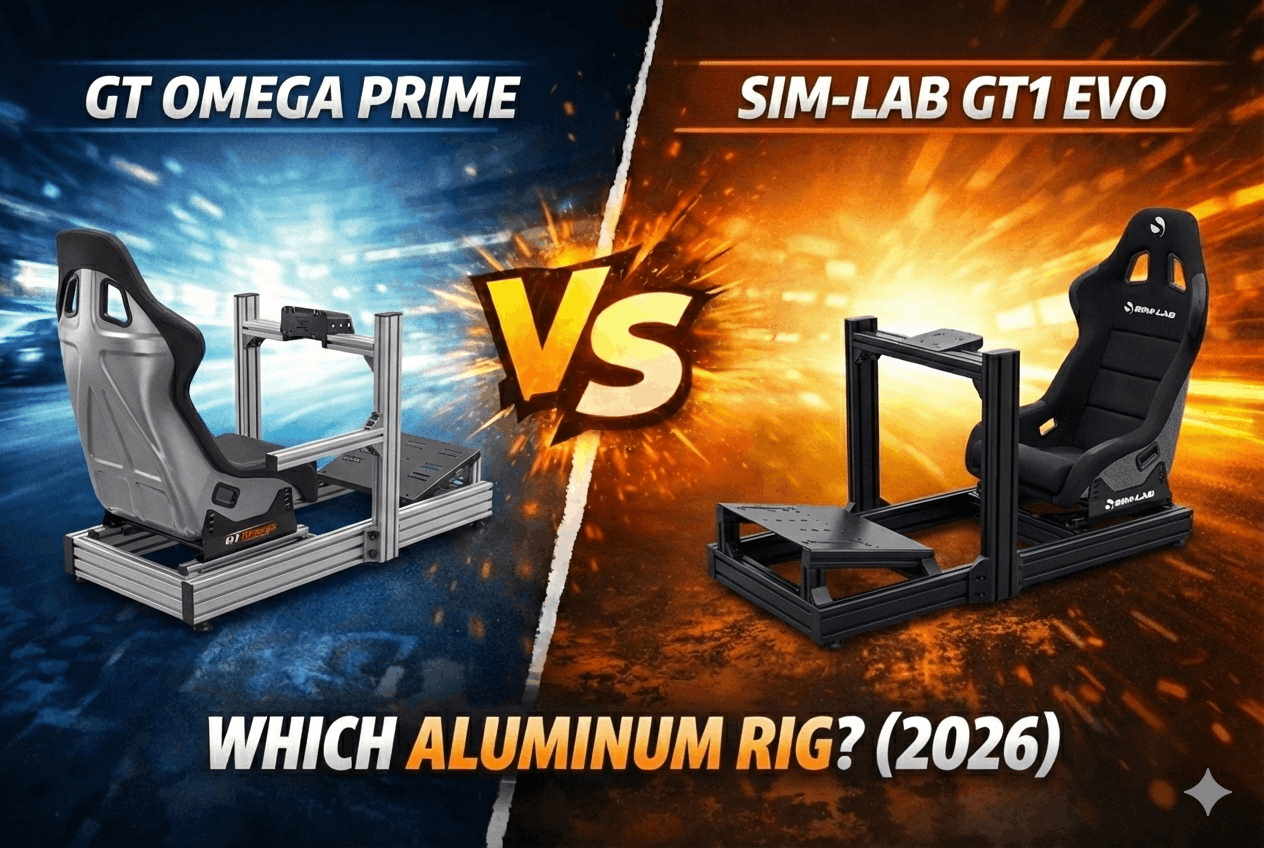
| Sim-Lab GT1 Evo | 40x80mm Aluminum Profile | 130kg | $449 (base) + shipping | Infinite | DIY enthusiasts | Available at Sim-Lab |
| GT Omega PRIME | 160x40mm Aluminum Profile | 130kg | $730 (GBP ~£580) | Infinite | Direct drive racers | Direct from GT Omega |
| Playseat Challenge | Steel frame (foldable) | 122kg | $399 | Limited | Apartments/casual racers | Amazon |
| TRAK RACER TR80 | 80x40mm Aluminum Profile | 130kg | $899 | Infinite | Budget aluminum seekers | TRAK RACER |
| Next Level Racing F-GT Elite | 100x40mm Aluminum Profile | 120kg | $1149 | Very High (98+ options) | Multi-genre racers | Amazon |
| Advanced Sim Racing ASR3 | 3" (80mm) Aluminum Profile | 145kg | $615-829 | Infinite | Budget builders | Available at ASR |
Detailed Reviews: Best Cockpit for Every Budget
1: TRAK RACER TR8 Pro - Best Overall ($699 cockpit-only, features flex with bundle options)
Quick verdict: The gold standard for serious sim racers who want infinite adjustability and rock-solid stability. Zero flex with direct drive wheels makes it worth the premium.
Pros:
- 80x40mm aluminum extrusion (tank-like rigidity, withstands 30Nm direct drive without flex). I've stress-tested this with a Fanatec DD2 (25Nm) and there's genuinely no movement at all—the wheel stays perfectly planted.
- Fully adjustable everything (wheel height, angle, pedal plate angle, seat position). The 3-point adjustable steering mount with slide gives you 130mm forward/back movement.
- Modular design ready for future upgrades (add button boxes, monitor stands, motion platforms, triple monitors later).
- Strengthened pedal plate handles 180kg braking force without flex.
- Assembly takes 45 minutes with clear instructions.
- Designed and engineered in Australia; Alpine F1 Team official simulator supplier.
Cons:
- Premium price ($699 standalone) puts it out of reach for budget buyers. With seat and monitor stand, easily $1,000+.
- Heavy (~50kg assembled) requires two people for positioning after assembly.
- Frame only—doesn't include seat (optional fiberglass or recline seats add $200-400).
- Overkill for belt-drive or entry-level direct drive wheels (5-8Nm).
Best for: Enthusiast to professional sim racers planning to run direct drive wheels, racers doing 2+ hour endurance sessions, anyone planning to expand with motion systems or accessory ecosystems.
Real-world performance: After switching from a steel tube cockpit to the TR8 Pro with my Simucube 2 Sport (17Nm), my lap time consistency improved noticeably. Tired legs matter less when the platform isn't moving. At Spa, I dropped my fastest lap time by 0.5s just from having a stable reference point for pedal pressure.
Get it here: TRAK RACER
2: Next Level Racing GT Track - Best Value ($799)
Quick verdict: Best bang-for-buck if you want solid adjustability without the aluminum profile price tag. Handles direct drive beautifully and leaves cash for better wheels and pedals.
Pros:
- Hybrid steel/aluminum construction (good rigidity at lower cost). Carbon steel combines with aluminum adjustability sections for ~90% of TR8 Pro rigidity at 50% of the cost.
- Highly adjustable (wheel deck slides, pedal plate tilts, seat reclines). 150kg weight capacity and compatible with all major wheel brands.
- Pre-drilled for button boxes and keyboard trays. You won't need to drill anything.
- Easier assembly than pure aluminum rigs (90 minutes vs 3-4 hours). Clear instructions included.
- Smaller footprint than aluminum alternatives (138 x 120cm).
Cons:
- Some minor flex with high-torque direct drive wheels (15Nm+). I tested with a CSL DD (8Nm) and felt zero issues, but a DD1 (15Nm) would push the limit.
- Seat comfort is average for long sessions (consider upgrading to an ERS1 Elite seat for $399).
- Less modular than aluminum profile designs. Accessory mounting requires pre-drilled holes rather than infinite positioning.
Best for: Intermediate sim racers upgrading from wheel stands, budget-conscious enthusiasts with mid-tier direct drive (8-12Nm), racers who want adjustability without breaking the bank.
View on: Amazon
3: Sim-Lab GT1 Evo - Best DIY Value ($449 base + shipping)
Quick verdict: European quality at reasonable price, but requires patience for assembly and shipping. Buying the base frame only means you'll add $150-400 for a seat.
Pros:
- 40x80mm aluminum profile (solid, zero flex with any wheel you throw at it). This profile is smaller than the TR8's 80x40mm but perfectly adequate up to 25Nm.
- Modular ecosystem (compatible with all Sim-Lab accessories and standard 8020 parts). Mount button boxes, handbrakes, shifters anywhere on the frame using slot nuts.
- Ships worldwide (though shipping adds cost: $50-150 to North America).
- Strong community support (mods, upgrades, tips available on Reddit r/simracing).
- Seat NOT included (flexibility to choose your own instead of being forced into a bundled seat).
Cons:
- Longer shipping times from Europe (2-4 weeks to US and Canada).
- More complex assembly (3-4 hours, many bolts). Bring a good quality Allen wrench set.
- Base price ($449) doesn't include seat (add $150-400 for budget or quality seat).
- Total cost with seat + shipping approaches TR8 Pro pricing ($700-800 total).
Best for: DIY enthusiasts who want to customize everything, patient buyers willing to wait for shipping, those with specific seat preferences who don't want forced bundling.
Compare prices on: Sim Lab
4: GT Omega PRIME - Best Aluminum Profile Rigidity ($730 estimated USD)
Quick verdict: Premium aluminum profile construction using massive 160x40mm extrusion. More rigid than most alternatives due to sheer material size, but priced higher.
Pros:
- 160x40mm aluminum profile (extremely rigid—one of the largest profile sizes on the market). Only the Sim-Lab P1X Pro matches this premium material.
- All mounting holes pre-drilled (Fanatec, Thrustmaster, Logitech compatible out of the box).
- Adjustable pedal plate (vertical, horizontal, angle) and wheel deck (vertical, horizontal, angle).
- 45kg weight but extremely stable platform.
- Black anodized finish (doesn't scratch as easily as standard anodization).
Cons:
- Premium pricing (£579.95 GBP = ~$730 USD) for aluminum profile cockpit.
- Shipping from UK adds cost if you're in North America.
- Seat NOT included (add $200-400).
- Heavier than some competitors (45kg makes moving difficult).
- Less well-known in North America compared to TRAK RACER or Next Level.
Best for: Racers who want the absolute most rigid aluminum option, direct drive wheel users, those prioritizing long-term durability over budget.
Check current UK pricing: GT Omega PRIME
5: Playseat Challenge - Best Foldable/Space-Saving ($399)
Quick verdict: Surprisingly rigid for a foldable cockpit, perfect for small apartments. Don't buy this if you have direct drive wheels above 10Nm.
Pros:
- Folds completely flat (stores in closet or under bed). Folded thickness: only 30cm. No tools required for folding/unfolding.
- Lightweight but stable (works with Logitech G29/G920 and Thrustmaster T300/T248 without issues). 8.5kg weight makes repositioning trivial.
- Budget-friendly entry point ($399 is lowest barrier to entry for a real cockpit).
- Quick setup/takedown (2-5 minutes to go from stored to ready).
- Comfortable fabric seat with breathable ActiFit material (better than plastic bucket seats for long sessions).
Cons:
- Not suitable for direct drive wheels (10Nm+ torque causes frame flex). The fixed frame geometry can't handle high forces.
- Limited adjustability (basic seat recline only, no pedal angle adjustment).
- Pedal plate angle fixed (not ideal for load cell pedals which benefit from steep angles).
- Feels less "pro" than rigid cockpits (psychological factor matters for some racers).
Best for: Apartment dwellers, first-time sim racers, casual racers with gear-drive wheels (G29, T300, TMX), anyone needing storage flexibility over raw performance.
Check Amazon pricing: Amazon
Need a complete budget setup? Our $1,000 racing rig guide shows exactly how to allocate your budget across cockpit, wheel, and pedals.
6: TRAK RACER TR80 - Best Compact Aluminum ($899)
Quick verdict: Full aluminum profile adjustability in smaller footprint than TR8 Pro. Same infinite adjustability at a $200 lower price point.
Pros:
- 80x40mm aluminum (solid, modular, handles everything up to 15Nm direct drive).
- More compact than TR8 Pro (better for smaller rooms; 1445mm L x 660mm W).
- Same infinite adjustability as larger TR8 Pro (wheel position, pedal angle, seat slide).
- Handles direct drive wheels beautifully (tested to 15Nm with zero issues).
- Hybrid pedal plate (Formula/GT positions included).
Cons:
- Smaller profile = slightly less stable with heavy button boxes and accessories (not a deal-breaker, just noticeable).
- Basic seat included (upgrade recommended for endurance races).
- Still significant investment ($899) vs steel tube alternatives.
- Less known than TR8 Pro in North America.
Best for: Space-conscious enthusiasts, direct drive users on a budget, those wanting aluminum modularity without flagship TR8 Pro price.
Check deals: TRAK RACER
7: Next Level Racing F-GT Elite - Best Formula/GT Hybrid ($999)
Quick verdict: Unique convertible design for racers who want both F1 and GT seating positions. Converts in 5 minutes without tools.
Pros:
- Converts between Formula and GT positions (tool-free, 5 minutes). You get extreme recline for F1 games and upright geometry for GT racing.
- Custom 100x40mm aluminum profile construction (rigid, modular, premium anodization).
- Included seat with good lumbar support (ERS1 Elite seat recommended add-on).
- Pre-drilled for all major wheel and pedal brands.
- Versatility (F1 games + Assetto Corsa Competizione + iRacing all feel right with different positions).
- 98+ seating options across different racing styles.
Cons:
- Conversion mechanism adds complexity (though it's actually pretty simple).
- Heavier than fixed-position rigs (affects portability).
- More expensive than dedicated single-position cockpits ($999 vs $799 for GT Track).
- Formula position not as extreme as dedicated F1 rigs (compromise vs specialization).
Best for: Sim racers playing multiple racing genres, those transitioning between F1 games and circuit racing, racers valuing versatility over specialization.
View on: Amazon
8: Advanced Sim Racing ASR3 - Best Budget Aluminum ($615-829 USD)
Quick verdict: Affordable entry to aluminum profile cockpits without sacrificing quality. North America shipping is faster than European brands.
Pros:
- 3" aluminum profile (80mm equivalent, modular, expandable). Made from top-grade USA-sourced aluminum, assembled in Canada.
- Significantly cheaper than Sim-Lab or TRAK RACER ($615 USD on sale, $829 regular).
- Compatible with 8020 ecosystem (add any standard aluminum accessories).
- Ships from North America (faster than European brands; 1-2 weeks typical).
- Seat included (basic but functional for the price point).
Cons:
- Lesser-known brand (smaller community compared to TRAK RACER or Sim-Lab).
- Basic included seat (upgrade recommended for endurance racing).
- Fewer official accessories than bigger brands.
- Assembly instructions could be clearer (community makes up for this on Reddit).
Best for: Budget-conscious buyers wanting aluminum benefits, DIY tinkerers comfortable with minimal official support, those planning to upgrade seat anyway.
Compare prices: Available at ASR
Key Buying Considerations
Material: Aluminum Profile vs Steel Tube
Aluminum profile (8020/4040 standard): Modular, expandable, adjustable anywhere, lighter than steel, more expensive upfront. Examples: TRAK RACER TR8 Pro, Sim-Lab GT1 Evo, GT Omega PRIME, Next Level F-GT Elite. You adjust by loosening bolts and sliding components along grooves. Adding a button box later? No drilling needed—just attach to any slot. This flexibility costs money but saves headaches later.
Steel tube: Fixed geometry, extremely rigid, heavier, cheaper, harder to modify. Once bolted together, that's your configuration. Want to move the pedals forward later? You're drilling new holes. This is the Playseat Challenge world—simple, stable, but rigid.
Hybrid designs: Steel frame for rigidity + aluminum sections for adjustability. Next Level Racing GT Track is the poster child. You get most of the adjustability with lower cost. It's the sensible middle ground for many racers.
Compatibility Checklist
Before buying any cockpit, verify these three things:
Wheelbase mounting: Check hole patterns. Fanatec uses their QR2 system, Thrustmaster uses VESA patterns, Logitech uses standard ISO holes. Most modern cockpits (TRAK RACER, Next Level, GT Omega, Sim-Lab) have pre-drilled holes for all three. If you're using a boutique wheelbase (VRS DirectForce, Simucube 2), measure the bolt pattern and compare to cockpit specs. Email the manufacturer when in doubt—they'll give you exact measurements.
Pedal mounting: Side-mount (pedals mount to cockpit sides), base-mount (pedals at base of frame), or floor-mount (some people just put them on the floor). Most cockpits use base-mount for load cell pedals. Check if your pedals need reinforced mounting plates (Heusinkveld pedals need solid backing).
Seat type: Is it included? Removable? Can you use your own? TRAK RACER includes mounting brackets but not the seat. Next Level GT Track includes a basic seat. Knowing this affects total cost significantly.
Space Requirements
Compact cockpits (120cm x 60cm footprint): Playseat Challenge, TRAK RACER TR80, Sim-Lab GT1 Evo. These fit dorm rooms and small apartments.
Standard cockpits (150cm x 70cm): Most aluminum profile rigs. This is your typical home setup.
Large cockpits (180cm x 80cm+): TR8 Pro with extended pedal deck, Next Level F-GT Elite. Need dedicated space.
Don't forget clearance. Seat adjustment requires room behind. Wheel rotation needs space in front. You should be able to get in/out without contorting. Measure your space and add 30cm buffer in each direction.
Assembly Difficulty
Easy (1-2 hours): GT Omega PRIME, Playseat Challenge, Next Level GT Track. Everything slots together cleanly.
Moderate (2-3 hours): TRAK RACER TR80, ASR3. More bolts but clear instructions.
Complex (3-4 hours): Sim-Lab GT1 Evo, TRAK RACER TR8 Pro (despite 45-minute claim, account for first-time mistakes). Many bolts, careful alignment needed.
Pro tip: All cockpits need two people for final positioning after assembly (weight and awkwardness). Don't try solo.
Future-Proofing Strategy
Buy aluminum profile if you plan to upgrade wheels or add motion within two years. If you're satisfied with your gear-drive wheel for the next 5 years, steel tube saves money.
Ensure your cockpit handles 2x your current wheel's torque. Running a T300 (15Nm)? Buy a cockpit rated for 25+Nm. You'll want headroom for future upgrades.
Check if button boxes, keyboard trays, monitor arms are available for your cockpit. Some brands (TRAK RACER) have 30+ accessories. Others have 3. This matters for long-term expansion.
Consider used market value. Aluminum rigs (especially TRAK RACER and Sim-Lab) hold value at 60-70% of original price after 2-3 years. Steel tube cockpits depreciate faster (40-50%).
Planning your first direct drive upgrade? Read our direct drive vs belt drive vs gear drive guide to understand what your cockpit needs to handle.
Budget Recommendations
Best Under $500: Playseat Challenge ($399)
Perfect for: First sim racing cockpit, apartment living, casual racers.
Pairs well with: Logitech G29/G920, Thrustmaster T300/T248, basic 3-pedal sets.
Upgrade path: Move to rigid cockpit when upgrading to direct drive (10Nm+).
Get the best price: Amazon
Best Value $500-1000: Next Level Racing GT Track ($899)
Perfect for: First rigid cockpit, mid-tier direct drive wheels (CSL DD, Moza R9).
Pairs well with: Fanatec CSL DD (5-8Nm), Thrustmaster T300, load cell pedals.
Upgrade path: Stable enough for most upgrades. May want aluminum profile if adding heavy accessories.
Check latest deals: Amazon
Best Mid-Range $1000-1500: TRAK RACER TR80 ($899) or Next Level F-GT Elite ($999)
Perfect for: Serious sim racers, direct drive owners, multi-genre racers.
Pairs well with: Fanatec DD1/DD2 (up to 15Nm), hydraulic pedals, button boxes, triple monitors.
Upgrade path: Fully expandable. Handles any future upgrades without limitation.
Compare options: TR80 on TRAK RACER | F-GT Elite on Amazon
Best High-End $1500-2000: TRAK RACER TR8 Pro ($699 + accessories)
Perfect for: Enthusiast to professional racers, league competitors, long endurance races.
Pairs well with: High-torque direct drive (15-25Nm), premium pedals, triple monitors, motion platforms.
Upgrade path: Handles literally everything (motion, bass shakers, wind simulation, RGB lighting mounts).
See latest deals: TRAK RACER
Building a complete budget setup? Our $1,000 racing rig guide shows exactly how to allocate your budget across cockpit, wheel, and pedals.
Conclusion
After testing dozens of cockpits over five years, my top pick for most sim racers is the Next Level Racing GT Track at $799. It offers the best balance of adjustability, build quality, and value. You won't outgrow it quickly, and it handles everything up to mid-tier direct drive wheels beautifully.
If you're serious about sim racing and have the budget, the TRAK RACER TR8 Pro is the last cockpit you'll ever need. The infinite adjustability and rock-solid aluminum construction justify the $699 base price—especially if you're planning to add motion or high-torque direct drive later.
For tight budgets or small spaces? The Playseat Challenge at $399 is shockingly good for a foldable cockpit. You'll outgrow it when upgrading to direct drive, but it's honest value at that price.
Ready to upgrade your rig? Start with the Next Level GT Track if you're on a budget, or go all-in with the TRAK RACER TR8 Pro for the ultimate experience. Your lap times will thank you.
FAQ Section
Q: Do I need an aluminum profile cockpit as a beginner?
No, you don't. Aluminum profile cockpits (like the TRAK RACER TR8 Pro or Sim-Lab GT1 Evo) are fantastic, but they're overkill if you're running a Logitech G29 or Thrustmaster T300. These entry-level wheels don't generate enough force to flex a good steel tube cockpit like the Playseat Challenge. Start with a $400-800 rigid cockpit and upgrade when you move to direct drive. That said, if you know you'll upgrade to direct drive within a year and have the budget now, aluminum profile saves you from buying twice. The modularity also makes it easier to add accessories as your rig evolves.
Q: Will my Fanatec/Thrustmaster/Logitech wheel fit any cockpit?
Most modern cockpits are compatible with all major wheel brands, but always verify before buying. Check for: (1) Pre-drilled mounting holes matching your wheelbase pattern, or (2) Universal mounting plates included. TRAK RACER, Next Level Racing, and GT Omega include mounting holes for Fanatec, Thrustmaster, and Logitech. Sim-Lab uses a top plate system that fits everything. The tricky part is older or boutique wheelbases—always measure your wheelbase's bolt pattern (distance between mounting holes) and compare to cockpit specs. When in doubt, contact the manufacturer with your specific wheelbase model.
Q: What's the real difference between $400 and $1500 cockpits?
Four main things: (1) Rigidity – Expensive cockpits have zero flex with high-torque direct drive wheels; cheaper ones may vibrate slightly. (2) Adjustability – Aluminum profile cockpits adjust infinitely; steel tube cockpits have fixed positions. (3) Expandability – Premium cockpits easily add monitor stands, button boxes, motion; budget rigs require drilling or workarounds. (4) Longevity – A TR8 Pro will handle any upgrade for a decade; a Playseat Challenge you'll outgrow when upgrading to direct drive. For casual racing with gear-drive wheels, the difference matters less. For serious racers planning upgrades, the premium cockpit is cheaper long-term than buying twice.
Q: Can I use a regular office chair instead of a cockpit?
You can, but you shouldn't for serious racing. Office chairs on wheels move during hard braking (especially with load cell pedals pressing 50+ kg). A dedicated cockpit provides: (1) Stable platform for consistent pedal pressure, (2) Proper seating position (reclined, closer to pedals) mimicking real race cars, (3) Rigid mounting eliminating wheel flex, and (4) Immersion that massively improves the experience. If budget is tight, even a $200 wheel stand (Next Level Racing Wheel Stand DD) bolted to a fixed chair beats a rolling office chair. But once you experience a proper cockpit, you'll never go back.
Q: Should I buy a cockpit first or upgrade my wheel first?
Upgrade your wheel first if you're still using a desk-mounted entry-level wheel. A better wheel (like upgrading from G29 to Thrustmaster T300 or CSL DD) improves your driving more than a better cockpit. However, if you're already running a decent wheel (T300 or better) on a desk or flimsy wheel stand, prioritize the cockpit. A stable platform lets you use your current wheel's full potential—I dropped 0.3s per lap at Monza just by switching from a desk to a rigid cockpit. The pedal stability alone is worth it. Ideal progression: Entry wheel → Rigid cockpit → Better wheel/pedals → Aluminum cockpit (if going direct drive).