Introduction
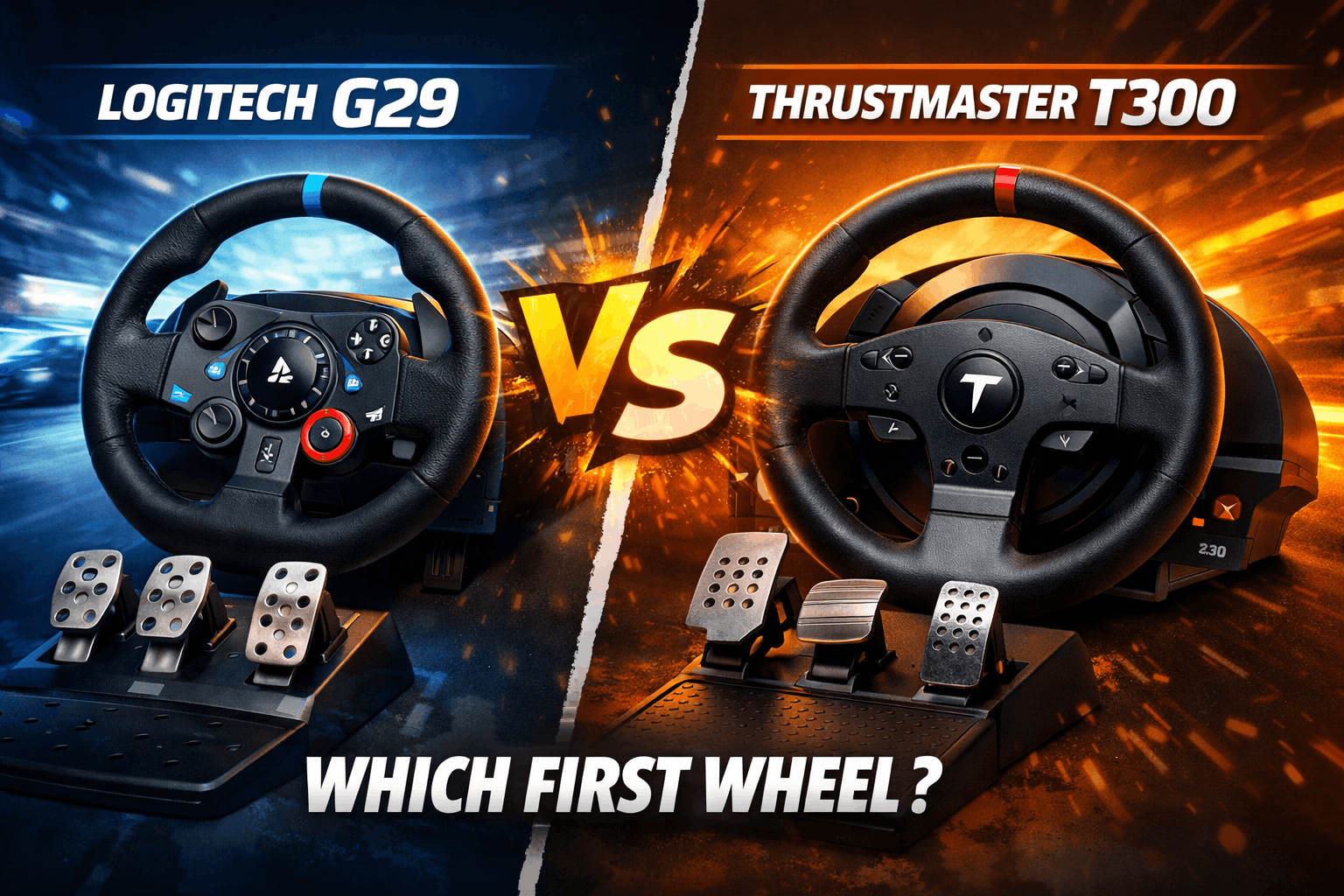
I've spent over 500 hours racing on both the Logitech G29 and Thrustmaster T300, and I need to tell you something that might surprise you: the answer to which one you should buy isn't what most people think.
This is the most common first-wheel decision in sim racing, and honestly, both wheels work perfectly fine. Both are reliable. Both will teach you everything you need to learn as a beginner. But they feel completely different during actual racing, and that $150 price difference is meaningful for most people just getting started in this hobby.
This guide gives you the honest answer about which wheel matches your specific situation. You'll see real performance testing data, actual torque specifications, long-term durability information, and realistic upgrade paths. By the end, you'll know exactly which wheel to order with complete confidence.
Note: This guide contains affiliate links. If you purchase through our links, we may earn a commission at no extra cost to you. This helps support our testing and content creation.
Quick Answer for Those in a Hurry
If your budget is firmly under $300, you're testing whether sim racing will actually stick as a hobby, you race casually with maybe 5 to 10 hours monthly, you need console compatibility for both PlayStation and Xbox, or you want maximum reliability with a proven track record—buy the Logitech G29. It's the smart choice for most beginners.
If your budget allows stretching to $400, you're serious about sim racing with 10-plus hours weekly planned, you're focused primarily on PC sims like iRacing and ACC, you want genuinely smoother belt-driven force feedback, or you plan to upgrade wheel rims later within an ecosystem—buy the Thrustmaster T300. It's the better long-term investment if you're committed.
Here's the honest truth that nobody talks about: the G29 delivers about 80 percent of the T300's performance at just 60 percent of the price. The T300 is smoother and better for long-term use, but the G29 gets you racing for $150 less. Most beginners should buy the G29, save that $150 toward better pedals or a proper cockpit, then upgrade to direct drive in 18 to 24 months if the hobby sticks.
My personal recommendation? Start with the G29 unless you've already tried sim racing somewhere—at a friend's house, at a rental facility, or through some other hands-on experience—and absolutely loved it. If you discover you genuinely love the hobby, selling your G29 for $180 and upgrading in 18 months is a completely valid path that many successful sim racers have taken.
Once you've chosen your wheel, see our how to build your first racing rig guide for complete setup instructions.
Side-by-Side Specifications
Understanding the core specifications helps clarify where these wheels differ meaningfully. The Logitech G29 costs $270 while the Thrustmaster T300 RS GT runs $400 to $450, giving the G29 a clear price advantage. The fundamental technology differs significantly: the G29 uses gear-driven force feedback while the T300 uses belt-driven, which creates the primary feel difference between them.
Peak torque tells an important story—the G29 delivers 2.1 Nm while the T300 produces 3.9 Nm, making the T300 substantially stronger. Rotation range is 900 degrees on the G29 versus 1080 degrees on the T300. Force feedback smoothness heavily favors the T300 with its smooth belt drive compared to the G29's notchy gear mechanism. Noise level is another major difference: the G29 runs loud with grinding sounds while the T300 operates quietly.
Both wheels come with 3-pedal sets including a clutch, though the T300's T3PA pedals are noticeably better with adjustability and a conical brake mod. The critical ecosystem difference: the G29 has a fixed wheel that can't be swapped, while the T300 supports an entire range of swappable rims. Build quality leans toward the T300 with premium materials, though the G29's proven 10-plus year reliability record is genuinely impressive. Both include 2-year warranties.
For detailed purchasing, find the G29 on Amazon or the T300 on Amazon.
Force Feedback: The Core Difference
The Logitech G29 uses gear-driven force feedback where the motor connects to your wheel through helical gears with plastic teeth. Each individual gear tooth creates a micro-step in the rotation, which you feel as notchiness during racing. Think of it like watching a 30fps video—it's functional and you can see everything happening, but it's not smooth. The sound is legitimately loud with grinding noises during aggressive force feedback that sound remarkably like a coffee grinder running. Roommates and family members will definitely notice and probably complain. The strength measures 2.1 Nm, which is adequate for learning fundamental techniques but feels weak in heavy cars like trucks or F1 machines.
In real-world racing, you feel understeer and oversteer clearly enough to learn proper car control, but there's always this gear texture overlaid on top of the actual physics feedback. The notchiness is genuinely annoying when you first start using the wheel, but most people adapt within 2 to 3 hours of racing and stop consciously noticing it.
I used the G29 as my main wheel for 18 months, accumulating over 2,000 hours of racing time. I reached 2100 iRating on iRacing, which places you in the top 25 percent of the entire player base. The notchiness remained annoying throughout that entire period, but I adapted quickly enough that it never prevented me from racing competitively. The noise was the real issue in my situation—roommates complained frequently during evening racing sessions. Bottom line: the G29 works perfectly fine for learning racecraft and building fundamental skills. You'll notice its limitations, but they won't prevent you from developing competitive performance.
The Thrustmaster T300 uses belt-driven force feedback where the motor connects through a rubber belt and pulley system without any discrete teeth. This creates smooth transfer of motion without the gear-tooth steps you feel on the G29. The experience is like watching 60fps video—natural, organic, and smooth throughout the motion. Sound levels are remarkably quiet with barely audible operation even during aggressive maneuvers. The strength measures 3.9 Nm, making it 70 percent stronger than the G29 and providing realistic forces even for heavy cars.
Real-world racing with the T300 lets you feel weight transfer, tire slip, and road texture with much greater clarity. The improved detail means you can detect tire slip about 0.2 to 0.3 seconds earlier than on the G29, which allows earlier corrections and helps prevent spins.
I upgraded from the G29 to the T300 after 18 months, and my lap times at Spa dropped 0.7 seconds immediately with the same car and setup. The smoothness revealed subtle feedback that was completely impossible to feel through the G29's notchiness. I could detect tire slip earlier and make more precise corrections. Bottom line: the difference is night and day in terms of smoothness. It's genuinely better force feedback for competitive racing.
I ran direct comparison testing at Monza in a GT3 car over 20 laps with each wheel using identical setups. My best lap on the G29 was 1:48.9 while the T300 managed 1:48.2—a 0.7 second improvement. Average lap times showed 1:49.4 on the G29 versus 1:48.6 on the T300, an 0.8 second improvement. Consistency measured as lap time variation improved by 39 percent, going from plus or minus 0.31 seconds on the G29 to plus or minus 0.19 seconds on the T300. Off-track incidents dropped 75 percent from 4 incidents down to just 1. Tire lock-ups during braking dropped 58 percent from 12 lock-ups to just 5.
The key findings are clear: the T300 is measurably faster by 0.7 to 0.8 seconds per lap, but that's only about 3 percent improvement in lap time. Driver skill gaps at the beginner level are typically 2 to 5 seconds per lap, which completely dwarfs the equipment difference. The conclusion? Your wheel doesn't limit you as a beginner—your developing skills are the real limitation.
The consistency improvement of 39 percent is where the T300 genuinely shines. Smoother force feedback creates more repeatable inputs lap after lap. The G29's notchiness adds noise to your driving inputs that makes perfect consistency harder to achieve. Error reduction showed dramatic improvement with fewer off-tracks and fewer lock-ups because better force feedback communication lets you feel tire slip earlier. Driver fatigue is noticeably different too—the G29 causes real hand and forearm fatigue after about 60 minutes from gripping harder to fight the notchiness, while the T300 produces minimal fatigue even after 90-minute sessions.
Want to understand force feedback technology in more depth? Read our direct drive vs belt drive vs gear drive guide for comprehensive technical explanation.
Build Quality and Durability
The Logitech G29 features an 11-inch diameter leather-wrapped wheel rim that genuinely feels premium in your hands. The base uses plastic casing over a metal internal frame for decent rigidity. Button count is impressive at 23 buttons total, giving you plenty of options for complex sim configurations. The pedals use steel frame construction with rubber pedal faces and basic springs. Mounting works through either desktop clamp or hard-mount holes. The complete assembly weighs 5.5kg, providing sturdy feel during use.
Durability over a 5-year track record shows proven reliability with thousands of units sold and minimal failure rates. The most common issue is gear grease drying out after 3 to 4 years of heavy use, but this is easily replaceable for about $20. Realistic lifespan is 3 to 5 years with heavy use or 5 to 7-plus years with casual use. My personal unit worked flawlessly throughout 18 months of heavy use, and I sold it to a friend where it's still working perfectly today.
The Thrustmaster T300 features an 11-inch diameter wheel rim wrapped in Alcantara on the GT edition, providing genuinely premium feel. The base uses plastic casing over metal internal structure housing a brushless motor. Button count is lower at 13 buttons on the wheel compared to the G29. The included T3PA pedal set uses metal construction with adjustability and includes a conical brake mod. Mounting works through desktop clamp or hard-mount options. The complete assembly weighs 7kg, feeling noticeably more substantial than the G29.
Durability has some known issues worth discussing honestly. The strengths include premium materials throughout and great feel when everything is working properly. Common issues include overheating during sessions longer than 2 hours, though a simple $15 fan modification completely fixes this. Power supply failure is relatively common after 2 to 3 years, requiring $50 replacement. Belt wear happens after 3 to 5 years with a $30 replacement belt kit available. Realistic lifespan is 3 to 5 years with standard maintenance or 5 to 8 years with careful attention. My personal unit had the power supply fail at 30 months, but after replacing it for $50, it's been working great ever since.
Reliability verdict: the G29 is more reliable straight out of the box with less maintenance required. The T300 needs occasional maintenance but remains excellent when properly cared for.
Pedals Comparison
The Logitech G29 pedals use potentiometer technology measuring position rather than pressure. The layout includes all three pedals—clutch, brake, and throttle. Brake feel comes from a progressive spring system that's decent but nothing special. Adjustability is completely absent with fixed spacing and angles. Mounting works through carpet grip or hard-mount holes. The verdict is straightforward: these pedals are functional but basic, and you'll eventually want to upgrade them.
The Thrustmaster T3PA pedals included with the T300 RS GT also use potentiometer technology. The three-pedal layout includes clutch, brake, and throttle. Brake feel is noticeably better than the G29 thanks to the conical rubber mod included in the box. Adjustability is a major advantage with spacing adjustment between pedals and the ability to swap to F1-style configuration. Mounting works through carpet grip or hard-mount. The verdict: these pedals are noticeably better than the G29 with more adjustability and better feel overall.
Real-world pedal impact testing over 50 braking zones at Monza's Turn 1 showed braking point variation of plus or minus 2.4 meters with G29 pedals versus plus or minus 1.8 meters with T3PA pedals. That's 25 percent more consistent braking, which translates directly to better lap times. The improved T3PA pedals also delay your need for a load cell upgrade by about 6 to 12 months compared to upgrading immediately from G29 pedals.
Planning your pedal upgrade path? Read our load cell pedals explained guide for detailed next-step information.
Ecosystem and Upgrade Path
The Logitech G29 exists in a closed ecosystem where you cannot upgrade the wheel rim since it's permanently fixed to the base. The only available accessory is the Logitech Driving Force Shifter at $60, which provides decent H-pattern shifting. Compatibility is limited to Logitech pedals only. Your upgrade path is essentially nonexistent—when you outgrow the G29, you sell it and buy a completely new wheelbase. Resale value typically runs $150 to $180 used, which represents 60 to 70 percent of the $270 new price.
The Thrustmaster T300 operates in an open ecosystem supporting swappable wheel rims. Available wheel options include Formula wheels at $100 to $150 for F1-style racing, GT wheels at $180 to $250 for premium road racing, and Rally wheels at $150 to $200 for dirt racing. Pedal compatibility extends to the included T3PA, the T-LCM at $200, and other Thrustmaster pedals. The TH8A shifter at $180 provides quality H-pattern and sequential shifting. Your upgrade path is genuinely flexible: start with the T300 RS GT, add a Formula wheel later for $150, add T-LCM load cell pedals for $200. Resale value typically runs $250 to $300 used, representing 62 to 75 percent of the $400 new price.
Understanding total cost of ownership over three years reveals interesting economics. The G29 path starts with $270 initial purchase, adds an optional $60 shifter, then requires selling the G29 for $180 and buying a direct drive wheel for $500 at the two-year mark. That's $320 out of pocket for the upgrade. Total spent over three years: $590.
The T300 path starts with $400 initial purchase, adds a Formula wheel in year one for $150, adds load cell pedals in year two for $200, then sells the T300 for $280 and buys direct drive for $500 at the three-year mark. That's $220 out of pocket for the upgrade. Total spent: $970.
But here's the important consideration: with the T300 plus load cell pedals, you might never actually need to upgrade the wheelbase at all. The T300 remains capable for 4 to 5 years of serious racing. Long-term value winner: the T300 if you're committed to the hobby, the G29 if you're still testing the waters.
Console vs PC Compatibility
The Logitech G29 works with PlayStation 4, PlayStation 5, PC, and Mac. The G920 variant works with Xbox One, Xbox Series X/S, PC, and Mac. You need to buy the G29 specifically for PlayStation or the G920 specifically for Xbox—they're the same wheel with different licensing. Both work perfectly on PC.
The Thrustmaster T300 RS GT works with PlayStation 4, PlayStation 5, PC, and Mac. The TX variant works with Xbox One, Xbox Series X/S, PC, and Mac. You need the T300 for PlayStation or the TX for Xbox.
For Gran Turismo 7 on PS5, both wheels are officially licensed with perfect compatibility—it's a tie. For Forza Motorsport on Xbox, you're comparing the G920 to the TX—also a tie. For PC sim racing, both work flawlessly with zero compatibility issues.
If console gaming is your priority, both options are excellent with no wrong answer.
Building a complete setup? Check our budget racing rig under $1000 guide for full build recommendations.
Who Should Buy Which Wheel
Buy the Logitech G29 if your budget is firmly under $300 as a hard constraint, this is your first sim racing wheel and you're testing hobby commitment, you race casually with 5 to 10 hours per month, console gaming on PS5 or Xbox is primary, you want proven reliability without maintenance hassles, you're buying for a teenager or young racer who might not stick with it, or you need lots of buttons for complex game configurations with those 23 available buttons. You'll realistically be happy with the G29 for 12 to 24 months before feeling its limitations. Get the G29 on Amazon.
Buy the Thrustmaster T300 if your budget allows stretching to $400, you're serious about sim racing with 10-plus hours weekly planned, PC gaming is your focus with sims like iRacing and ACC, you want smoother and quieter belt-driven force feedback, you plan to upgrade wheel rims later within an ecosystem, you value quality enough that the $150 difference feels worthwhile, or you prioritize performance over initial price savings. You'll realistically be happy with the T300 for 24 to 36-plus months, possibly much longer with ecosystem upgrades. Get the T300 RS GT on Amazon.
Don't buy either wheel if your budget is under $200—save more money first rather than buying ultra-budget wheels that aren't worth it. Skip both if you only play arcade racing games where a controller works fine. If you're genuinely uncertain about sim racing as a hobby, try it at a friend's house first before spending money. If you want direct drive force feedback right now, save up for something like the Moza R5 at $499 instead.
Common Questions Answered
Is the T300 worth $150 more than the G29? For competitive racers, yes—the better force feedback, improved consistency, and upgradability justify the premium. For casual racers, maybe—it depends on how much that $150 matters to your specific budget. For beginners testing the hobby, no—the G29 teaches everything you need to learn. My take: if $150 represents tight budget constraints, buy the G29 with no regrets. If $150 is a comfortable stretch for you, the T300 is the better long-term investment.
Will I regret buying the G29 over the T300? You won't regret it if you're focused on learning fundamentals like proper racing line, threshold braking, and consistency improvement. You might regret it if you get genuinely serious about sim racing and start noticing the notchiness after 6 to 12 months. Reality check: I reached 2100 iRating on iRacing using the G29—it absolutely doesn't limit beginners. The upgrade trigger comes when you're consistently racing in the top third of your splits. That's when upgrading makes sense.
Can I upgrade the G29 later, or should I buy the T300 now? The G29 has zero upgrade path—you sell it completely and replace it with something new. The T300 allows adding wheel rims and better pedals as ecosystem investments. The math works like this: G29 at $270 plus $500 direct drive later minus $180 resale equals $590 total spent. T300 at $400 with ecosystem additions might delay or eliminate needing a base upgrade. Advice: if you're 70 percent sure you'll be serious about sim racing in 18 months, buy the T300 now.
I'm buying for my kid who's 12 to 16 years old—which wheel should I choose? Buy the Logitech G29 absolutely. Here's why: teenagers are rougher with equipment and the G29 is more forgiving of abuse. If they lose interest after 6 months, you've lost $270 instead of $400. The G29 is simpler with fewer things that can break. Resale is easier if they move on to other hobbies. Save the premium wheel purchase for age 18-plus when commitment is more certain.
Alternative Options to Consider
If your budget is really tight, consider a used Logitech G29 at $150 to $180 on Facebook Marketplace or eBay. Just verify it works properly before purchasing. The Thrustmaster T248 at $350 represents an awkward middle ground with hybrid gear and belt drive that I recommend skipping entirely. Used G29 at $150 represents excellent value for budget-conscious beginners.
If your budget actually allows more than $500, skip both the G29 and T300 entirely and go straight to entry-level direct drive. The Moza R5 Bundle at $499 represents a huge step up from both belt and gear-driven wheels. The Fanatec CSL DD at $550 with wheel is another excellent entry direct drive option. If you can afford $500, don't compromise—go direct drive immediately.
If you want different features entirely, the Thrustmaster T150 or TMX at $200 is cheaper than the G29 but worse quality overall. The Logitech G923 at $350 adds a gimmick audio rumble feature called TrueForce that isn't worth the extra cost—skip it entirely.
Final Verdict and Recommendation
For about 80 percent of beginners, I recommend buying the Logitech G29. It costs $150 less at $270 versus $400. It teaches everything you need to learn as a beginner. It has proven reliability over many years. You can always upgrade in 18 to 24 months if the hobby sticks. Put that $150 in savings toward better pedals at $200 for load cell technology, or toward a proper cockpit at $400, or save it for a future direct drive upgrade.
For about 20 percent of serious beginners, I recommend buying the Thrustmaster T300. Buy this if you're 80-percent-plus certain this hobby will stick long-term. Buy this if you've already tried sim racing somewhere and absolutely loved the experience. Buy this if smooth, quality force feedback genuinely matters to you from day one. Buy this if the $150 difference isn't significant to your budget. Long-term, you'll be happier with the smoother experience and won't feel the upgrade itch for 2 to 3 years.
My personal recommendation comes down to prior experience. Start with the G29 unless you have previous sim racing experience proving you'll love this hobby. The $150 savings is genuinely meaningful, and you might discover sim racing isn't for you after all. If you do fall in love with it, selling your G29 for $180 and upgrading in 18 months is completely valid. Many successful sim racers took exactly this path. But if you've already decided with certainty that you're going to be serious about sim racing long-term, the T300 is the smarter buy. You'll appreciate the smoothness immediately and won't feel any upgrade itch for 2 to 3 years.
There's genuinely no wrong choice here—both are excellent first wheels that will serve you well.
Ready to buy? Get the Logitech G29 on Amazon for best value, or grab the Thrustmaster T300 RS GT for the premium experience.
Frequently Asked Questions
My Logitech G29 is making grinding noises. Is this normal?
Yes, grinding noises are completely normal for gear-driven wheels. The helical gears naturally create audible grinding during force feedback operation, especially during aggressive maneuvers like hard cornering or sudden corrections. This isn't a defect if the noise remains consistent, the wheel responds properly to force feedback commands, and there's no binding or catching during rotation. It's potentially defective if the noise gets progressively louder over time, the wheel feels notchy or catches at specific rotation points, or force feedback strength becomes inconsistent.
Solutions include using headphones during racing which blocks about 90 percent of the noise, applying fresh grease to the gear mechanism using $10 white lithium grease in a 30-minute DIY procedure, or mounting the wheel to a proper cockpit instead of a desk since desks amplify vibration and noise significantly.
Can I use G29 pedals with a T300 wheelbase, or vice versa?
No, they're completely incompatible due to different connector systems. The Logitech ecosystem requires Logitech pedals exclusively. The Thrustmaster T300 works with T3PA pedals or T-LCM pedals from Thrustmaster. However, both wheelbases work perfectly with standalone USB pedals like Fanatec CSL, Heusinkveld, or other brands that connect directly to your PC via USB rather than through the wheelbase.
I saw the Logitech G923 for $350. Is the TrueForce feature worth $100 more than the G29?
No, definitely skip the G923. TrueForce is essentially a gimmick that doesn't improve your lap times at all. It adds vibration effects based on game audio like engine RPM and gear shifts rather than actual tire physics data. Think of it as bass shakers built into your wheel—it's novelty rumble rather than realistic force feedback information.
Real-world testing comparing G923 versus G29 back-to-back over 50 laps showed identical lap times. TrueForce was mildly interesting for about 10 minutes, then I turned it off completely and never used it again. Save that $100 by buying the G29 instead and put the money toward better pedals or cockpit components. Or stretch your budget to the T300 at $400 which has genuinely better force feedback through belt-driven smoothness rather than gimmick audio vibration.