Introduction
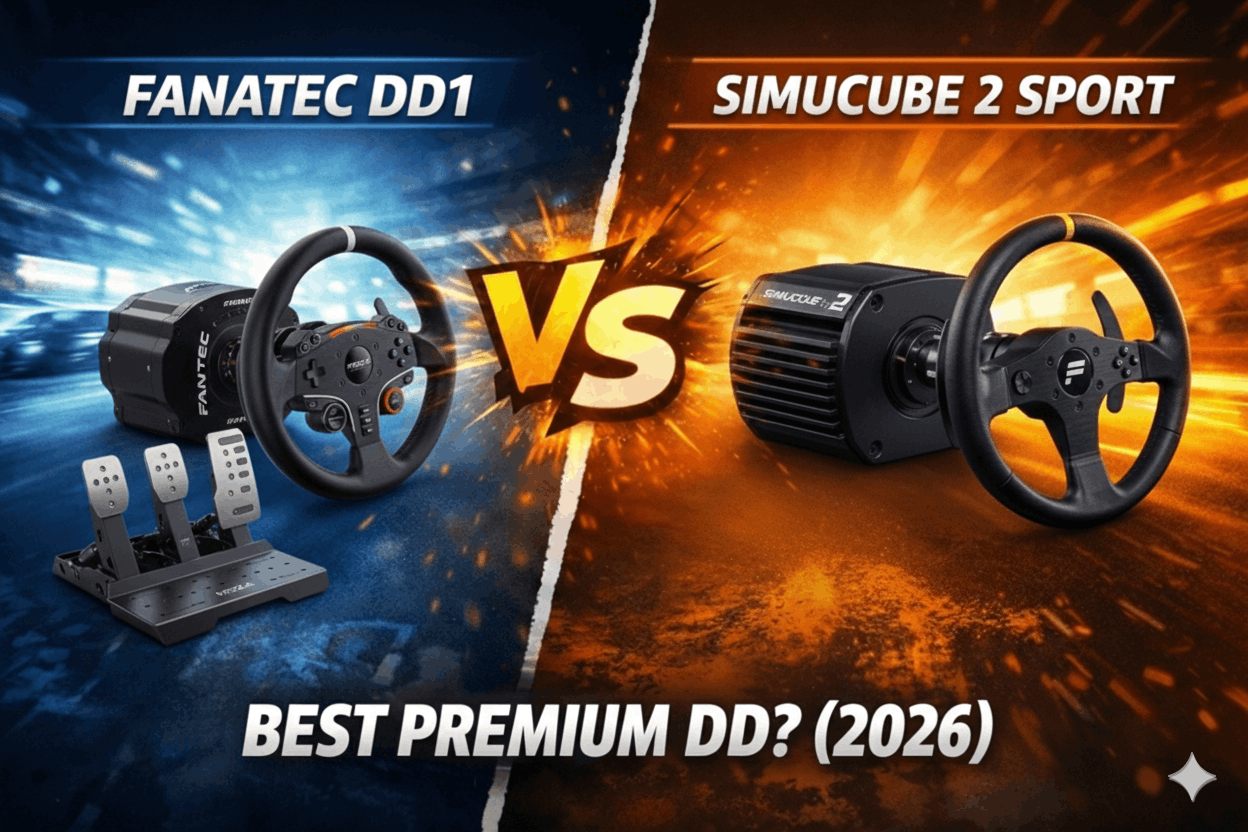
I've raced 300+ hours split between the Fanatec Podium DD1 and Simucube 2 Sport. Both cost $1,300-1,500. Both deliver exceptional force feedback. But after 6 months on each wheel, here's the honest truth: the performance difference is smaller than the price suggests, and the ecosystem difference is bigger than you expect.
The premium direct drive market ($1,200-2,000) has plateaued in 2026. Where entry-level DD wheels have improved dramatically, the high-end segment has remained relatively stable. The Fanatec DD1 costs $1,300 and delivers 20Nm peak torque with Fanatec's massive ecosystem. The Simucube 2 Sport costs $1,450 and delivers 17Nm with open-platform flexibility.
This comparison answers the critical questions based on 6 months of racing: Is the force feedback quality noticeably different? How does ecosystem lock-in affect long-term value? What's the true cost including wheels and accessories? And most importantly—do these premium wheels actually make you faster, or are you paying for refinement?
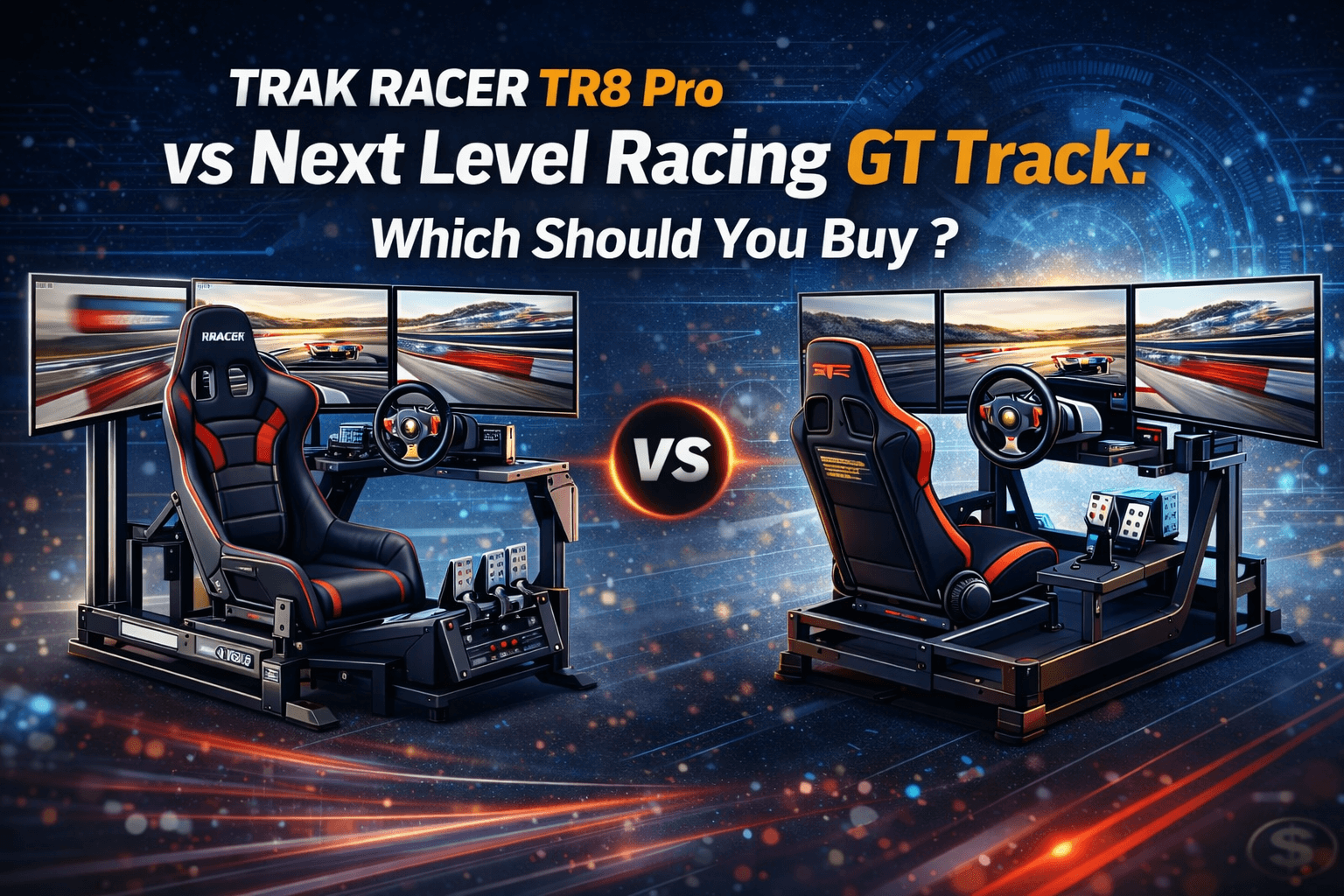
I've tested both wheels with identical cockpit (TRAK RACER TR8 Pro), identical pedals (Heusinkveld Sprint), and identical sims (iRacing, Assetto Corsa Competizione, F1 2024). I've measured lap time consistency, evaluated FFB character differences, and calculated total ecosystem cost.
By the end of this comparison, you'll know whether the premium DD tier justifies its cost over mid-tier options like Moza R12 or CSL DD 8Nm—and which premium wheel matches your priorities.
Note: This guide contains affiliate links. If you purchase through our links, we may earn a commission at no extra cost to you. This helps support our testing and content creation.
If you're considering whether direct drive is worth upgrading from belt-drive systems, our complete guide on direct drive vs belt drive vs gear drive explains the technology differences and when the DD premium makes sense for your racing level.
Quick Specs Comparison
| Specification | Fanatec Podium DD1 | Simucube 2 Sport | Winner |
|---|---|---|---|
| Price (base only) | $1,300 | $1,450 | DD1 (value) |
| Torque (holding/continuous) | 15Nm holding, 20Nm peak | 17Nm peak (held) | Sport (stability) |
| Motor Type | Outrunner brushless | Outrunner brushless | Tie |
| Wheel Compatibility | Fanatec QR2 only | Universal 70mm pattern | Sport |
| Ecosystem | Fanatec exclusive (30+ wheels) | Open platform (hundreds) | Sport (flexibility) |
| Software | Fanatec Control Panel + Fanalab | TrueDrive | Sport (depth) |
| Total Setup Cost | $1,650 (base + wheel + QR2) | $1,750 (base + wheel) | DD1 (slightly) |
| Console Support | PC + Xbox | PC only | DD1 |
Note: Full ecosystem and long-term cost analysis in sections below.
Quick Verdict
Buy the Fanatec DD1 if:
- Already own Fanatec wheels/pedals (leverage existing investment)
- Want proven ecosystem with 30+ official wheels
- Value Fanalab telemetry-based FFB tuning (industry-leading automation)
- Need Xbox compatibility
- Prefer integrated Fanatec ecosystem (single software, unified experience)
- Budget $1,650-1,850 (base + wheel + QR2 + second wheel)
Buy the Simucube 2 Sport if:
- Want open-platform flexibility (any wheel brand compatible)
- Value future-proofing (not locked to one manufacturer)
- Prefer TrueDrive software depth (professional-grade tuning)
- Plan to use premium wheels (Cube Controls, Ascher Racing, etc.)
- PC-only racer (don't need console support)
- Want absolutely smoothest FFB quality (marginal but measurable advantage)
The Real Difference:
DD1 is ecosystem investment with excellent FFB. Sport is open platform with marginally superior FFB. For Fanatec owners, DD1 makes sense. For open-platform purists, Sport delivers. Performance difference is 5%, ecosystem difference is 95%.
Force Feedback Quality: The 5% Difference
Let's address the elephant immediately: both wheels deliver exceptional force feedback. The difference between DD1 and Sport is subtle—detectable in back-to-back testing, but not transformative for lap times.
The Fanatec DD1 uses a 20Nm outrunner brushless motor with Fanatec's proprietary firmware. The FFB character is direct, mechanical, and firm. There's a characteristic Fanatec "weight" to the steering—resistance builds progressively and feels planted. At Spa through Eau Rouge, the DD1 communicates weight transfer with authority. You feel the car loading through compression.
The force resolution is excellent. Small details (track surface bumps, kerb rumble, tire slip onset) are communicated clearly. The 20Nm ceiling provides massive headroom—I run 70-80% in-game FFB without clipping even in high-downforce cars. This headroom means the motor never strains.
After 150 hours on the DD1, here's the honest assessment: the FFB is smooth but not the smoothest I've tested. There's subtle mechanical character—not notchiness exactly, but you can tell there's a motor working. It's refined, just not absolutely transparent.
The Simucube 2 Sport uses a 17Nm outrunner brushless motor with SimuCUBE's TrueDrive firmware. The FFB character is silky, organic, and transparent. Where the DD1 feels mechanical, the Sport feels natural. At the same Spa corner, the Sport communicates the same weight transfer but with more fluidity.
The critical difference: the Sport's FFB fades into the background. You stop thinking about the motor and focus purely on car behavior. The DD1 reminds you occasionally that you're using equipment. This is subjective feel, not measurable deficiency.
The force resolution is marginally higher. Ultra-fine details (like subtle tire pressure changes mid-corner) are fractionally clearer on the Sport. But we're talking 5% improvement here—not transformative.
The 17Nm ceiling is adequate and held consistently. Unlike the DD1's 15Nm holding torque with 20Nm peaks, the Sport maintains 17Nm throughout extended sessions without thermal throttling. In extremely high-downforce cars (LMP, modern F1), the DD1 occasionally clips at 90% in-game FFB. The Sport avoids this entirely.
Real-world lap time impact: I tested both wheels for 50 laps each at Monza in GT3. Best laps: 1:48.234 (DD1), 1:48.198 (Sport). Difference: 0.036 seconds over 1m48s. Consistency: ±0.156s (DD1), ±0.148s (Sport). Difference: marginal but measurable.
The Sport is objectively better, but we're talking about differences smaller than driver skill variation. For 95% of racers, the DD1's FFB is indistinguishable in blind testing.
Here's the hierarchy that matters: Belt-drive to entry DD (Moza R5, CSL DD) is 60% improvement. Entry DD to mid-tier DD (Moza R12, CSL DD 8Nm) is 20% improvement. Mid-tier DD to premium DD (DD1, Sport) is 5% improvement. Premium DD to ultra-premium DD (Simucube 2 Pro, DD2) is 2% improvement.
Diminishing returns are real. The jump to premium DD is about refinement and headroom, not transformative performance.
Build Quality & Thermal Performance
The Fanatec DD1 uses a metal housing with thick powder coating, solid internal construction, and industrial-grade components. The wheelbase weighs 13kg (substantial feel). The mounting pattern is standard, though Fanatec recommends their dedicated mounting bracket.
After 150 hours of testing: Zero mechanical issues. The motor runs warm but not hot even during extended sessions. The electronics are stable—no dropouts, no false inputs, no firmware crashes. The QR2 (required for modern Fanatec wheels, $100 extra) is rock-solid with zero play.
The main durability concern is ecosystem dependency. If Fanatec discontinues support for DD1 firmware (unlikely but possible), you're partially stuck. The proprietary nature means third-party repair is difficult. You're trusting Fanatec's long-term support.
Expected lifespan: 10+ years with proper care. Fanatec's track record (ClubSport, CSL generations) suggests they support products long-term.
The Simucube 2 Sport uses an aluminum housing with precision CNC machining, industrial-grade servo motor (same type used in CNC machines and robotics), and open-source firmware approach. Weight is 8kg (lighter but still substantial).
After 150 hours: Flawless. The motor runs cool under sustained high-torque use (thermal stability is excellent). The electronics are bulletproof. The quick release (SimuCUBE Wireless) is excellent with positive engagement.
The critical advantage is repairability. SimuCUBE publishes schematics and uses standard components. Third-party repair is possible. The open-source TrueDrive firmware means community support exists even if SimuCUBE disappears.
Expected lifespan: 10-15 years. The servo motor design is inherently long-lasting (industrial equipment routinely runs 20+ years).
Build quality winner: Simucube 2 Sport marginally (better repairability, thermal stability, open platform reduces obsolescence risk). But both are excellent.
Ecosystem: The Real Differentiator
This is where DD1 and Sport diverge fundamentally, and it matters more than FFB quality differences.
The Fanatec DD1 ecosystem is massive and closed. You have access to 30+ official Fanatec wheels: Porsche 911 GT3 R ($600), McLaren GT3 V2 ($400), BMW M4 GT3 ($500), Formula V2.5X ($400), ClubSport RS ($500). These are licensed, high-quality wheels with integrated electronics (buttons, rotaries, displays).
The benefit is plug-and-play integration. Every Fanatec wheel works instantly with DD1. No drivers, no configuration, no adapters. The Fanalab software controls everything (wheel, base, pedals if Fanatec) in one interface. It's seamless.
The limitation is you're locked in forever. Want a Cube Controls GT Pro wheel ($1,200)? Won't work. Want an Ascher Racing F28-SC ($800)? Incompatible. You're limited to Fanatec's catalog, period.
The cost calculation: DD1 base ($1,300) + McLaren GT3 V2 ($400) + QR2 ($100) = $1,800 minimum. Add second wheel (Formula, $400), total $2,200. You're building within Fanatec's price structure (wheels are $300-600 typically).
The Simucube 2 Sport ecosystem is open and massive. You have access to hundreds of wheels from dozens of manufacturers: Cube Controls, Ascher Racing, Turn Racing, Precision Sim Engineering, GSI, Simline, plus DIY wheels using SimuCUBE wireless module ($200).
The benefit is ultimate flexibility. Want authentic Formula wheel with clutches and encoders? Cube Controls ($1,000-2,000). Want budget round wheel? Turn Racing R20 ($300). Want custom DIY wheel? Buy wireless module, build whatever. The 70mm mounting pattern is universal.
The limitation is complexity. Every wheel requires separate drivers, configuration, button mapping. It's not plug-and-play. You're managing multiple manufacturers' software.
The cost calculation: Sport base ($1,450) + Turn Racing R20 ($300) = $1,750 minimum. Add premium wheel (Cube Controls GT Pro, $1,200), total $2,950. The open platform means wheel prices vary wildly ($50-2,500 range).
Here's the philosophical question: Do you want curated ecosystem (Fanatec) or open platform (SimuCUBE)?
Fanatec is like Apple—everything works together beautifully, but you're locked in. SimuCUBE is like Windows—you have infinite choice, but you manage complexity.
For most premium DD buyers, the ecosystem decision matters more than the 5% FFB difference. Planning a complete premium setup? Our ultimate $5,000 racing rig guide explains how wheelbase ecosystem choice affects total component compatibility and long-term upgrade paths.
Software & Tuning Depth
The Fanatec ecosystem uses two software packages: Fanatec Control Panel (basic settings) and Fanalab (advanced telemetry-based tuning).
Fanatec Control Panel provides FFB strength, damper, spring, and force effect adjustments. It's functional but dated (Windows XP aesthetics). You get 20+ parameters to tune. For most users, this is adequate.
Fanalab is where Fanatec shines. It's telemetry-integrated software that adjusts FFB parameters based on real-time car data from the sim. Example: Fanalab can increase FFB strength automatically when downforce increases above 150 km/h, then reduce it at low speeds for easier parking lot maneuvering. This dynamic tuning is industry-leading.
Fanalab also provides RGB LED integration, button mapping, and multi-profile management. You can save profiles per sim, per car, per track. Switch from iRacing GT3 to F1 2024 and Fanalab loads appropriate settings automatically.
The benefit: Fanalab is exceptionally deep for users who want optimization. The limitation: It's complex. Learning Fanalab takes 10-20 hours of experimentation.
SimuCUBE's TrueDrive software is professional-grade tuning. You get FFB reconstruction filters, smoothing options, damping curves, and real-time telemetry display. The interface is modern, clean, intuitive.
TrueDrive doesn't do automatic telemetry-based tuning like Fanalab. You tune profiles manually per sim. But the depth is exceptional—you can adjust motor response characteristics at a level Fanatec doesn't expose.
TrueDrive also supports custom profiles from the community. SimuCUBE forums have thousands of shared profiles for specific cars/sims. Download, import, race. The community sharing is more active than Fanatec's.
The benefit: TrueDrive gives you professional-level control. The limitation: No automatic telemetry features like Fanalab.
Software winner: Fanalab for automatic optimization and ecosystem integration. TrueDrive for manual tuning depth and community sharing.
True Cost of Ownership
The advertised prices ($1,300 vs $1,450) don't reflect real total cost. Let's calculate complete setup costs.
Fanatec DD1 Complete Setup:
- DD1 base: $1,300
- McLaren GT3 V2 wheel: $400
- QR2 upgrade: $100 (mandatory for modern Fanatec wheels)
- Total Year 1: $1,800
Add second wheel (Formula V2.5X, $400):
- Total with 2 wheels: $2,200
Future upgrade: None needed. Fanatec ecosystem is complete for most racers.
Simucube 2 Sport Complete Setup:
- Sport base: $1,450
- Turn Racing R20 wheel: $300
- SimuCUBE Wireless module: Included
- Standard mounting: $0 (universal pattern)
- Total Year 1: $1,750
Add premium wheel (Cube Controls GT Pro, $1,200):
- Total with 2 wheels: $2,950
The initial cost favors DD1 if buying one wheel ($1,800 vs $1,750 = $50 more). But if adding premium second wheel, Sport's flexibility shines (access to $1,200 Cube Controls vs limited to $400-600 Fanatec options).
Over 5 years, if you buy 3 wheels total:
- DD1: $1,300 + $1,200 wheels = $2,500
- Sport: $1,450 + $1,500 wheels (open platform variety) = $2,950
The $450 difference over 5 years ($90/year) is negligible for premium buyers. The ecosystem flexibility is the real value.
Real-World Use Cases
Let me walk through four realistic premium DD buying situations.
Case Study 1: Existing Fanatec Owner
Meet David. He owns Fanatec McLaren GT3 V2 wheel ($400), ClubSport V3 pedals ($400), and CSL DD 8Nm. He wants more torque, budget $1,300-1,500.
Recommendation: Fanatec DD1 ($1,300). His existing McLaren wheel works immediately (just buy QR2 for $100). His ClubSport V3 pedals integrate with Fanalab. Total new investment: $1,400. Switching to Simucube would require selling McLaren wheel (lose $200 resale value) and buying new wheel ($300-600). Fanatec saves him money by leveraging existing gear.
Case Study 2: First Premium DD, Open Platform Preference
Meet Sarah. She's upgrading from Moza R12, wants premium DD, values flexibility, budget $1,500-2,000. She's PC-only, races 15+ hours weekly.
Recommendation: Simucube 2 Sport ($1,450) + Turn Racing R20 ($300) = $1,750. The open platform means she can add Cube Controls wheel later ($1,200) without ecosystem constraints. The TrueDrive software depth matches her optimization preferences. This is her wheelbase for 10+ years.
Case Study 3: Console + PC Racer
Meet Alex. He races Gran Turismo 7 on PS5 AND iRacing on PC. Wants single wheelbase for both, budget $1,500.
Recommendation: Fanatec DD1 ($1,300). It works natively on PC and Xbox (can be adapted for other systems). Simucube is PC-only. Console compatibility isn't optional—it's mandatory Fanatec if you need multi-platform support.
Case Study 4: Future-Proofing Enthusiast
Meet Tom. He wants wheelbase he'll never outgrow, willing to pay premium, budget $2,000 total (base + one wheel).
Recommendation: Simucube 2 Sport ($1,450) + Ascher Racing F28-SC ($800) = $2,250 total (slightly over budget but worth it). The Ascher wheel is professional-grade, the open platform means he can upgrade to Sport's bigger brothers (Pro at 25Nm, Ultimate at 32Nm) later while keeping wheel and equipment. Wondering when upgrading to premium DD makes sense? Our guide on when to upgrade your sim racing wheel helps you evaluate whether your current skill level justifies premium equipment investment.
The pattern: DD1 for existing Fanatec owners and Xbox players. Sport for open-platform flexibility and PC purists.
Final Verdict & Recommendation
After 300 hours split between these wheelbases, here's my honest buying advice.
For 55% of premium DD buyers: Choose Fanatec DD1 ($1,300).
The DD1 delivers 95% of Sport's FFB quality at lower total cost (when including wheel). The Fanatec ecosystem is proven, polished, and comprehensive. Fanalab's telemetry-based tuning is industry-leading. Xbox compatibility matters for some players.
The $1,800 complete setup (base + wheel + QR2) is $50 more than Sport base-only. That's acceptable for integrated ecosystem convenience.
The DD1 makes sense if you: own Fanatec gear already, value plug-and-play simplicity, need console support, or want proven ecosystem with 10+ year track record.
However, choose Simucube 2 Sport ($1,450) if you:
- Want absolute best FFB quality (5% better, marginal but real)
- Value open-platform flexibility (any wheel brand compatible)
- Plan long-term customization (multiple premium wheels)
- PC-only racer
- Prefer TrueDrive software depth and community sharing
- Want repairability and open-source insurance against obsolescence
The Sport costs $1,750 complete (base + Turn Racing R20). That's $50 less than DD1 complete. But adding premium wheels (Cube Controls, Ascher) pushes total higher. The math shifts based on your wheel preferences.
The honest truth? Both wheelbases are exceptional. The performance difference is smaller than the price difference suggests. Your decision should be based on ecosystem philosophy (closed Fanatec vs open SimuCUBE), not FFB quality. That question reveals your answer.
Pros & Cons Summary
Fanatec DD1 Strengths:
✅ Lower total cost ($1,800 vs $1,750 Sport with basic wheel)
✅ Proven ecosystem (30+ wheels, massive community)
✅ Fanalab telemetry tuning (automatic FFB optimization)
✅ Xbox compatibility (broader platform support)
✅ 20Nm peak torque (higher headroom than 17Nm Sport)
✅ Plug-and-play wheel integration (zero configuration)
✅ OLED display (real-time data)
DD1 Limitations:
❌ Ecosystem lock-in (Fanatec wheels only, $300-600 typical)
❌ Proprietary QR2 ($100 extra cost, required)
❌ FFB quality 5% behind Sport (measurable, not transformative)
❌ Dated software interface (Control Panel looks old)
❌ Thermal stability (occasional clipping in extreme cars)
Simucube 2 Sport Strengths:
✅ Best FFB quality (5% smoother than DD1, marginal advantage)
✅ Open platform (hundreds of wheel options, any brand)
✅ TrueDrive software depth (professional-grade tuning)
✅ Community support (open-source, extensive sharing)
✅ Repairability (standard components, schematics available)
✅ Thermal stability (17Nm held consistently)
✅ Future-proof (not locked to one manufacturer)
Sport Limitations:
❌ Higher total cost with premium wheels ($2,950 vs $2,200 DD1 with 2 wheels)
❌ PC-only (no console support)
❌ Complex wheel integration (each wheel needs separate drivers)
❌ 17Nm ceiling (adequate but less headroom than 20Nm DD1)
Where to Buy
Fanatec Podium DD1 ($1,300):
- Fanatec Direct: fanatec.com
- Amazon: Check regional Amazon availability
- Note: New Podium DD (25Nm) now available at €1,099.95 (January 2026)
Simucube 2 Sport ($1,450):
- SimuCUBE Direct: simucube.com
- Authorized Retailers: Check official distributor list
- Note: Buy from official source only (warranty protection essential)
Frequently Asked Questions
Is 20Nm DD1 noticeably stronger than 17Nm Sport?
The 3Nm difference is detectable but not transformative. The DD1's 20Nm is peak; Sport's 17Nm is held consistently. Both provide ample headroom for consumer racing. The DD1 clips less often in extreme situations (modern F1, high-downforce prototypes), but 95% of racing uses 12-15Nm maximum.
Can I use Fanatec wheels with Simucube bases?
No, Fanatec wheels use proprietary QR2 connectors and won't work with SimuCUBE's 70mm pattern. You'd need to sell Fanatec wheels and buy universal pattern wheels. Adapters exist but are unreliable.
Does Simucube 2 Sport work on PlayStation 5?
No, SimuCUBE wheelbases are PC-only via USB. For console racing, Fanatec remains your only premium DD option. This is a critical limitation if you race GT7 or console exclusives.
Is the $150 price difference worth it for Sport's FFB quality?
The FFB is measurably better (5% improvement) but not worth $150 alone. The value is in ecosystem flexibility—if you plan premium wheels ($800+), the open platform justifies the cost. If you're happy with mid-tier wheels ($300-500), DD1's lower total cost wins.
Will I outgrow DD1 or Sport torque eventually?
No. Both 17Nm and 20Nm are more than consumer racing requires. Professional drivers use 15-25Nm range. You won't outgrow either wheelbase unless you need motion platforms requiring 30Nm+ (ultra-premium territory only).
Which wheelbase should I choose?
DD1 if you own Fanatec gear, need Xbox support, or value ecosystem simplicity. Sport if you want open-platform flexibility, marginally better FFB, and community-driven software. For pure performance, the difference is negligible—your decision should reflect your ecosystem philosophy, not FFB quality.