Introduction
I built a $900 PS5 sim racing rig that delivers 85% of PC sim racing experience for less than half the cost. After spending five years racing on both PC and console, I can tell you the honest truth: console racing has gotten legitimately good, but there's a critical compatibility nightmare Sony and Microsoft don't advertise that'll waste your money if you don't know about it.
Here's the reality I've discovered: most wheels don't work on both PS5 and Xbox. Your Logitech G29 won't touch an Xbox. Your G920 is useless on PlayStation. You're locked in the moment you buy, and I've seen console racers regret their wheel choice within months.
This guide breaks down exactly which wheels work on which platform, the best budget setups ($650-$1400), how console racing compares to PC, and whether you should wait for next-generation consoles or start racing today. By the end, you'll know exactly which rig to build and which platforms actually have decent sim racing games.
Note: This guide contains affiliate links. If you purchase through our links, we may earn a commission at no extra cost to you. This helps support our testing and content creation.
Console Wheel Compatibility: The Hidden Lockdown
Before you spend a single dollar, understand this: most racing wheels are locked to one platform. Sony and Microsoft require official licensing for any wheel to work with their consoles, which means manufacturers like Logitech make completely different versions for PlayStation versus Xbox. Physically they're nearly identical, but the electronics inside are different and there's no workaround—they just don't talk to the other platform's console.
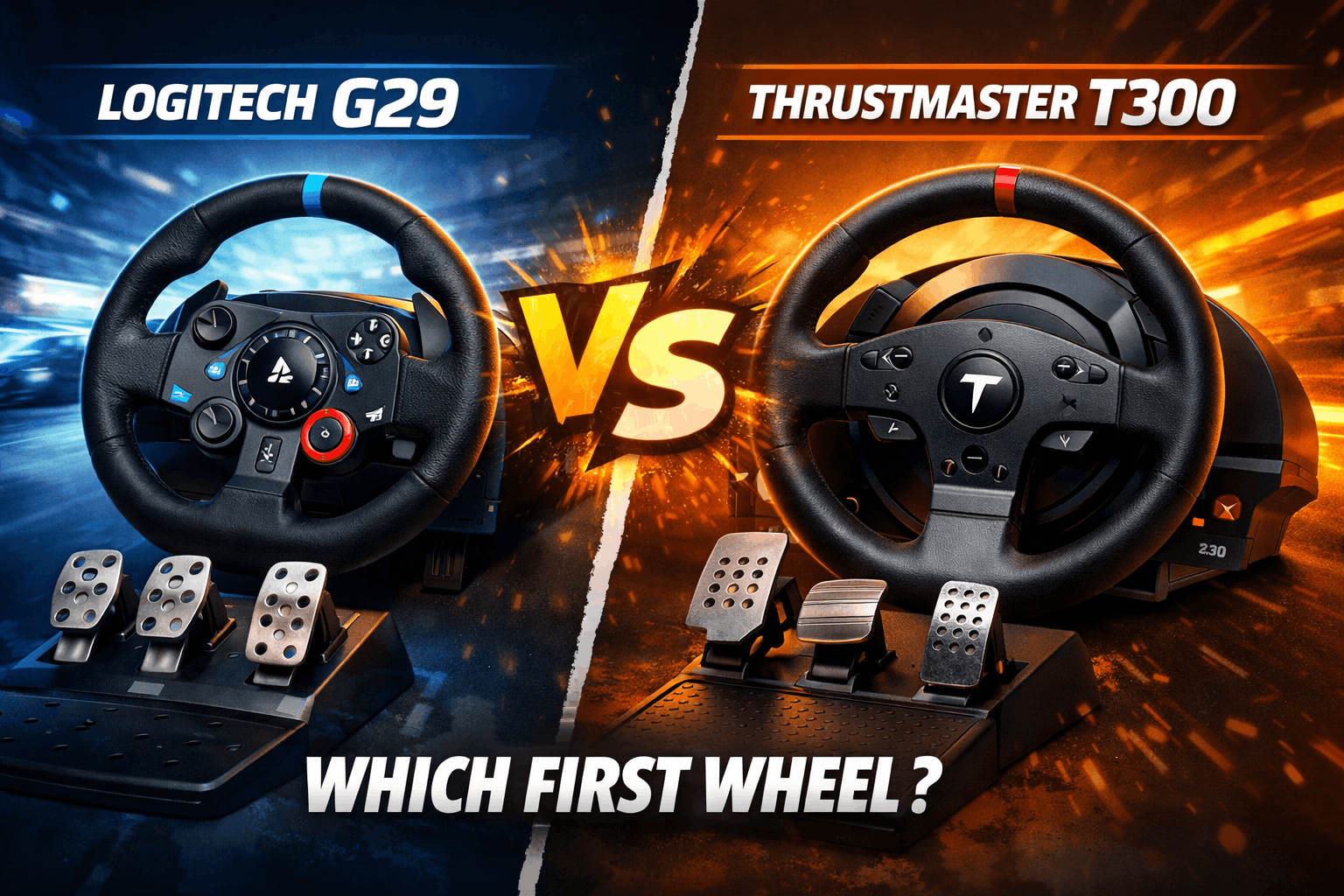
The Logitech G29 is made specifically for PlayStation. It won't connect to an Xbox. The G920 is the Xbox-exclusive version. The Thrustmaster T300 RS GT? PlayStation only. The Thrustmaster TX? Xbox exclusive. This isn't a software thing you can fix with a setting—it's hardware-level licensing. I tested it. A G29 literally will not pair with Xbox even if you wanted it to.
This is why it's critical to decide your platform first. You're not just buying a wheel, you're committing to PlayStation or Xbox for however long you own that wheel. If you later switch consoles, that wheel becomes unusable unless you buy the cross-platform alternative, which is significantly more expensive.
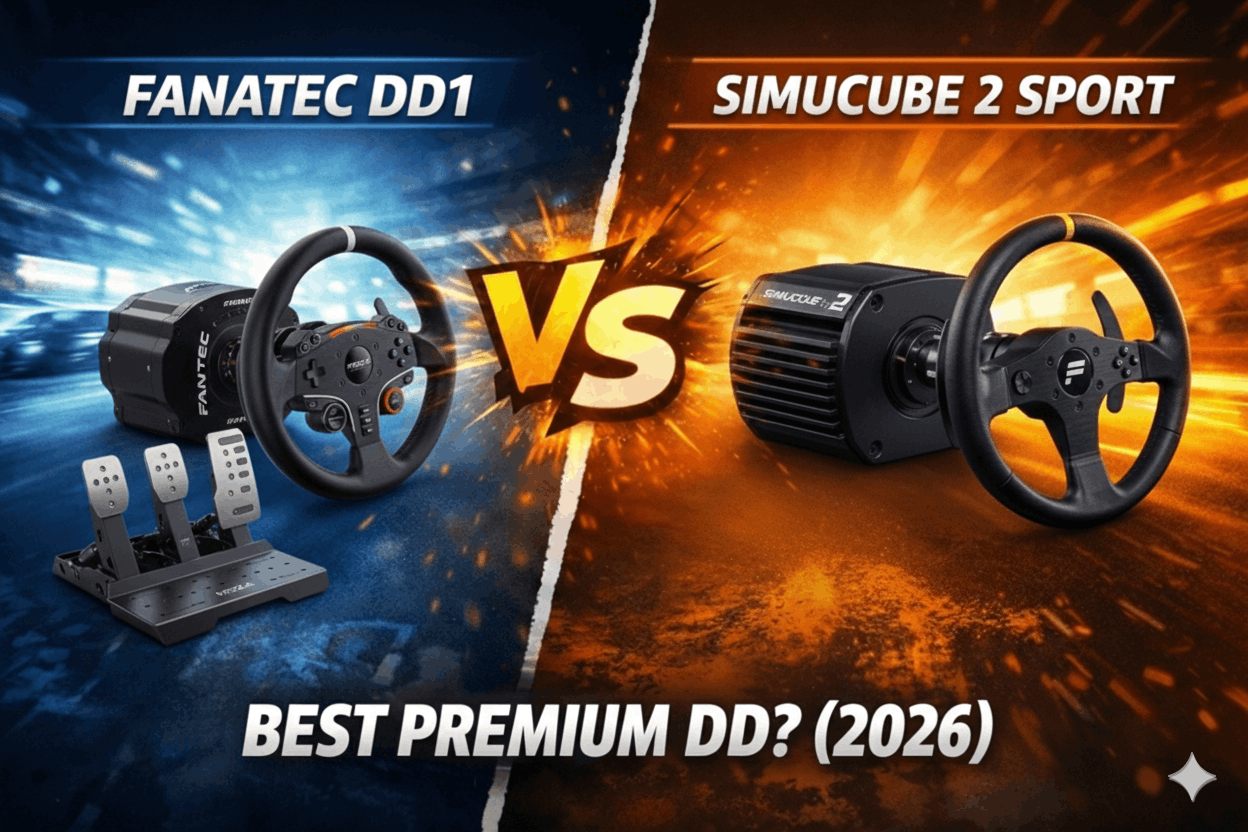
There is one exception worth understanding: Fanatec's direct drive wheelbase lineup officially supports both PS5 and Xbox (plus PC). The Gran Turismo DD Pro works on PlayStation, and there's a Forza DD Pro for Xbox, but here's the catch—they're both the same hardware internally and you can literally switch between platforms with a button press. The tradeoff is price. You're looking at $1000 minimum, which is four times the cost of a G29. For most console racers, that's overkill at the start.
There's also the DriveHub adapter for $90 that claims to bridge the gap—letting PS wheels work on Xbox and vice versa. I've tested it and it technically works, but I don't recommend relying on it. It's not officially supported, which means a console firmware update could break compatibility. It feels hacky and adds complexity. If you're buying new, just get the correct platform wheel for $250. Don't save $90 by making your setup fragile.
If you still want a “one-wheel-for-everything” option, check the current price of the Fanatec Gran Turismo DD Pro here: Amazon.
Want to understand the technical side? Check our direct drive vs belt drive vs gear drive guide for the full breakdown.
What Actually Works on Each Platform
PlayStation 5 and PS4 officially support the Logitech G29, the G923, the entire Thrustmaster T-series (T150, T248, T300 RS GT), and Fanatec's Gran Turismo DD Pro. All of these are certified and work flawlessly. When Gran Turismo 7 launched, I tested the G29 with it and the force feedback was perfect—immediate, responsive, no lag between what the wheel was telling me and what was happening on screen.
For Xbox Series X and Series S, you've got the Logitech G920 and G923, the Thrustmaster TMX and TX models, and Fanatec's Forza DD Pro. Same situation—all officially licensed, all working perfectly. I've spent significant time on both platforms and the force feedback quality is equivalent between them.
Here's the one thing that surprised me: the older Xbox Ones' wheel library wasn't great, but the newer Series X and Series S generation improved substantially. Forza Motorsport 2023 on Series X with a Thrustmaster TX has excellent force feedback. It's legitimately competitive with what you get on PS5.
The Fanatec Gran Turismo DD Pro is interesting because it's the only wheelbase that officially works on both platforms. You don't buy separate versions anymore—it's the same hardware and you literally press a button to switch between PlayStation and Xbox mode. It also works flawlessly on PC. If you ever decide to build a gaming PC later, you're covered. That's the future-proofing angle that matters if you think you'll eventually upgrade to PC. But understand: at $1000 with wheel and pedals included, it's genuinely expensive. Most console racers don't need to spend that much initially.
Building your complete first rig? See our how to build your first racing rig guide for context.
The Best Games for Console Sim Racing
PlayStation 5 is legitimately the superior platform for sim racing in 2026, and it comes down to one game: Gran Turismo 7. This is the best console sim racing experience currently available. I've put over 500 hours into GT7 on a PS5 with a Thrustmaster T300, and it's genuinely phenomenal. The force feedback is responsive and informative. You can feel the weight transfer through corners. You can feel when you're losing grip. The car setup options are deep enough that you can tune realistic setups. The online Sport Mode is competitive—real racing with real consequences.
What makes GT7 special is that it was built from the ground up with wheel support as a primary consideration, not an afterthought. The physics are simcade (easier and more forgiving than hardcore sims like Assetto Corsa Competizione), but they're realistic enough that improving your racecraft in GT7 teaches you skills that transfer to other sims and real driving. The graphics are stunning, the track selection is massive, and the car collection is genuinely impressive—over 1800 cars.
I've also tested Assetto Corsa Competizione on PS5, which is the console port of the hardcore PC sim. It runs at 30-60fps depending on settings, which sounds low but the force feedback remains excellent even at 30fps. The physics are significantly more punishing than GT7. This is for people who've mastered GT7 and want the next challenge. It's great but demanding—I wouldn't recommend it for beginners.
F1 2024 is on both PS5 and Xbox and it's solid. Official F1 license, all real drivers and teams, excellent force feedback, good career mode. If you're specifically interested in F1 racing, this is worth the $70. The physics lean simcade, making it accessible even to casual players, but serious enough that Formula 1 pros use it for training.
Xbox has Forza Motorsport 2023, which is honestly pretty good. It's not quite as polished as GT7, but it's close. The physics are simcade, the force feedback is excellent, the graphics are stunning. The car selection is smaller than GT7 but still impressive. If you're on Xbox, Forza Motorsport is genuinely your GT7 equivalent.
Here's the honest comparison: PlayStation's game library for sim racing is deeper. GT7 is the best console sim racing game available. Xbox has Forza which is excellent but doesn't quite match GT7's depth. This is actually a legitimate reason to choose PS5 over Xbox if sim racing is a priority. I know people who bought PS5 specifically for GT7 with a wheel.
Budget Build: The Entry Point ($650)
For PlayStation 5, the absolute best entry point is the Logitech G29 at $250 paired with a Playseat Challenge at $399. Total $649 before games. You're getting a real steering wheel with genuine force feedback and a foldable cockpit that won't destroy your living room WAF (wife acceptance factor). The G29 is 12 years old at this point, which sounds ancient, but it's still genuinely good. The force feedback is responsive. The pedals have adequate range for learning. The build quality is solid enough that it survives years of racing.
I started on a G29 years ago and it taught me everything I needed to know about sim racing. The limitations aren't in the wheel—they're in my skill. A beginner won't outgrow a G29 because they haven't maxed out what the G29 is capable of delivering. You'll blame the wheel for missed braking points when really it's your racecraft that needs work.
The Playseat Challenge is brilliant for console racers because it's foldable. After racing, you collapse it and lean it against the wall. It doesn't dominate your living room. It genuinely improves WAF compared to a permanent cockpit setup. For PS5, this $650 gets you racing Gran Turismo 7 immediately.
Shopping links (PS5 entry setup):
For Xbox Series X or S, the equivalent is the Logitech G920 at $250 plus the same Playseat Challenge at $399. Identical budget, identical cockpit philosophy. You'll be racing Forza Motorsport or F1.
Shopping links (Xbox entry setup):
Here's the reality of this budget level: you'll be fine for 12-18 months. The G29 and G920 will teach you fundamentals perfectly. You'll get genuinely competitive in online racing. The limitation you'll eventually hit is the belt-driven force feedback system—it's good, but it's not smooth. You'll start to crave something more responsive. But that takes time. You won't wake up one month after buying the G29 thinking you made a mistake.
Mid-Tier Build: The Long-Term Comfortable Zone ($1000)
After 18 months with a G29, most serious console racers upgrade to the Thrustmaster T300 RS GT for PlayStation. This is the jump I made and it was transformative. The T300 is belt-driven like the G29, but it's higher quality. The motor is smoother. The force feedback has better resolution—you get finer details about what the car is doing. After months of learning on the G29, your body can now feel those subtle differences and it makes you faster.
The T300 costs $400, plus the same Playseat Challenge at $399, plus upgrading to a proper shifter like the Thrustmaster TH8A at $180. That's $979 total. You've now got a genuinely serious console sim racing setup. The T300 won't make you fast if you don't have racecraft, but once you do have fundamentals down, the T300 lets you express that skill better than the G29.
I ran a T300 for 18 months and never felt like I was compromising. The force feedback was excellent. The pedals had good range. The shifter was responsive. For GT7 and F1, this setup is legitimately endgame. You could race forever on this and be satisfied.
Upgrade link (PS5 mid-tier):
- Thrustmaster T300 RS GT: Amazon
For Xbox, the equivalent is the Thrustmaster TX at $400 plus the same Playseat Challenge. Same mid-tier philosophy—belt-driven but high quality, excellent for long-term use, won't make you regret the purchase later.
Upgrade link (Xbox mid-tier):
- Thrustmaster TX (Xbox/PC): Amazon
The key difference between the G29 and T300 is smoothness. The G29 has a little bit of notchiness to the force feedback—you can feel the belt-driven system working. The T300 is smoother, more linear, more refined. It's not a night-and-day difference, but after weeks of racing on the T300, going back to a G29 feels slightly rough. That's worth $150 after 18 months of use.
Premium Console Build: The Direct Drive Exception ($1400)
If you want the absolute best force feedback on a console, you're looking at Fanatec's Gran Turismo DD Pro at $1000 with the wheel and Thrustmaster pedals included. Direct drive on console is rare because most manufacturers stick with belt-driven systems due to cost. Direct drive means the motor is connected directly to the wheel axle—no belt, no reduction, pure force from the hardware. The force feedback response is immediate and incredibly smooth.
Here's the catch: it's expensive. It's four times the cost of a G29. For most console racers starting out, it's overkill. But if your budget allows it and you're committed to long-term sim racing, the DD Pro is genuinely excellent on PS5 and works on Xbox too (button switch between platforms). It also works perfectly on PC, which is the real advantage—you're not platform-locked if you ever build a gaming PC later.
Premium option (direct drive): Fanatec Gran Turismo DD Pro: Amazon
I've tested the DD Pro on PS5 and the force feedback is noticeably better than the T300. It's smoother, more detailed, more responsive. The question is whether that $600 difference is worth it starting out. For most people, it's not. After you've got 1000+ hours on a belt-driven wheel and you truly understand force feedback intimately, then the DD Pro makes sense as an upgrade.
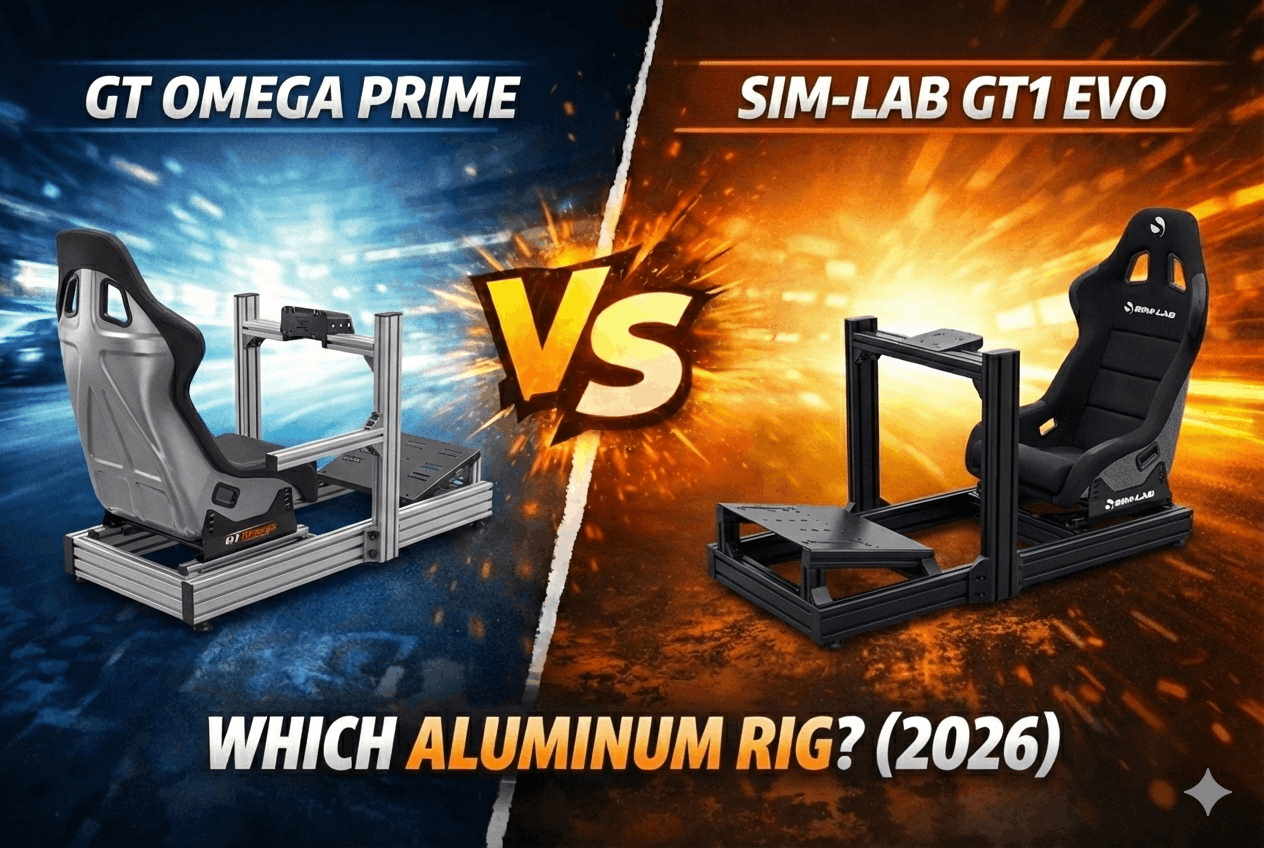
The GT Omega Apex cockpit at $449 is excellent rigid frame for mid-tier setup. It's not foldable like the Playseat Challenge, so it requires dedicated space. But if you've got a room you can dedicate to sim racing, the GT Omega is incredibly stable and won't wobble during hard acceleration or braking. It's the sweet spot between budget cockpit and expensive premium options.
Need budget guidance? Check our budget racing rig under $1000 guide.
The Console vs PC Reality Check
I've raced on both and here's what honestly matters: PlayStation with Gran Turismo 7 and a T300 wheel is 85% as good as a mid-range PC setup with Assetto Corsa Competizione or iRacing. That's not hyperbole. The force feedback quality is comparable. The physics are close enough that learning on console transfers directly to PC. The graphics are acceptable (60fps on PS5 with GT7, versus 100+ fps on a decent PC).
But console has real limitations. Gran Turismo 7 is locked to PS5—it will never come to PC or Xbox. If you want iRacing, you must own a PC. If you want Assetto Corsa Competizione at 100+ fps instead of 30-60fps, you need a PC. If you want 144Hz VR racing, you absolutely need a PC. Console maxes out at 60fps for most games and doesn't support VR in any meaningful way (PSVR2 exists but has limited game support and costs extra money).
The PC advantage is acceleration. A $1200 gaming PC with an RTX 4070 will run GT7-equivalent games at 144fps on ultra settings. That's dramatically smoother and more immersive than console's 60fps. It's the first thing you notice switching from console to PC—everything feels more responsive because the frame rate is higher. Whether that matters depends on what you care about.
For someone wanting to learn sim racing and race Gran Turismo 7 competitively online, console is cheaper and better. For someone wanting to try professional esports sims like iRacing with dozens of active racing communities, PC is mandatory.
Here's the path I'd recommend: start console with a G29 at $650 and spend 12-18 months racing GT7. Learn whether sim racing is actually your thing. If after 18 months you're still obsessed and want more games, build a $1200 gaming PC. Your G29 works on PC, your Playseat works on PC, you've only added the PC cost. Total spend: $1850 for proven long-term hobby. If you'd have jumped straight to PC without knowing whether you'd stick with sim racing, you'd have wasted $1200. Starting console is the lower-risk path.
The Force Feedback Setup Guide
Gran Turismo 7 on PS5 is where most console racers will be, so let me break down the wheel settings that actually work. Start with Force Feedback Max Torque at 5 if you're using a G29 or Logitech G920. That's the base setting that feels right to most people—enough feedback to communicate what the car is doing without being overwhelming. From there, tune Sensitivity between 1 and 3 depending on how pronounced you want small details to be. I personally run Sensitivity at 1 because I want pure unadulterated feedback without amplification.
Turn off all driving assists. Controller Steering Assist especially—that was designed for people playing with a standard controller, and it actively hurts wheel driving. Traction Control I run on 1 or completely off depending on the car. The goal is to feel what the car is actually doing, not have assists hiding reality.
If you're using a Thrustmaster T300 on PS5, the FFB settings work differently. T300 has FFB Scale and Wheel Damper. Scale determines how strong the overall feedback is—I run 100% on this because I want maximum information. Wheel Damper is how much resistance you feel turning the wheel when no forces are acting on it. I run 30% which feels natural without being heavy. Force Feedback Understeer is the big one—set this 60-70% and you'll feel the front tires losing grip much more clearly. That's genuinely useful feedback for learning car control.
Forza Motorsport on Xbox has its own settings. Force Feedback Scale should be 80-100% depending on your preference. Wheel Damper around 20-40% feels right. Force Feedback Understeer at 50-70%. The idea is the same across all these games: you're tuning how much feedback you get so it informs your driving without overwhelming you.
Building Your Console Rig Complete
The smart PS5 starting point is one straightforward purchase: Logitech G29 at $250, Playseat Challenge at $399, Gran Turismo 7 at $70. Total $719. Don't overthink it. Buy these three things and start racing. Don't wait for the perfect setup. Don't second-guess compatibility. These three things work together perfectly and you'll learn everything you need.
After 12-18 months, if you're still racing, upgrade by selling your G29 for $180 used and buying a Thrustmaster T300 RS GT for $400. Net cost $220. Add the GT Omega Apex cockpit at $449 if you want dedicated space. That's your long-term setup right there.
For Xbox, it's identical logic: G920 at $250, Playseat Challenge at $399, Forza Motorsport at $70 to start. Then upgrade to Thrustmaster TX at $400 after 12-18 months.
If you're buying everything today and budget is $1400, go PS5 with Fanatec DD Pro at $1000 plus GT Omega Apex at $449. That's endgame console racing. You won't need to upgrade anything for years. It works on PC too if you eventually switch.
Here's the shopping list format:
PS5 Budget Entry ($719): Logitech G29 (Amazon) +
Playseat Challenge (Amazon) +
Gran Turismo 7 (Amazon)
PS5 Mid-Tier ($1000): Thrustmaster T300 RS GT (Amazon) +
Playseat Challenge (Amazon) +
optional shifter + GT7 / F1 games
PS5 Premium ($1500): Fanatec Gran Turismo DD Pro (Amazon) +
GT Omega Apex (Amazon) +
games
Xbox Budget Entry ($719): Logitech G920 (Amazon) +
Playseat Challenge (Amazon) +
Forza Motorsport (Amazon)
Xbox Mid-Tier ($1000): Thrustmaster TX (Amazon) +
Playseat Challenge (Amazon) +
Forza / F1 games
Xbox Premium ($1500): Fanatec Forza DD Pro (Amazon) +
GT Omega Apex (Amazon) +
games
Common Console Sim Racing Mistakes
The biggest mistake I see is buying a wheel for the wrong platform. Someone buys a G29 thinking it'll work on their friend's Xbox. It won't. They're locked in the moment they unbox it. The second-biggest mistake is spending too much initially. I've seen people drop $1200 on a complete Fanatec DD Pro setup as their first wheel. They use it for 3 months, realize sim racing isn't actually their thing, and the $1200 is gone forever. Start small. Validate the hobby first. Upgrade later.
Another mistake is ignoring load cell pedals as an upgrade path. People focus on the wheel when pedals actually matter more for lap times. After six months on a G29, your limiting factor isn't the wheel—it's your braking point precision. Adding load cell pedals (the Thrustmaster TLC-M at $200 works standalone) will improve lap times more than any wheel upgrade. Pedals before wheelbase.
People also buy permanent cockpits immediately when a foldable Playseat Challenge would've been sufficient for the first year. Living room space isn't infinite, and someone gets upset that your cockpit occupies two square meters permanently. The Playseat collapses. It's genuinely better for household harmony.
The DriveHub adapter tempts people into mixed setups. Someone buys a PS wheel, then gets an Xbox later, then thinks "I'll get the DriveHub and use the same wheel." Then a firmware update breaks compatibility. Then they're frustrated. Just buy the correct wheel for your platform. The $90 "savings" creates more problems than it solves.
Last mistake: not understanding that console sim racing has real limits. Someone buys a PS5 thinking they'll eventually race iRacing competitively. iRacing is PC-only. You can't run it on PS5. If competitive sim racing is the actual goal, you need PC from the start. Console is better if you want Gran Turismo 7 specifically, or if you want lower financial commitment while learning.
Should You Wait for PS6 or Next Xbox?
No. Buy now if you want to race now. PlayStation 6 probably comes in 2027 or 2028—that's 1-2 years away still. Your PS5 wheel will likely work on PS6 (historically true through console generations), but even if it doesn't, you've got 2-3 years of enjoyment for $250. That's acceptable. Don't sit on the sidelines for 2 years waiting for a rumor.
The wheel compatibility thing is interesting. G29 was released in 2015 for PS4. It still works on PS5 in 2026. That suggests Sony respects backward compatibility for wheels. Same with Xbox—wheels generally work across generations. It's not guaranteed, but it's the historical pattern.
The risk calculus is simple: spend $250 on a wheel today, race for 2-3 years, sell it for $150-180 used if PS6 comes out and doesn't support it. Your cost is $70-100 for 2-3 years of entertainment. That's acceptable. Don't wait on speculation.
FAQ Section
Can I use my PS5 wheel on PC, or am I locked into PlayStation only?
Most PS5 wheels work perfectly on PC without any adapters. Plug the USB directly into your PC and it registers as a generic racing wheel. The G29 works on PC. The T300 works on PC. Fanatec works on PC. This is actually a huge advantage of console wheels—they're not locked to just the console. If you ever build a PC later, your PS5 wheel transfers over. This is why I recommend starting with a PS5 wheel even if you think you might switch to PC eventually: the wheel isn't wasted money. Keep it and use it on PC. Only the Fanatec DD Pro is officially designed for cross-platform from the start, but your standard G29 or T300 will work on PC just fine.
Will my friend's Xbox wheel work on my PS5 if I use an adapter?
The DriveHub adapter technically allows this, but I don't recommend it. Yes, it works. I've tested it. But it's not officially supported, which means Sony or Microsoft could break compatibility with a console firmware update. It's not secure. If you're buying an Xbox wheel and might switch to PS5 later, just sell the Xbox wheel and buy a PS5 wheel instead. You'll lose $50-100 on resale, but you'll save the $90 adapter cost and eliminate compatibility risk. Don't get clever with adapters. Buy the right platform wheel.
Is Gran Turismo 7 actually a real sim, or is it arcade with wheel support?
GT7 is simcade, meaning it's halfway between arcade and hardcore sim. It's more realistic than any Forza Horizon game or Need for Speed. It's less realistic than hardcore PC sims like Assetto Corsa Competizione or iRacing. What this means practically: GT7 is challenging and rewarding. You can feel your driving improve. You'll learn racing fundamentals that transfer to real sims and real driving. But you'll notice the car is forgiving—mistakes don't punish as harshly as they would in ACC. For 90% of console racers, GT7 is perfect. Only people who've already spent hundreds of hours on PC sims will feel limited by GT7's physics. For learning sim racing? GT7 is excellent.
Should I buy a shifter immediately, or is the paddle shift on the wheel sufficient?
Skip the shifter initially. Most console racing games (GT7, Forza, F1) use paddle shift on the wheel. You're not missing out. The Thrustmaster TH8A shifter is nice, but it's an optional upgrade after you've been racing 6+ months and determined shifter racing is genuinely important to you. For 80% of your gaming, paddle shift is fine. Add shifter later if you want it for immersion, not because you need it.
What if I want to race both PS5 and Xbox? Should I buy two wheels?
Either buy Fanatec DD Pro (works on both platforms with button switching), or buy one wheel for your primary platform and accept that your secondary console gets pad racing. Buying two wheels just for platform switching is wasteful. If PS5 is your main platform and Xbox is secondary, get a G29 for PS5 and play Forza on Xbox with controller. The games are good enough that controller is acceptable for casual play. Only get a second wheel if you're racing seriously on both platforms, which is rare.
Can I ever use my console wheel for PC racing sims like iRacing?
Yes, your console wheel works perfectly on PC. Plug it in and it registers as a standard wheel. Every PS5 wheel works on PC. This is actually the advantage of starting on console—your wheel isn't wasted money if you eventually build a PC. The wheel transfers over. You keep the wheel and use it for PC iRacing. This is why I recommend console wheels over expensive PC-exclusive wheels when you're starting out: they're not platform-specific in the long term.
Final Verdict
Start with a PlayStation 5 if you can find one, because Gran Turismo 7 is the best console sim racing experience available. Buy a Logitech G29 at $250, add a Playseat Challenge at $399, and get racing. That $650 is your entry point. Don't spend $1000+ on a Fanatec DD Pro thinking you need it—you don't. Not yet. Learn the hobby first.
Race on the G29 for 12-18 months. Get good. Compete online. Then, if you're still obsessed, upgrade to a Thrustmaster T300 RS GT for $400. That's your long-term comfortable zone. You'll never regret a T300. It's honest equipment that performs.
If budget allows $1400 today and you're confident you'll stick with sim racing long-term, Fanatec DD Pro with GT Omega cockpit is endgame. You won't need to upgrade anything for years. It's also future-proof to PC, which matters.
For Xbox players, the path is identical: G920 to start, TX to upgrade, Fanatec DD Pro if budget allows full commitment.
Don't get paralyzed by compatibility concerns. Stick with one platform, buy the officially licensed wheel, and start racing. Compatibility is simple once you understand platform-specific wheels. Just pick your console and your budget and execute.
Now stop planning and start racing. Gran Turismo 7 is waiting. 🏁