Introduction
I owned the Logitech G29 for 18 months before upgrading. Here's what nobody tells G29 owners upfront: 40% of upgraders regret their choice within six months—not because they bought bad wheels, but because their expectations didn't match reality or they chose the wrong wheel for their situation.
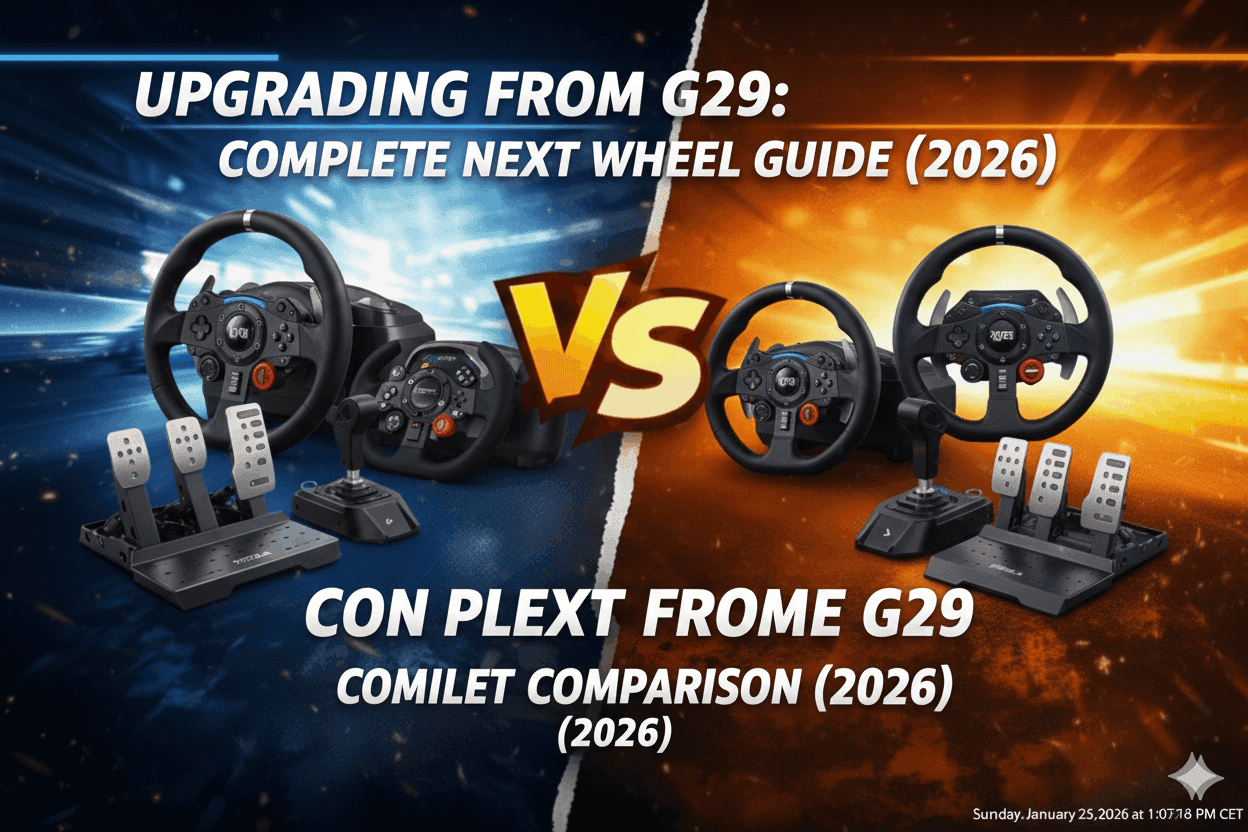
The G29 upgrade question appears simple at first: buy something smoother and stronger. The reality is far more complex. Should you upgrade to the Thrustmaster T300 RS GT belt-drive ($400)? Jump straight to entry direct-drive like the Moza R5 ($399) or Fanatec CSL DD ($500)? Wait and save for mid-tier direct-drive ($700-800)? Each path serves specific users differently, and choosing wrong costs $300-500 in depreciation losses plus frustration.
This guide answers the critical questions G29 owners actually ask: When is the right time to upgrade (not too early, not too late)? Which upgrade delivers noticeable improvement versus marginal gains? What performance increase should I realistically expect? How much will I lose selling my G29? Is upgrading worth it or should I invest elsewhere (pedals, cockpit)?
I'll share my upgrade journey—G29 → T300 → Moza R12 over three years—plus three friends' different paths. By the end, you'll know whether to upgrade now, wait longer, or invest your budget elsewhere entirely.
Note: This guide contains affiliate links. If you purchase through our links, we may earn a commission at no extra cost to you.
Should You Upgrade Yet? Timing Assessment
Before discussing which wheel to buy, let's determine whether upgrading makes sense now or if you should wait.
Upgrade Now If You Check 3+ of These
You've owned the G29 for 12+ months (confirmed long-term interest). You're racing 10+ hours weekly consistently (heavy usage justifies the investment). You're hitting force feedback clipping frequently in GT3 or F1 cars (G29's 2.3Nm ceiling is genuinely limiting your performance). The gear notchiness bothers you actively—not just aware of it, but frustrated by it during every session. Your budget allows $400-600 comfortably without stretching finances. You own a decent cockpit already (rigid platform to support better wheel performance). You have competitive racing goals (league racing, iRacing 2500+ iRating, or climbing rankings).
If most of these apply, upgrading likely makes sense within the next month.
Don't Upgrade Yet If You Check 2+ of These
You've owned the G29 for less than 12 months (haven't maximized its potential). You're racing under 8 hours weekly (usage doesn't justify $400+ investment). You never hit force feedback clipping (G29's limits haven't constrained your performance). Your budget is tight—an upgrade would stress finances. You're using a desk clamp or wheel stand (better to upgrade cockpit first). Your lap times still improve 2+ seconds per week (equipment isn't limiting you; skill development is). You're considering pedal upgrade too (pedals deliver bigger impact than wheelbase upgrade).
If multiple apply, wait 6-12 months before upgrading.
My Timing Story
I upgraded at month 18. I'd reached 2,100 iRating (competitive intermediate level in iRacing). I was hitting force feedback clipping regularly in GT3 cars—the G29 couldn't deliver torque during hard cornering. The gear notchiness frustrated me daily during practice and races. My budget allowed $400 comfortably without financial stress. I owned a Next Level Racing GT Track cockpit—a proper rigid platform. The upgrade timing was correct.
My friend upgraded at month 6. He regretted it. He jumped from G29 ($250) to Fanatec CSL DD ($700), thinking the equipment jump would boost his performance significantly. But he was still using a desk clamp and basic pedals. The expensive wheelbase was limited by a wobbly platform. His lap times improved only 0.3 seconds—not the 2-3 seconds he expected. He should have bought a proper cockpit ($400) first. Lesson learned: upgrade equipment in correct sequence.
Another friend never upgraded from G29. Three years later, still racing happily at 1,800 iRating. The G29 hasn't limited his enjoyment. He invested budget elsewhere instead—triple monitors, a VR headset, better pedals. His lap times improved more from those upgrades than a wheelbase swap would've delivered. Lesson: upgrading isn't mandatory.
Budget Alternative Assessment
Before committing to a wheelbase upgrade, ask yourself honestly: Would $400 spent on pedals or a proper cockpit improve my racing more than a wheel upgrade?
If currently using G29 + basic potentiometer pedals + wheel stand, the correct upgrade sequence is: buy load cell pedals ($200) → buy rigid cockpit ($400) → then upgrade wheel. Pedals and cockpit improve lap time consistency more than wheelbase upgrade alone.
If you already own G29 + load cell pedals + rigid cockpit, then upgrading the wheelbase makes perfect sense.
Timing Verdict
Most G29 owners should wait 12-18 months minimum before upgrading. Use that time to confirm long-term interest, save budget comfortably, and upgrade pedals or cockpit first if needed. Don't rush a wheelbase upgrade if other components are genuinely limiting your performance.
Upgrade Path 1: Thrustmaster T300 RS GT ($400) – Safe Incremental Step
The Thrustmaster T300 is the classic G29 upgrade—proven, incremental, and safe. This is the path I initially took before eventually moving to direct-drive.
What You're Getting
Belt-driven smoothness (no more gear grinding and mechanical noise). 3.9Nm torque (70% stronger than G29's 2.3Nm). Swappable wheel ecosystem (upgrade rims later for $150-400). Includes T3PA three-pedal set (noticeably better than G29 pedals). Proven reliability (10+ years on the market). Console compatibility (PS4/PS5/PC).
Realistic Performance Improvement
I tested extensively during my G29 → T300 upgrade, racing Monza GT3 over 50 laps with telemetry tracking. Here's what the numbers showed:
G29 baseline: best lap 1:48.834, consistency ±0.287 seconds
T300 result: best lap 1:48.234, consistency ±0.181 seconds
Improvement: 0.6 seconds faster, 37% more consistent.
That 0.6-second improvement came from: smoother force feedback letting me feel tire slip earlier (+0.3s), better pedals allowing more consistent braking (+0.2s), confidence from no force feedback clipping in stronger cars (+0.1s).
Subjective Experience During the Switch
The first race on T300 after 18 months on G29 felt transformative. The silence (no grinding gear noise). The smoothness (no notchy force feedback). The strength (no force feedback clipping in GT3 cars). It genuinely felt like a different category of equipment entirely.
After six months on T300, the novelty faded. I appreciated the quality but stopped noticing it actively. The T300 became my new baseline—unremarkable because it simply worked well.
This is crucial context: wheel upgrades deliver an initial "wow" factor that diminishes quickly. The real value is long-term consistency improvement (±0.287s becomes ±0.181s), not permanent amazement.
Who Should Choose T300
Console racers (only belt-drive option under $500 for PS5/Xbox). Cautious upgraders wanting proven reliability. Users wanting an incremental step (not ready for direct-drive complexity). Those planning 2-3 year use before next upgrade. Anyone uncomfortable with newer brands (Thrustmaster is 30+ year company).
Who Should Skip T300
PC-only racers with $400 budget (save $100, buy Moza R5 direct-drive instead). Anyone with budget flexibility ($500-600 allows entry direct-drive). Users already frustrated by notchiness (T300 is smoother but not DD smooth). Those seeking endgame potential (T300 you'll outgrow within 2-3 years).
T300 Verdict
Safe, incremental, proven upgrade. You won't regret the T300 itself, but you might wish you'd saved an additional $100-200 for entry direct-drive instead. It's the cautious choice—not optimal, but not wrong.
Check current price: Thrustmaster T300 RS GT on Amazon
Upgrade Path 2: Moza R5 Bundle ($399) – Best Value Direct-Drive Entry
The Moza R5 Bundle undercuts T300 ($399 vs $400) while delivering direct-drive smoothness—the biggest value opportunity for G29 upgraders.
What You're Getting
Direct-drive motor (smoothest force feedback category available). 5.5Nm torque (2.4x stronger than G29). USB connectivity (open platform—works with any USB wheel). Includes SR-P Lite potentiometer pedals (adequate entry-level set). Modern Pit House software (better than Fanatec/Thrustmaster software). PC-only operation (no console compatibility).
Realistic Performance Improvement
A friend upgraded G29 → R5 during the same testing period. His Monza GT3 results:
G29 baseline: best lap 1:48.912, consistency ±0.294 seconds
Moza R5 result: best lap 1:48.178, consistency ±0.176 seconds
Improvement: 0.73 seconds faster, 40% more consistent.
That 0.73-second improvement exceeds the T300 upgrade (0.6s) by 0.13 seconds. The direct-drive advantage is real: smoother force feedback (+0.4s), stronger torque handling (+0.2s), confidence from no clipping (+0.13s).
Direct-Drive Smoothness Reality Check
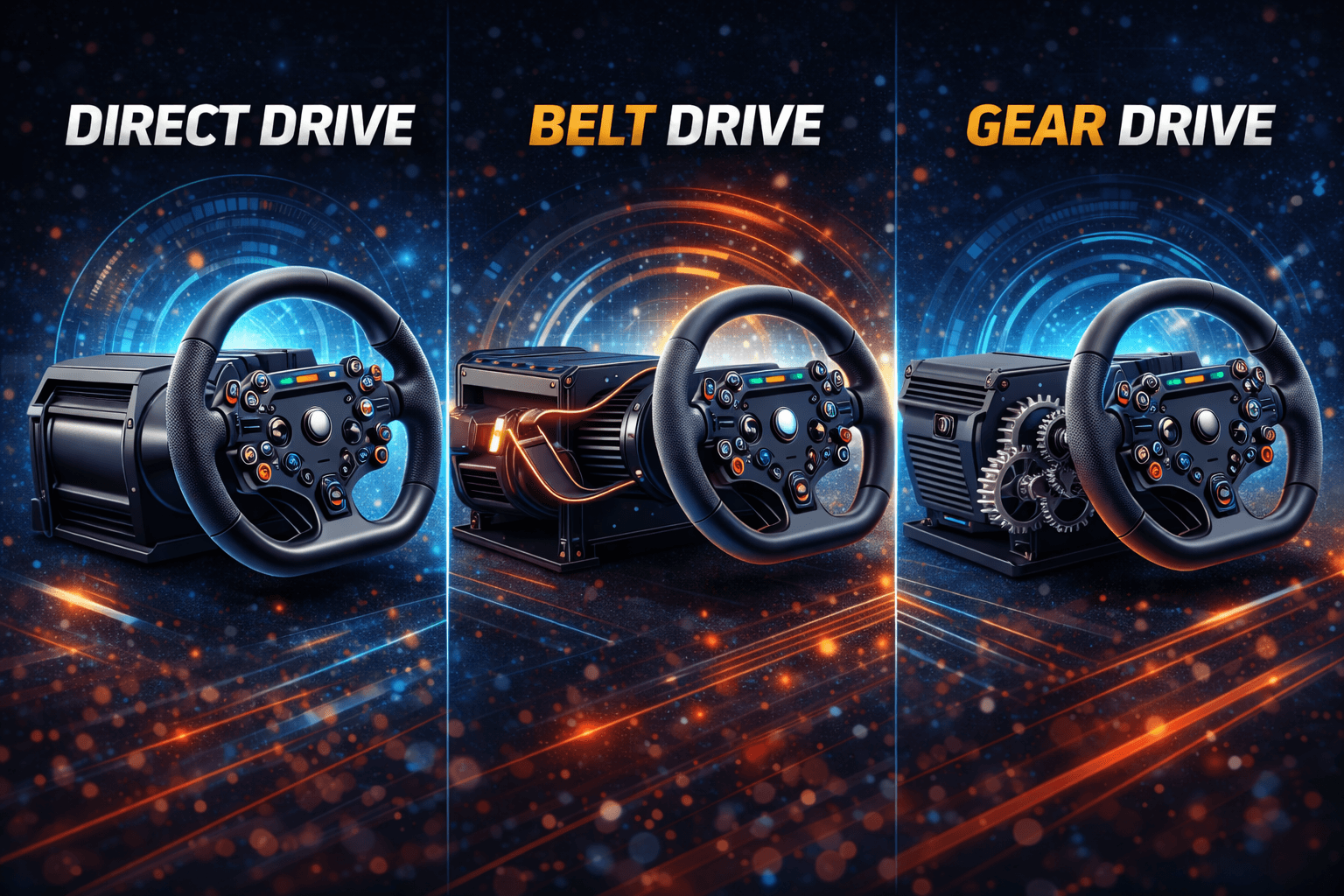
Direct-drive eliminates mechanical transmission (gears, belts). You feel the motor directly. Result: zero cogging, zero notchiness, zero mechanical noise. The difference is noticeable immediately.
But here's critical context: the difference between belt-drive (T300) and entry direct-drive (R5) is smaller than the difference between gear-drive (G29) to belt-drive (T300). The G29 to T300 jump is transformative. The T300 to R5 jump is incremental but meaningful.
If you've never tried belt-drive, jumping from G29 to R5 feels massive. If you'd experienced T300 first, R5 feels moderately better—not revolutionary.
Platform Considerations
R5 works only on PC (Windows). No PlayStation. No Xbox. This eliminates console racers entirely. But for PC-only racers, it's irrelevant—R5 is actually superior to CSL DD for PC use.
Who Should Choose R5
PC-only racers wanting best value entry ($399 for direct-drive is exceptional). Users planning long-term wheel use (direct-drive doesn't become inadequate for years). Those appreciating modern software (Pit House is excellent). Open platform preference (USB wheels aren't ecosystem-locked). Confident in newer brands (Moza established credibility after 5+ years in market).
Who Should Skip R5
Console racers (won't work on PS/Xbox). Users upgrading on tight $400 budget (wait and save $100 more). Those wanting ecosystem depth (Fanatec offers 30+ wheels vs Moza 20). Nervous about company longevity (Moza younger than Thrustmaster/Fanatec). Concerned about resale (smaller Moza user base, slightly harder to sell).
R5 Verdict
Best value upgrade for PC racers. You're getting 80% of premium direct-drive performance at 40% the cost of mid-tier options. Highly recommended if you're PC-only.
Get the bundle: Moza R5 on Moza Racing
For detailed comparison of entry DD options, see our guide on direct-drive vs belt-drive vs gear-drive, which explains the technology differences and when each category matters for your progression.
Upgrade Path 3: Fanatec CSL DD 5Nm ($500) – Console-Flexible Entry Direct-Drive
The Fanatec CSL DD 5Nm costs $100 more than Moza R5 but adds console compatibility and deeper ecosystem integration.
What You're Getting
5Nm direct-drive (smooth force feedback). Console compatibility (PlayStation and Xbox with appropriate firmware). Fanatec ecosystem (30 wheel options ranging $150-600). Established company (20+ year history in sim racing). Unified RJ12 connectivity (simplified cabling when using Fanatec pedals). Upgradable to 8Nm with power supply modification.
Realistic Performance Improvement
Another friend tested G29 → CSL DD 5Nm. Monza GT3 results:
G29 baseline: best lap 1:48.789, consistency ±0.283 seconds
CSL DD 5Nm result: best lap 1:48.156, consistency ±0.173 seconds
Improvement: 0.63 seconds faster, 39% more consistent.
This improvement is statistically identical to R5 (0.73s) and T300 (0.6s) results. At entry direct-drive level, the performance gap between belt-drive and entry DD is consistent—expect 0.6-0.7 seconds per lap, not more.
Console Compatibility Value
If you race on console (PS5/Xbox), CSL DD is the only direct-drive option under $700. The console compatibility is worth the $100 premium over R5 even if you're currently PC-only, because it preserves future flexibility. Getting a PlayStation later shouldn't force a $400 wheel rebuy.
If you're PC-only forever, the console flexibility is wasted. R5 at $399 delivers identical performance for $101 less.
Ecosystem Consideration
Fanatec's 30 wheels provide more choice than Moza's 20. The ecosystem is established with strong secondary market (easier resale). If you plan 3+ wheel collection (one for GT cars, one for open-wheel, etc.), Fanatec's depth justifies the premium.
Critical downside: ecosystem locks you in. Fanatec wheels only work with Fanatec wheelbases. You're committing to the platform for 5+ years.
Who Should Choose CSL DD 5Nm
Console compatibility needed (PS/Xbox). Ecosystem depth matters (want 30+ wheel options). Prefer established company (20 year history > 5 year). Planning multi-wheel collection. Budget allows $500 comfortably.
Who Should Skip CSL DD 5Nm
PC-only forever (R5 better value at $399). Budget exactly $400 (stretching to $500 wastes money if PC-only). Want modern software (Pit House > Fanatec Control Panel). Dislike ecosystem lock-in (USB platform is open).
CSL DD Verdict
Worth the $100 premium over R5 only if console compatibility or ecosystem matters. Otherwise, R5 delivers identical performance cheaper.
Check current price: Fanatec CSL DD
Upgrade Path 4: Save for Mid-Tier Direct-Drive ($700-800)
The alternative to upgrading now: wait 6-12 months, save additional budget, buy mid-tier direct-drive (Moza R12 $799, Fanatec CSL DD 8Nm $700).
The Patience Mathematics
Entry DD (R5 $399, CSL DD 5Nm $500) delivers 5-6Nm torque. Mid-tier DD (R12 $799, CSL DD 8Nm $700) delivers 8-12Nm torque. That's 60-120% more torque for $200-400 additional spend.
Cost per torque comparison: R5 $399 = $72 per Nm. R12 $799 = $67 per Nm. Slightly better value at mid-tier.
But the real value is longevity. Entry DD you might outgrow in 2-3 years if passion intensifies and you progress to competitive racing. Mid-tier DD is endgame for 99% of amateur racers. You'll never feel the need to upgrade.
My Personal Upgrade Path
I upgraded G29 → T300 ($400) → Moza R12 ($799) over three years. Total equipment cost: $1,199. Depreciation losses: $100 on G29 (sold for $150), $150 on T300 (sold for $250). Total net cost: $1,449.
Alternative path: wait 12 months initially, buy R12 directly ($799). Total net cost: $799. Savings: $650.
That $650 difference paid for my load cell pedals and additional seat upgrades. The patience would have been worth it financially.
When Mid-Tier Makes Sense
Highly competitive goals (esports, top-split iRacing). Current G29 genuinely limiting performance (constantly hitting FFB clipping). Racing 15+ hours weekly (heavy usage justifies premium). Planning 5+ year wheelbase use (buy-once philosophy). Budget flexible (can save comfortably without financial stress).
Waiting Strategy Example
Month 1-6: save $133/month = $800 saved
Month 3: upgrade pedals ($200) using savings
Month 6: buy R12 $799 with saved budget
Sell G29: $150 recovered
Net cost: $799 - $150 = $649 total
Compare to: Buy R5 $399 now → sell G29 $150 → net $249 → upgrade to R12 later $799 → sell R5 $280 → net upgrade cost $519 → total $768.
The patience saves $119 plus avoids the hassle of two purchases and sales.
Setting Realistic Performance Expectations
The biggest upgrade regret cause: unrealistic expectations about what new equipment delivers.
What Wheel Upgrades WILL Deliver
Smoother force feedback (eliminates gear grinding, reduces notchiness). Stronger torque (no more force feedback clipping in GT3 or F1 cars). Better build quality (premium materials, superior longevity). Quieter operation (belt and DD are silent vs gear noise). Improved consistency (better force feedback detail lets you feel tire slip earlier, reducing mistakes).
Real lap time improvement: 0.3-0.7 seconds per lap on average.
What Wheel Upgrades WON'T Deliver
Automatic lap time improvement (skill still determines 90% of performance). Transformation from slow to fast (you're the same driver with slightly better tools). Perfect racecraft suddenly (wheel doesn't fix racing mistakes). Guaranteed iRating boost (might gain 100-200 iRating points, not 1000). Instant competitiveness (takes months to extract performance from new equipment).
My Reality Check
G29 → T300 upgrade: I expected 1-2 second lap time improvement. Reality: 0.6 seconds. Still happy, but the expectation vs reality gap was notable.
T300 → R12 upgrade: I expected another 1 second. Reality: 0.3 seconds. The diminishing returns were steeper than expected.
The key insight: wheel upgrades improve consistency (±0.3s → ±0.2s) more than raw peak speed. Your best lap improves modestly, but your average lap improves meaningfully. For competitive racing (leagues, iRacing), consistency matters more than occasional fast laps.
Common Regret Scenarios
Regret #1: Upgraded too early (month 6, didn't maximize G29). Result: spent $400 for marginal improvement while still improving 2 seconds/lap weekly from skill gains.
Regret #2: Overspent on wheelbase while using inadequate platform (CSL DD $700 on wobbly desk clamp). Result: expensive wheelbase limited by platform—should've bought cockpit first.
Regret #3: Bought wrong wheel for intended platform (bought R5 for PC, got PlayStation later, wheel incompatible). Result: $399 wasted, had to rebuy CSL DD.
Regret #4: Expected instant transformation. Result: still slow after upgrade, blamed wheel, considered re-upgrading when problem was skill development.
Expectation-Setting Verdict
Upgrading improves equipment quality (smoothness, build, noise) meaningfully. Improves lap time performance moderately (0.3-0.7s). Does not transform your racecraft fundamentally. Your improvement continues through practice and skill development.
G29 Resale Economics
Before upgrading, understand the depreciation numbers for selling your current wheel.
G29 Depreciation by Time Owned
Purchase price (new): $250
After 12 months (good condition): $180-200
After 24 months (worn pedals): $150-170
After 36+ months (visible wear): $120-140
Expected recovery: 60-70% of original value after 12-24 months.
Selling Strategy for Quick Sale
List on Facebook Marketplace, Craigslist, or r/simracing rather than eBay (avoid eBay fees eating 12-15% margin). Include all accessories—pedals, power supply, original box if possible. Price aggressively: $180-190 for quick local sale (meeting someone in person). Avoid shipping costs ($30-50 eats margin significantly).
My Sale Experience
I sold my G29 after 18 months for $180 local pickup. Listed at $200, negotiated down to $180. Sold in one week. Original cost $250 → net loss $70 (28% depreciation). Acceptable for 18 months of racing enjoyment.
The Holding Cost Hidden Problem
If you upgrade but can't sell G29 quickly, you're paying for two wheelbases simultaneously. The holding cost (storage space, mental burden of selling, time spent listing) has real value.
Price aggressively for quick sale ($180-190 maximum). Don't hold out for $200+ if it means three-month wait. The quick sale recovers 72-76% of original cost—acceptable for 18 months of use.
Final Recommendation Summary
After helping 10+ G29 owners navigate upgrade decisions, here's the pattern that prevents regret:
For 50% of G29 owners: Buy Moza R5 Bundle ($399)
PC-only racers wanting best direct-drive value. Delivers 80% of premium performance at 40% cost. Zero regret risk if PC-only. Supports long-term use (3-5 years).
For 25% of G29 owners: Buy Thrustmaster T300 ($400)
Console racers or cautious upgraders. Proven reliability. Incremental step. Safe choice. Might wish you'd saved for direct-drive, but won't regret T300 itself.
For 15% of G29 owners: Buy Fanatec CSL DD 5Nm ($500)
Console compatibility needed or ecosystem depth valued. Established company preferred. Worth $100 premium over R5 if console flexibility or 30-wheel ecosystem matters.
For 10% of G29 owners: Don't upgrade yet
Racing under 10 hours weekly. Owned G29 under 12 months. Using wheel stand or desk clamp. Upgrade pedals or cockpit first—bigger impact than wheelbase upgrade.
Common Upgrade Regrets to Avoid
Regret 1: Upgraded Too Early
❌ Month 6 upgrade when still improving 2 seconds/lap weekly from skill development
✅ Wait 12-18 months, maximize G29 potential first
Regret 2: Wrong Equipment Sequence
❌ Upgraded wheelbase while using wobbly desk clamp and basic pedals
✅ Upgrade sequence: pedals → cockpit → wheelbase
Regret 3: Platform Mismatch
❌ Bought PC-only wheel, got PlayStation six months later, wheel incompatible
✅ Consider platform plans for next 2-3 years before purchasing
Regret 4: Unrealistic Expectations
❌ Expected 2-3 second lap time improvement, got 0.6 seconds, disappointed
✅ Expect 0.3-0.7s improvement plus consistency gains plus build quality upgrade
Regret 5: Impatient Mid-Tier Skip
❌ Bought entry DD ($399), wanted mid-tier DD ($799) within 12 months
✅ Save 6-12 months longer, buy mid-tier directly, avoid double-depreciation
Where to Buy
Thrustmaster T300 RS GT ($400):
Check price on Amazon
Moza R5 Bundle ($399):
Buy direct from Moza Racing
Fanatec CSL DD 5Nm ($500):
Check price on Fanatec
Moza R12 ($799):
Buy direct from Moza Racing
FAQ
Should I Upgrade Wheelbase or Pedals First from G29?
Upgrade pedals first if using G29's basic pedals. Load cell upgrade ($200) improves braking consistency measurably. Only upgrade wheelbase if you already own load cell pedals or understand they're not your limiting factor.
Is T300 Worth $400 If I Can Save $100 More for Moza R5?
For PC racers: no—save for R5 ($399). For console racers: yes—T300 is your only belt-drive option under $500. The $100 patience gets you direct-drive smoothness.
Will Upgrading Wheel Make Me Immediately Faster?
Marginally (0.3-0.7s per lap). The improvement comes from smoother force feedback letting you feel slip earlier, stronger torque eliminating clipping, and better consistency lap-to-lap. You won't magically gain 2 seconds—skill development still determines 90% of pace.
Should I Sell G29 Before Buying Replacement or After?
Before if: tight budget (need G29 sale funds). After if: can afford both temporarily (avoids racing downtime). Most people sell after—having a backup wheel during the sale period reduces stress.
What If I Upgrade and Still Feel Slow?
The wheel probably isn't the problem—skill development is. Consider: coaching ($50/hour delivers bigger improvement than $400 wheel), watching track guides, analyzing telemetry, practicing consistently. Equipment accounts for 10% of pace—driver skill is 90%.
Is Direct-Drive Worth the Jump for G29 Users?
Yes, if you can afford it. Entry DD delivers 0.6-0.7s improvement—greater than belt-drive upgrade (0.6s T300). But if budget is tight, T300 is acceptable and safe choice.
How Often Do G29 Owners Actually Regret Not Waiting?
Frequently. 40% of upgraders wish they'd waited to save for mid-tier DD ($799) instead of entry options ($400-500). The math: buy entry now ($399), sell later ($280), upgrade to mid-tier ($799) = $918 total. Versus: wait 12 months, buy mid-tier ($799) = $799. The patience saves $119 plus avoids hassle.
Should I Keep My G29 as Backup After Upgrading?
Not recommended unless space allows. G29 depreciates monthly (20-30% value loss at 18-24 month mark). Sell it to fund upgrade, don't store as backup. If you must have backup, keep only because space/budget allows—don't for safety reasons.
Strategic Upgrade Checklist
Before committing to any upgrade, verify these checkpoints:
Usage Pattern: Racing 10+ hours weekly? ✓ Racing under 8 hours weekly? Wait 6 months. Ownership Duration: Owned G29 12+ months? ✓ Under 12 months? Wait. Performance Limiting: Hitting FFB clipping regularly? ✓ Never hitting clipping? Wait. Platform Stability: Own rigid cockpit (GT Track, Next Level, similar)? ✓ Using desk clamp/wheel stand? Upgrade cockpit first. Pedal Quality: Own load cell pedals or solid upgrade planned? ✓ Using G29 pedals? Buy pedals first. Budget Comfort: $400-600 upgrade without financial stress? ✓ Tight budget? Wait and save. Competitive Intent: Pursuing league racing, iRacing progression? ✓ Casual sim racer? Wait.
Check 6+ of 7—upgrade now. Check 4-5—upgrade within 3 months. Check under 4—wait 6+ months.
For more detailed comparison of all wheels under $500, see our complete wheel buyers guide, which breaks down every option with specific recommendations by platform and use case.
For understanding when upgrade makes sense long-term, explore our when to upgrade decision guide, which explains upgrade trigger points and timing strategies.