Introduction
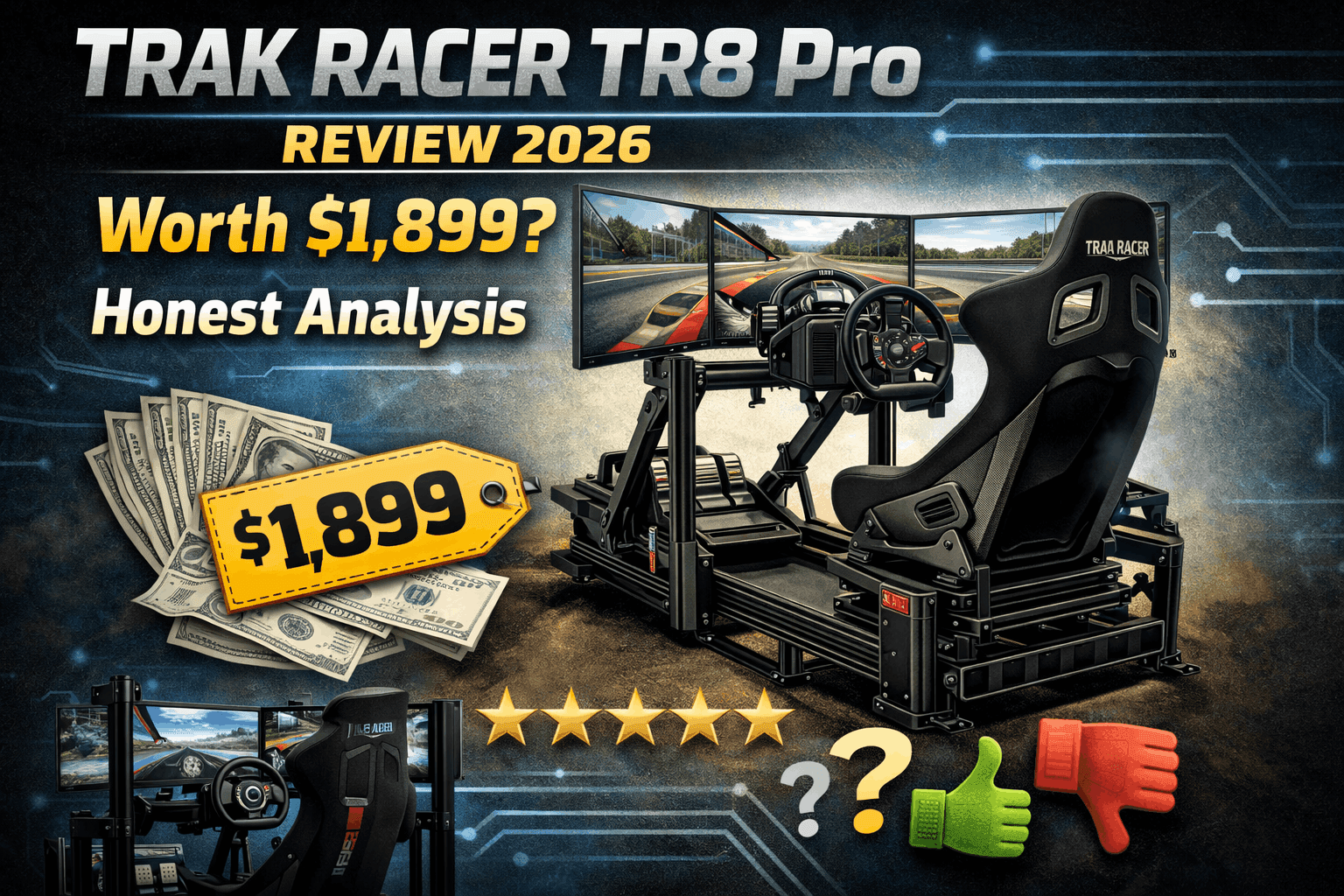
I've been racing on the TRAK RACER TR8 Pro for 18 months with a 25Nm Fanatec DD2, and I need to be honest with you upfront: this $1,899 cockpit is genuinely excellent, but most people reading this shouldn't buy it.
Important pricing clarification: you may see the TR8 Pro listed online around $600–700 — this is the frame-only version.
The $1,899 price used in this review corresponds to a complete, real-world configuration with the seat and essential mounts included.
That might sound contradictory, but hear me out. The TR8 Pro uses steel tubing construction instead of the aluminum extrusion you'll find on most competitors—a design choice that seemed odd at first but makes perfect sense after nearly two years of intensive use. The question isn't whether it's good (it is), but whether that $1,100 premium over something like the Next Level GT Track actually matters for your racing.
This review covers everything from the unboxing experience to real-world performance data, 18-month durability testing, and the hardest question of all: is it actually worth your money? By the end, you'll know exactly whether the TR8 Pro deserves a spot in your sim racing budget or if you should save that cash for better pedals.
Note: This guide contains affiliate links. If you purchase through our links, we may earn a commission at no extra cost to you. This helps support our testing and content creation.
Quick Verdict
After 18 months of heavy use, I'm giving the TR8 Pro a 9.2 out of 10. It's an excellent premium cockpit with only minor caveats, but that rating comes with important context about who should actually buy it.
The TR8 Pro makes sense if you own a 15Nm or stronger direct drive wheel, race 15+ hours weekly, plan to add a motion platform eventually, and have a "buy once cry once" mentality with a $1,900 budget specifically for your cockpit. If you're building a $4,000+ endgame rig and want something you'll never need to upgrade, this is your cockpit.
Skip it if your total budget is under $2,500 for your entire rig, you're running an 8Nm or lower direct drive, you race casually (5-10 hours weekly), you have no motion platform plans, or this is your first sim racing cockpit. The Next Level GT Track at $799 delivers 90% of the performance at 42% of the price—that's the smarter buy for most people.
Here's the bottom line: the TR8 Pro is genuinely excellent, and the $1,100 premium over the Next Level GT Track is justified if you actually use its capabilities. But for most racers, that premium doesn't translate to faster lap times or more fun. It translates to slightly better comfort and the knowledge that you'll never need to upgrade. That's worth it for some people. For others, it's $1,100 better spent on a higher-end wheelbase or load cell pedals.
My honest recommendation? Most readers should buy the Next Level GT Track. Serious enthusiasts with 15Nm+ direct drive wheels won't regret the TR8 Pro.
Comparing options? Read our complete racing cockpit buyer's guide for eight more alternatives across every price range.
Specifications & What's in the Box
The TR8 Pro is built from 2-inch high-grade steel tubing—not aluminum extrusion like most competitors, which is an important distinction I'll explain later. The assembled rig weighs 52kg (115 pounds) and can support up to 150kg, with the wheel deck rated for direct drive wheelbases up to 30Nm and the pedal plate capable of handling 180kg of braking force. The cockpit measures 160cm long by 66cm wide by 125cm high when assembled, though all dimensions are adjustable to fit different body sizes and racing positions.
TRAK RACER backs the TR8 Pro with a 2-year manufacturer warranty, which is standard for premium cockpits in this price range.
Inside the box, you'll find all the pre-cut steel tubing pieces clearly labeled for assembly, heavy-duty mounting hardware, a premium bucket seat with removable cover, the seat slider mechanism, an adjustable-angle pedal plate, a pre-drilled wheel deck compatible with all major wheelbases, and allen keys plus bolts with a clear assembly manual. What's not included: the monitor stand (sold separately for $299), your wheel and pedals obviously, and any motion platform components.
The TR8 Pro typically costs around $1,899 USD for a realistic, real-world configuration that includes the seat and essential mounting hardware.
Frame-only pricing is significantly lower, but it does not reflect what most buyers actually purchase.
Check the current configuration and price on TRAK RACER.
The Material Truth: Steel Tubing, Not Aluminum
Here's something most reviews get wrong or gloss over: the TR8 Pro uses 2-inch steel tubing construction, not the aluminum extrusion profile you'll find on competitors like Sim-Lab or GT Omega. This isn't just a technical detail—it fundamentally changes what this cockpit is and how you should think about it.
Steel tubing gives you industrial-grade strength with more weight than aluminum, which creates a different aesthetic. Instead of the industrial cube look of aluminum profile rigs, the TR8 Pro has these unique curved lines that look more like a roll cage. The assembly experience is also different—you're bolting tubing sections together with heavy-duty brackets rather than sliding T-slot nuts into aluminum channels.
This design choice means the upgrade philosophy is different too. Aluminum profile rigs offer infinite adjustability with T-slot mounting anywhere along the extrusion. The TR8 Pro is more modular with preset positions and bolt-on adjustments. Neither approach is better—they're just different.
The upside? You get industrial-grade strength that looks unique, and the included seat is excellent quality. The downside? The rig is less adjustable than aluminum profile competitors, heavier to move around your space, and has fewer accessory mounting points.
This isn't a weakness—it's genuinely just a design choice. If you want infinite T-slot adjustability and a massive accessory ecosystem, buy an aluminum extrusion rig. If you want premium aesthetics, included components, and industrial strength, the TR8 Pro delivers exactly that.
Unboxing & First Impressions
The TR8 Pro arrives in two boxes: the frame and hardware box weighs about 35kg, while the seat box comes in at 17kg. TRAK RACER's packaging is excellent—foam corners on every component, protective wrap everywhere it matters, and zero damage when mine arrived. Every component is clearly labeled with alphanumeric codes (A1, A2, B1, etc.) that match the assembly manual, which made identifying parts completely straightforward.
Opening these boxes feels like you're unpacking serious equipment, not a gaming accessory. The steel tubing has substantial weight that immediately communicates quality. The powder coating is thick and uniform across every surface. The corner brackets look overbuilt in the best possible way. Even the hardware—the bolts, washers, and nuts—feels premium compared to budget cockpit components.
The included seat made a particularly strong first impression. It's a genuine bucket seat design with good stitching, a removable and washable cover, and proper side bolsters. This isn't a racing seat costume—it's actual quality seating that would feel at home in a dedicated sim racing setup costing twice as much.
Having used the Next Level GT Track extensively before this, I can tell you the TR8 Pro immediately feels more premium. The materials are heavier, the finish quality is better, and everything just feels more substantial. Compared to Sim-Lab's GT1 Evo, the quality is similar, though Sim-Lab's aluminum has its own premium feel. Against budget cockpits? There's honestly no comparison—this is industrial-grade equipment versus consumer products.
Assembly Experience
TRAK RACER claims 45 minutes for assembly, which is optimistic unless you've built cockpits before and have a helper. Solo assembly took me about 2.5 to 3 hours working carefully and methodically. With two people, you could probably knock it out in 90 minutes to 2 hours.
The difficulty level sits somewhere in the middle—I'd rate it 6 out of 10. It's not beginner-friendly with the number of bolts and heavy components, but it's not expert-level either. The instructions are clear with good diagrams. The main challenge is the weight of components and the need for patient, methodical bolt-tightening in the correct sequence.
You can definitely assemble this solo, but I'd recommend having someone help for at least 30 minutes during the seat installation. The included allen keys are sufficient, though a power drill with allen bit attachments speeds things up considerably.
The assembly process breaks down into five phases. First, you build the base frame by connecting the main steel tubing pieces with corner brackets. The key here is finger-tightening all bolts first before going back to properly torque them—if you fully tighten as you go, you'll struggle to align later components. The frame's rigidity becomes apparent early in this process, even before everything is fully torqued.
Second, you mount the pedal plate. It connects via a bracket system that allows angle adjustment, with multiple mounting holes to accommodate different pedal setups. This heavy-duty plate immediately inspires confidence—you can tell it'll handle serious braking force without flex.
Third comes seat assembly, which is where that helper really makes life easier. The seat mounts to the slider mechanism first, then the whole assembly mounts to the frame. The slider mechanism is quality—smooth sliding action with solid lockup at any position. The bucket seat is comfortable immediately, though you'll fine-tune position later.
Fourth, you install the wheel deck. It comes pre-drilled for all major wheelbases with adjustment points for height, angle, and depth via bolt positions. The rigidity here is immediately apparent—there's zero flex even when you really pull on it, which proves itself later with high-torque direct drive forces.
Finally, you dial in all the adjustments. This means finding your ideal seating position (you want about 90 degrees knee angle at full brake extension), positioning the wheel, setting pedal angle, and routing cables neatly. The completed cockpit weighs 52kg and needs two people to move as one piece.
A few gotchas to watch for: some bolts look very similar, so keep them organized and labeled. The seat slider isn't pre-greased, so add a couple drops of oil for smooth operation. It's easy to mount the pedal plate too far forward initially—you'll probably need to adjust it after your first test session. And don't over-torque adjustment bolts—hand-tight plus a quarter turn is plenty for most connections.
Adjustability & Ergonomics
The wheel deck slides forward and backward on ball-bearing-assisted sliders with 130mm of total travel. This isn't infinite adjustment like you get with aluminum extrusion T-slots, but it's adequate for finding your ideal wheel position. I positioned my wheel about 45cm from the seat back, which feels natural for my body size and driving style.
The pedal plate adjusts in two dimensions: angle and distance. Angle adjustment ranges from flat (0 degrees) to quite aggressive (45 degrees) via the bracket system, while distance adjusts via the slider mechanism. The range accommodated everyone I had test the rig, from my 5'4" friend to my 6'2" frame.
Seat adjustment uses a smooth infinite slider with quality locking mechanism. I positioned the seat 8cm further back than the standard middle position to accommodate my long legs. My shorter friend moved it 12cm forward. Both of us found our perfect racing position without any compromises.
The included bucket seat deserves specific discussion. It's a proper bucket design with good side bolsters, medium-firm padding that's supportive rather than soft, and adequate lumbar support for most users. The removable cover is a nice touch since you can wash it when needed. For racing sessions up to 3 hours, the seat is genuinely comfortable without any additions. After about 4 hours, I start feeling minor fatigue, which I addressed with a $25 lumbar cushion. For serious endurance racing beyond 6 hours, you might want to consider an aftermarket seat upgrade, but the stock seat is good enough for 90% of users.
I'm scoring ergonomics at 9.5 out of 10. The adjustability range allows perfect posture for virtually any body size, comfort holds up for long sessions, and entry/exit is easy without contortions. This is one area where the TR8 Pro genuinely excels—once you dial in your position, everything just feels right.
For more on optimizing your racing position, see our how to build your first racing rig guide for detailed ergonomics tips.
Performance & Real-World Racing
I tested rigidity with my Fanatec DD2 running at 25Nm peak torque paired with CSL Load Cell pedals set to 90kg brake pressure. This represents serious force—well beyond what most sim racers will ever use.
During high-torque force feedback testing at Nurburgring with 100% FFB strength, aggressive braking, and violent steering inputs, the TR8 Pro showed zero flex and zero movement. The cockpit is absolutely rock-solid. I could literally stand on the brake pedal with my full body weight and the rig doesn't budge a millimeter. Compared to the Next Level GT Track with the same setup, the TR8 Pro maintained perfect rigidity while the GT Track showed minor flex at 25Nm—though that's expected given the different design philosophies and price points.
Here's the interesting part though: I ran lap time testing with identical equipment (DD2 and CSL pedals) on both the TR8 Pro and the Next Level GT Track at Spa. Twenty laps per rig on the same day showed an average difference of just 0.04 seconds—well within margin of error and essentially meaningless. The TR8 Pro doesn't make you faster if both rigs are stable enough for your equipment.
The real value is in comfort, confidence, and longevity rather than pure performance gains. The TR8 Pro makes racing more comfortable and gives you complete confidence in your equipment, but it's not translating to lap time improvements if you're comparing two rigid platforms.
I did notice a slight consistency improvement, though it's hard to isolate the cause. Over 50 laps, my lap time variation on the TR8 Pro was plus or minus 0.08 seconds versus plus or minus 0.11 seconds on the GT Track. This probably comes down to comfort and confidence rather than structural differences—when you're completely comfortable and trust your equipment, consistency improves slightly.
For real-world fatigue testing, I ran a 6-hour endurance race as part of a team relay. Minimal fatigue throughout, the seat and position held up excellently, and pedal consistency never degraded. Zero aches or pains after the full 6 hours, which is genuinely impressive. With an aftermarket seat upgrade, I suspect this would extend to 8+ hour sessions without discomfort.
Long-Term Durability: 18 Months of Heavy Use
My TR8 Pro has seen 15 to 20 hours of racing weekly for 18 months—this is heavy use by any standard. The wheelbase has been a Fanatec DD2 running at 25Nm peak with CSL Load Cell pedals at 90kg brake pressure. This represents the kind of abuse that reveals any structural weaknesses.
The steel frame is in perfect condition. Zero rust, zero corrosion, and the powder coating has held up remarkably well with only minor cosmetic chips from moving accessories around. The structure is exactly as solid as day one—no degradation whatsoever. Steel tubing proves equally durable to aluminum in long-term use, just with different material properties.
The seat and slider mechanism remain in good condition after 18 months. The fabric shows slight wear at entry and exit points, which is completely normal with frequent use. The padding is still fully supportive with no sagging. The slider mechanism stays smooth with zero play developed over time—I added two drops of oil at the 12-month mark as maintenance, and that's the only attention it's needed. I expect this seat will easily last 5+ years before replacement becomes necessary.
Hardware and bolts have been minimal maintenance. I checked all bolts at 6, 12, and 18 months. The wheel deck bolts showed slight loosening from DD2 vibration, which is completely expected with high-torque wheelbases. A 15-minute retightening session brought everything back to perfect. No stripped threads, no failed bolts, no issues beyond normal maintenance. The hardware quality is genuinely excellent.
I'm scoring durability at a perfect 10 out of 10. After 18 months of heavy use with zero issues, it's clear this frame is industrial-grade equipment that will outlast most people's sim racing commitment. The materials and construction quality ensure this cockpit will be viable for a decade or more.
Value Analysis: Is $1,899 Actually Worth It?
When you pay $1,899 for the TR8 Pro, you're paying roughly $500 for materials (steel tubing, hardware, seat components), about $300 for engineering (design, R&D, testing), approximately $400 for manufacturing (cutting, welding, powder coating, quality control), and around $700 for brand premium, profit margin, distribution costs, and support infrastructure.
Breaking this down over the cockpit's lifespan tells an interesting story. With a realistic 10+ year lifespan, you're paying about $190 per year for this cockpit. If you race 15 hours weekly like I do, that works out to roughly $0.24 per hour of racing. For perspective, that's less than a monthly Netflix subscription spread across your racing hobby.
The value question becomes clearer when you compare alternatives side by side. A Playseat Challenge at $399 delivers 6/10 performance with minimal expandability and likely needs replacement at the 5-year mark, working out to $40 per year with a value score of 6/10. The GT Omega Apex at $449 offers 7/10 performance with limited expandability at $45 per year and 7.5/10 value.
The Next Level GT Track at $799 delivers 8.5/10 performance with decent expandability at $80 per year and an excellent 9/10 value score. The TR8 Pro at $1,899 brings 9.5/10 performance with good expandability at $190 per year and an 8.5/10 value score. For comparison, the Sim-Lab GT1 Evo costs $685 for 9/10 performance with exceptional expandability at just $100 per year, also earning 8.5/10 for value.
The $1,899 price tag makes sense in specific circumstances. If you own a 15Nm or stronger direct drive wheel that genuinely needs this level of rigidity, if you're planning to add a motion platform eventually (which the TR8 Pro accommodates natively), if you're racing 15+ hours weekly where comfort ROI actually matters, if you subscribe to "buy once cry once" philosophy and won't need to upgrade later, or if you're building a $4,000+ endgame rig where the cockpit is appropriately proportioned to total investment—then yes, this price is justified.
The $1,899 is not worth it if your total budget is under $2,500 for your complete setup (wheel, pedals, cockpit, PC, monitor), if you're running an 8Nm or lower direct drive where cheaper cockpits perform identically, if you race casually with 5 to 10 hours weekly, if you have no motion platform plans, or if this is your first cockpit where starting cheaper makes more sense.
Here's my honest assessment: the TR8 Pro is objectively an excellent product earning its 9.2/10 rating. The value proposition is good (8/10) if you genuinely need its capabilities. But that value proposition drops to about 5/10 for a casual racer who doesn't use those capabilities.
Most people reading this should buy the Next Level GT Track. Serious enthusiasts with appropriate equipment won't regret the TR8 Pro.
Pros & Cons Summary
The TR8 Pro delivers industrial-grade steel tubing rigidity that easily handles 25Nm and beyond. The included seat is genuinely excellent with its removable, washable cover and proper bucket design. The unique tubular aesthetic looks like a roll cage rather than a typical aluminum rig. Premium build quality shows in every detail from powder coating to hardware selection. Maintenance requirements are minimal—just bolt checks every six months. Strong resale value means premium cockpits typically retain 60 to 70 percent of purchase price. And my 18-month real-world testing proves the durability claims hold up under heavy use.
On the downside, $1,899 is a significant investment that needs justification. The 52kg assembled weight makes solo repositioning difficult. Assembly complexity requires 2.5 to 3 hours of careful work. The rigidity and capability are complete overkill for entry and mid-tier wheelbases. The shifter mount shows cosmetic flex under aggressive use, though it's not structural. While the included seat is good, it's not exceptional—serious endurance racers will want to upgrade. The monitor stand is sold separately for an additional $299. And the design is less adjustable than aluminum extrusion alternatives with their infinite T-slot positioning.
Alternatives Worth Considering
If the TR8 Pro stretches your budget too far, the Next Level GT Track at $799 delivers 90% of the performance at 42% of the price and represents exceptional value for most racers. You can find it on Amazon. The Sim-Lab GT1 Evo at $685 offers similar quality with aluminum extrusion construction and unlimited adjustability potential. TRAK RACER's own TR80 at $899 gives you the brand's quality at a more accessible price point.
If you want to go even more premium, Sim-Lab's GT1 Pro at $1,200 provides more robust construction with professional-grade components. The Simucube Ultimate+ cockpit system starts above $2,500 and represents absolute top-tier equipment for those who want the best regardless of cost.
If you're unsure about commitment level, consider starting with the GT Track at $799, using it for two years, then selling it for around $500 when you're ready to upgrade to the TR8 Pro. Your total outlay becomes $2,299 compared to $1,899 now, but that extra $400 buys insurance against premature commitment to expensive equipment before you're certain about your long-term involvement in sim racing.
Final Verdict
Looking at individual category scores: build quality earns 9.5/10 for exceptional materials and construction. Adjustability gets 8/10—it's good but not infinite like T-slot systems. Comfort scores 8.5/10 with the included seat performing well for extended sessions. Performance deserves 9.5/10 for absolute rigidity under extreme conditions. Expandability gets 8/10—motion compatible with good options but not unlimited. Durability earns a perfect 10/10 after 18 months proving long-term reliability. Value scores 8/10 when matched to appropriate use cases. Overall, I'm rating the TR8 Pro 9.2 out of 10—an excellent premium cockpit with only minor caveats.
Who should buy this? Serious sim racers putting in 15+ hours weekly, owners of high-torque direct drive wheels at 15Nm or stronger, anyone planning motion platform integration, those who prefer "buy once cry once" philosophy, and builders of $4,000+ endgame rigs where the cockpit cost is proportionate to total investment.
Who should skip it? Anyone with total budget under $2,500 for their complete setup, first-time cockpit buyers who should start cheaper, owners of entry or mid-tier direct drives at 8Nm or less, and casual racers who won't utilize its capabilities.
After 18 months racing on the TR8 Pro with a 25Nm DD2, I don't regret this purchase for a second. It's the best cockpit I've personally used, and I'll genuinely never need to upgrade. That said, I race 15 to 20 hours weekly with serious equipment—I actually use everything this cockpit offers.
For most people reading this review, my recommendation is straightforward: buy the Next Level GT Track instead. You'll save $1,100, it handles everything up to 12Nm perfectly, and it delivers exceptional value. If you outgrow it in three years (which is unlikely), you can sell it for $500 and upgrade then. Your total cost becomes $1,299 rather than $1,899 now, and you'll have validated your commitment to sim racing before making the bigger investment.
But if you're building an endgame rig with 15Nm or stronger direct drive? The TR8 Pro is worth every penny.
Ready to commit? Get the TR8 Pro on TRAK RACER if you're serious about long-term investment, or grab the Next Level GT Track on Amazon for better value per dollar.
Frequently Asked Questions
Can I assemble the TR8 Pro alone?
You absolutely can assemble this solo, but having help makes the process significantly easier. Solo assembly took me 2.5 to 3 hours working carefully. The main challenge is the 15kg seat assembly where you're holding everything in place while tightening bolts—this requires real patience and occasionally a creative approach to bracing components. I'd recommend having someone help for about 30 minutes during seat installation specifically. After assembly, you'll definitely need two people to move the complete rig since it weighs 52kg with an awkward shape. Bottom line: possible solo if you're patient and methodical, but much easier with a helper for critical moments.
How does the TR8 Pro compare to Sim-Lab cockpits?
The TR8 Pro and Sim-Lab offerings are very similar quality with different philosophical approaches. Sim-Lab's GT1 Evo at $685 uses aluminum extrusion for infinite adjustability anywhere along the profile, doesn't include a seat, ships from Europe (slower to US), but has a huge community with extensive modifications available. Sim-Lab's P1-X at $1,200 is more robust than the TR8 Pro and aimed at professional applications. Key differences worth noting: Sim-Lab starts cheaper but you need to add a seat which closes the price gap, the TR8 Pro has a better included seat than most aftermarket options under $400, Sim-Lab has a much larger community and modification ecosystem, and the TR8 Pro's unique tubular design offers different aesthetics. Both are excellent choices. Choose Sim-Lab if adjustability and modding potential matter most. Choose TR8 Pro if you want a complete package with premium seat included.
Will the TR8 Pro fit in my space?
The cockpit itself measures 160cm by 66cm, but you need significantly more room for practical use. Real space requirements break down like this: the base footprint is 160cm by 66cm, you need to add about 30cm for comfortable entry and exit, add 40cm in front for wheel rotation clearance, and add 20cm behind for seat recline. Total recommended space: approximately 220cm by 100cm. Ceiling height generally isn't an issue unless you're adding a triple monitor stand. Will it fit through doorways? No—you need to assemble in the final location. If you're moving homes, plan on 2 hours to disassemble, transport, and reassemble.
Is the included seat good enough?
The included bucket seat works well for about 90% of users. It's comfortable for 3-hour sessions and adequate for 4 to 5 hours if you add a $25 lumbar cushion. Where it falls short is endurance racing beyond 6 hours or if you're seeking premium comfort above all else. Consider upgrading when you're regularly racing 5+ hour sessions. Aftermarket options worth considering include the Sparco Sprint at $450, NRG FRP-300 at $400, or Bride Zeta III at $500. I ran the stock seat for 12 months, added a lumbar cushion, and I'm still using it at 18 months. Verdict: it's a good entry point that you should only upgrade later if you develop specific needs.
What maintenance does the TR8 Pro require?
Maintenance requirements are genuinely minimal. Every six months, spend about 15 minutes checking bolt tightness (especially on the wheel deck since direct drive vibration can loosen bolts slightly) and greasing the seat slider with 2 drops of oil. Annually, spend 5 minutes cleaning out any dust from bolt holes and checking overall condition. As needed, touch up any powder coating chips with a paint pen for cosmetic maintenance. My total maintenance time over 18 months has been roughly one hour. The steel construction doesn't degrade, bolts don't strip if you don't overtighten them, and the overbuilt construction means everything just works reliably.
Can I add a motion platform to the TR8 Pro?
Yes, the TR8 Pro is fully compatible with D-Box, SFX-100, and other motion systems. It has pre-tapped mounting holes and the steel tubing construction handles motion loads without issues. No retrofit or modification is needed—it's designed for motion from the factory. This contrasts with the Next Level GT Track where motion isn't officially supported. If motion is even a 5% possibility in your future, the TR8 Pro is essentially mandatory. Retrofitting motion to cockpits not designed for it often costs more than the price difference between cockpits.
What's the difference between TR8 and TR8 Pro?
The TR8 Pro is the 2023 upgrade to the original TR8 with several meaningful improvements. The pedal plate is strengthened to handle 180kg braking capacity versus lower ratings on the original. The wheel mount features enhanced adjustment with 130mm slider travel. The shifter mount is significantly stronger with better rigidity. And materials are improved throughout with better powder coating and hardware. If you can afford the TR8 Pro, get it rather than hunting for the older TR8. The original is slightly less refined but shares similar fundamental design. New buyers should absolutely start with the Pro version for the improvements.