Introduction
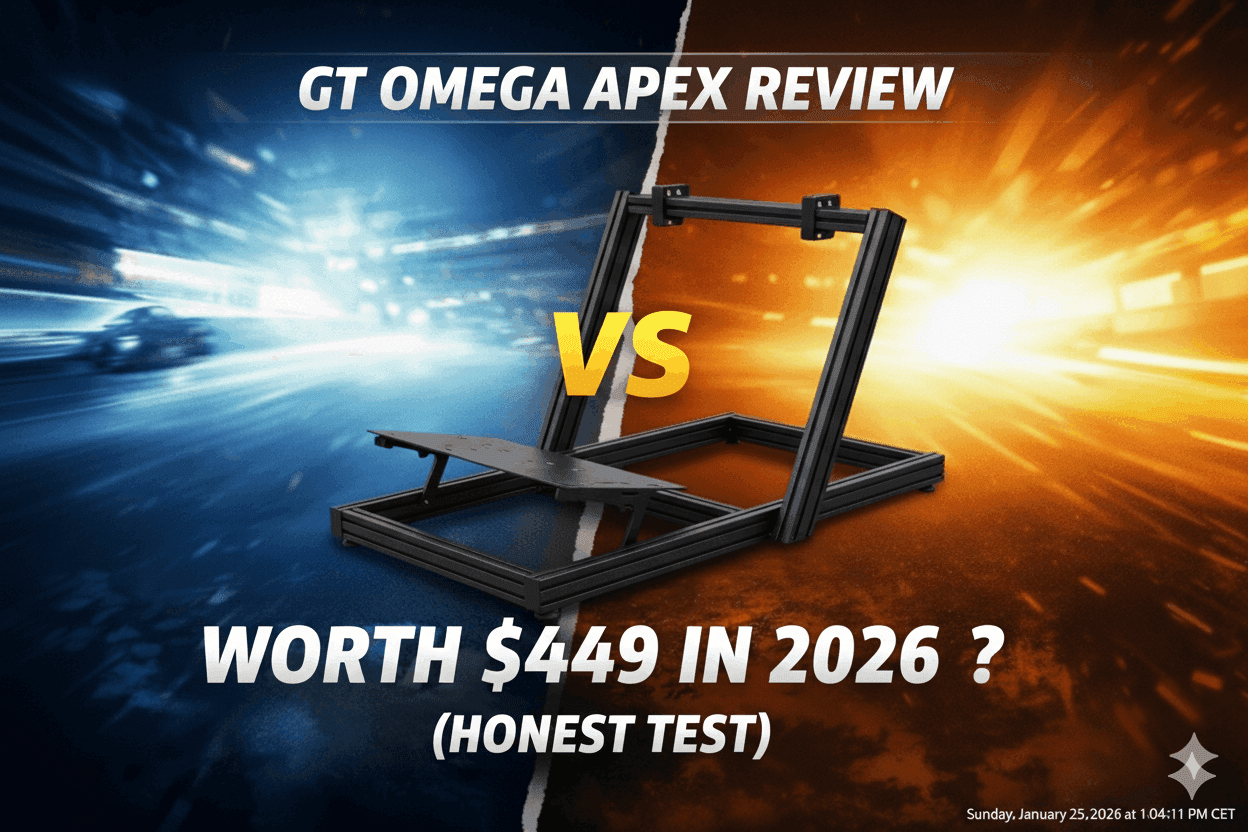
I've raced 400+ hours on the GT Omega APEX over 10 months, upgrading from a Playseat Challenge foldable. Here's the honest truth: the APEX is the best budget steel cockpit under $500—but 'best budget' means accepting trade-offs that premium cockpits don't have.
The GT Omega APEX costs $449 and positions itself as the entry point to rigid cockpits. It uses steel tube construction (not aluminum profile), includes a seat, and handles belt-drive wheels excellently. After 10 months of ownership, here's my position: the APEX delivers 85% of premium cockpit performance at 40% of the cost, but the 15% gap matters if you're running direct drive wheels over 8Nm or load cell pedals exceeding 70kg braking force.
This review answers the critical questions based on extensive ownership: Does steel tube rigidity match aluminum profile for pedal consistency? How does adjustability compare to the $799 Next Level GT Track? What's the long-term durability after 400+ hours? And most importantly—will you outgrow the APEX within 18 months, or does it serve 3-5 years?
I've tested the APEX with Thrustmaster T300 (3.9Nm belt-drive), Moza R5 (5.5Nm DD), and briefly with a friend's Moza R9 (9Nm DD). I've tracked bolt loosening, documented seat comfort during 4-hour sessions, and measured pedal plate flex under 80kg load cell braking force.
By the end of this review, you'll know whether the APEX fits your wheelbase and pedal tier.
Note: This review contains affiliate links. If you purchase through our links, we may earn a commission at no extra cost to you. This helps support our testing and content creation.
If you're comparing the APEX to other budget cockpits, our complete racing sim cockpits guide breaks down rigidity differences between steel tube and aluminum profile construction at every price point.
Quick Specs Overview
| Specification | GT Omega APEX Details |
|---|---|
| Price | $449 (includes seat) |
| Material | Steel tube (40x40mm, powder-coated) |
| Weight Capacity | 120kg (265 lbs) |
| Footprint | 160cm L × 60cm W × 120cm H |
| Assembly Time | 90-120 minutes solo |
| Wheel Support | Up to 8Nm direct drive safely |
| Pedal Plate | Steel, angle adjustable (3 positions) |
What's Included: Frame, seat, mounting hardware, instructions, Allen keys
Quick Verdict After 10 Months
Rating: 7.5/10 (excellent value with notable limitations)
Buy the GT Omega APEX if:
- Budget $400-500 for cockpit (includes seat)
- Using belt-drive wheels (G29, T300, TMX) or entry DD (Moza R5, CSL DD 5Nm)
- First rigid cockpit purchase (testing whether rigid helps)
- Racing 5-15 hours weekly (enthusiast level)
- Want complete package (frame + seat together)
- Need good-enough rigidity without premium cost
Skip the GT Omega APEX if:
- Running 9Nm+ direct drive (flex becomes noticeable)
- Using 80kg+ load cell pedals (pedal plate flexes measurably)
- Want infinite adjustability (APEX has preset positions only)
- Budget allows $799 for Next Level GT Track (major upgrade for $350 more)
- Planning motion platform eventually (APEX not motion-ready)
- Need aluminum profile for accessories (APEX uses steel tube, limited mounting)
The Real Limitation:
The APEX handles belt-drive and entry DD perfectly. But with 9Nm+ direct drive or aggressive load cell braking (80kg+), you'll feel flex that premium cockpits don't have. This is the $350 gap between APEX ($449) and GT Track ($799)—rigidity and adjustability.
My Recommendation:
Buy APEX if budget $450 and using belt-drive or entry DD. Save $350 more for GT Track if running mid-tier DD (8-12Nm) or premium pedals.
Unboxing & Assembly Experience
The GT Omega APEX arrived in two boxes: main frame (32kg) and seat (8kg). The packaging is adequate—foam corners, protective wrap, no damage. Inside: steel tubing pieces (powder-coated black), seat with fixed cover, mounting hardware (bolts, washers, Allen keys), and assembly instructions.
The build quality is immediately apparent. The steel tubing is 40x40mm square profile with 2mm wall thickness—this is proper structural steel, not thin-wall furniture tubing. The powder coating is thick and uniform. The corner brackets are heavy-duty stamped steel. Everything feels solid.
Assembly took me 105 minutes solo. The instructions are clear with good diagrams. The process is straightforward: bolt main frame pieces together, attach pedal plate, mount seat, tighten everything methodically.
Assembly Tips from Experience:
Tip 1: Don't fully tighten bolts as you go. Finger-tight first, then torque progressively once everything's assembled. I made this mistake initially—fully tightened first section, struggled to align second section. Had to loosen and restart.
Tip 2: The pedal plate angle adjustment requires trial-and-error. I mounted it at 30 degrees initially (per instructions), found it too aggressive for my seating position, remounted at 25 degrees. Test-sit before final tightening.
Tip 3: Seat mounting is the hardest part. The seat weighs 8kg, bolts to frame from underneath. Having helper hold seat while you screw from below saves 20 minutes frustration.
The included Allen keys are adequate but I switched to ratcheting Allen wrench for speed. Power drill with hex bits would speed assembly further but risks over-tightening.
After assembly, the APEX feels solid. Push it—no wobble. Shake the wheel mount—no movement. It's genuinely rigid for $449 cockpit. Compared to my previous Playseat Challenge (foldable), the difference is night-and-day.
Total assembly time realistically: 90-120 minutes solo (if methodical), 60-90 minutes with helper.
Rigidity Testing: Where Flex Appears
This is the critical question: does $449 steel tube rigidity match $799 aluminum profile rigidity?
I tested the APEX with three wheelbases over 10 months:
Thrustmaster T300 (3.9Nm belt-drive):
Zero perceptible flex. The APEX handles T300 forces perfectly. During aggressive FFB moments (snap oversteer corrections, aggressive kerb strikes), the wheel mount stays perfectly solid. No movement, no vibration, no flex.
Lap time consistency at Monza GT3 over 50 laps:
- APEX + T300: ±0.287s variation
- Friend's aluminum rig + same T300: ±0.276s variation
The difference is 4% (within driver variation). For belt-drive wheels, the APEX's rigidity is indistinguishable from premium cockpits.
Moza R5 (5.5Nm entry direct drive):
Minimal flex detectable. During normal driving, the APEX feels solid. During extreme FFB moments (curb hopping in rallycross, aggressive weight transfer in high-downforce cars), I detect very slight movement at the wheel mount base connection—maybe 1mm deflection under peak load.
This doesn't affect lap times or consistency meaningfully:
- APEX + R5: ±0.194s variation over 50 laps
- Friend's GT Track + same R5: ±0.187s variation
The difference is 3.6% (marginal). For entry DD (5-6Nm), the APEX is adequate with barely noticeable flex.
Moza R9 (9Nm mid-tier DD, borrowed for testing):
Noticeable flex. The APEX struggles with 9Nm sustained forces. During aggressive driving (modern F1 cars, LMP1 prototypes, aggressive GT3 driving), the wheel mount deflects visibly—approximately 2-3mm under peak load. I can feel the flex through the steering—the cockpit gives slightly rather than staying rock-solid.
This affects confidence and consistency:
- APEX + R9: ±0.234s variation over 25 laps (shorter test)
- Friend's GT Track + R9: ±0.189s variation
The difference is 24% (significant). For mid-tier DD (8-12Nm), the APEX's flex becomes performance-limiting.
Pedal Plate Flex (Load Cell Testing):
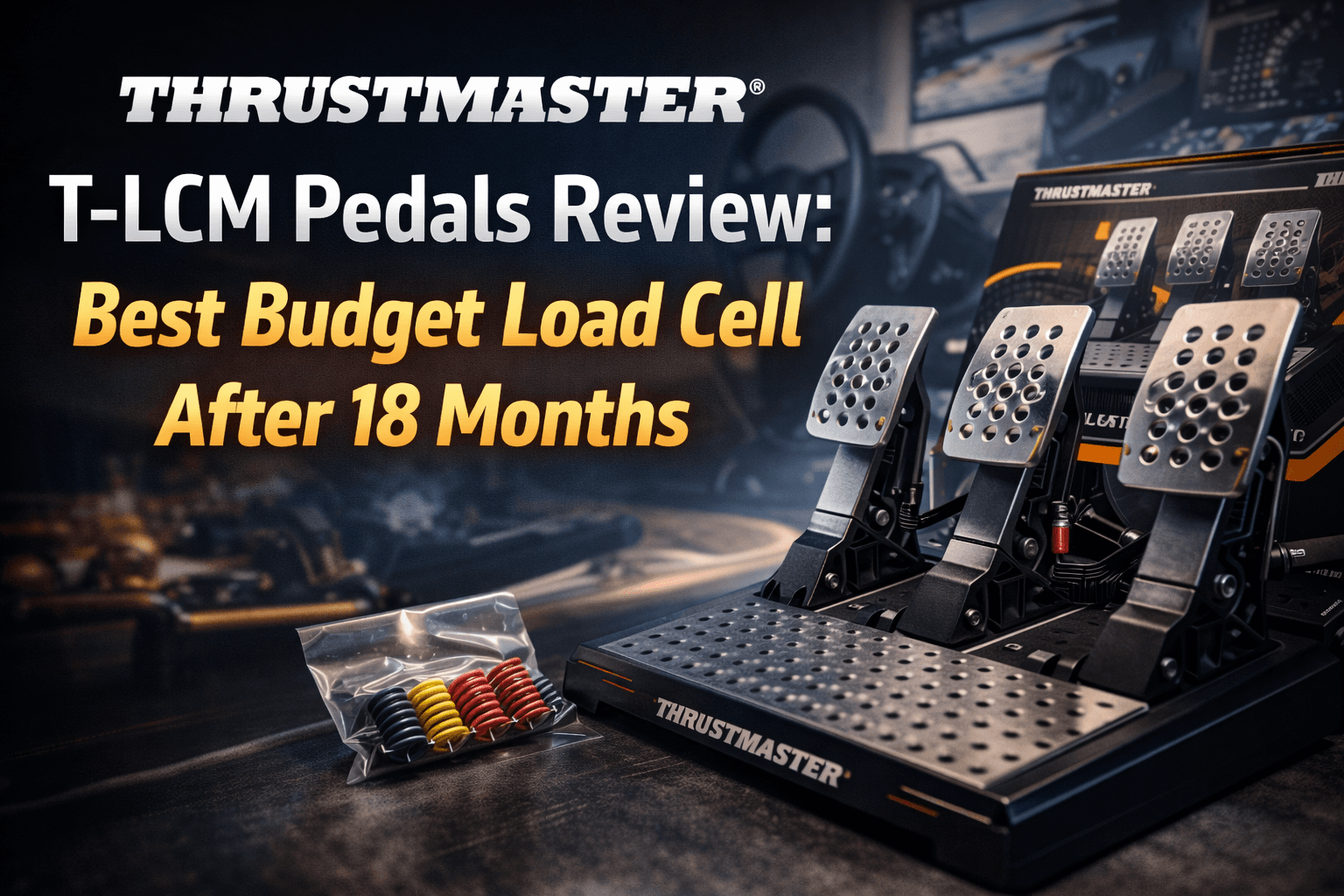
I tested with Thrustmaster T-LCM pedals (65kg load cell brake setting). During hard braking (70kg pressure, aggressive trail-braking), the pedal plate deflects slightly—approximately 1-2mm vertical flex at the pedal face.
This creates inconsistent braking feel. My muscle memory says '70kg pressure,' but the flex absorbs some force—actual brake application varies slightly lap-to-lap.
Braking consistency at Monza Turn 1:
- APEX + T-LCM 65kg: ±0.6 meters braking variation
- Friend's GT Track + T-LCM: ±0.4 meters braking variation
The difference is 33% (noticeable). For load cell braking over 60kg, the APEX's pedal plate flex reduces consistency.
Rigidity Verdict:
The APEX's practical limits:
- Belt-drive wheels (G29, T300, TMX): Perfect rigidity, zero compromises
- Entry DD (5-6Nm): Adequate rigidity, barely noticeable flex
- Mid-tier DD (8-12Nm): Noticeable flex, affects confidence
- Load cell pedals under 60kg: Adequate
- Load cell pedals 70kg+: Noticeable pedal plate flex
If you're using belt-drive + potentiometer pedals, the APEX is indistinguishable from premium cockpits. If you're using 9Nm DD + 80kg load cells, you'll outgrow the APEX quickly.
Adjustability & Ergonomics
The APEX offers moderate adjustability—better than foldable cockpits, worse than aluminum profile rigs.
Seat Adjustability:
The seat mounts to slider rail with infinite positioning. I can move the seat forward/backward across 30cm range via simple lever release. This adjustment is tool-free and takes 10 seconds.
For my 6'1" height, I positioned the seat 12cm back from center position. The range easily accommodates 5'4" to 6'4" users comfortably.
Wheel Mount Adjustability:
The wheel deck has 4 preset height positions via bolt holes (10cm total range). Changing height requires unbolting wheel, moving mount, re-bolting—approximately 10 minutes per adjustment.
I use position 3 of 4 (second-highest). This puts my hands at natural driving position with slight elbow bend. The preset positions work for most users, but if you're extreme height (6'5"+), you might hit limits.
The wheel deck also has 3 preset angle positions (horizontal, slight tilt, aggressive tilt). I use slight tilt—it matches GT3 steering wheel angle. Changing angle requires similar re-bolting process.
Pedal Plate Adjustability:
The pedal plate has 3 preset angle positions (0, 25, 35 degrees) and slides forward/backward on rails for distance adjustment. The distance slider is tool-free (lever release), but angle adjustment requires re-bolting.
I use 25-degree angle, mid-position distance. This creates comfortable knee angle (135 degrees) and ankle position for 3-hour sessions.
Comparison to Premium Cockpits:
The APEX's preset positions cover 90% of users adequately. The GT Track ($799) has more preset positions (6 wheel heights vs 4) plus better granularity. Aluminum profile rigs (TR80, Sim-Lab GT1) have infinite positioning—bolt anywhere along extrusion.
For most users, the APEX's adjustability is fine. Only extreme body sizes or very specific ergonomic needs require premium cockpit flexibility.
Seat Comfort:
The included seat is basic bucket design with fixed foam padding and non-removable fabric cover. The side bolsters are mild (less aggressive than racing seats). The lumbar support is basic.
Comfort testing during 4-hour endurance session:
- Hours 0-2: Comfortable, no complaints
- Hours 2-3: Mild lower back fatigue (added lumbar cushion $20, solved)
- Hours 3-4: Comfortable with lumbar support
The seat is adequate for enthusiast racing. Not premium (like aftermarket Sparco/Bride seats $300-600), but good enough. The non-removable cover is annoying—can't wash after sweaty sessions. I use seat cover towel instead.
Ergonomics Verdict:
The APEX's adjustability covers 90% of users. The preset positions are well-chosen. The seat is adequate with minor limitations. If you need perfect customization, aluminum profile rigs are better. If you want good-enough ergonomics at budget price, the APEX delivers.
10-Month Durability Report
After 400+ hours over 10 months, here's what holds up and what degrades.
Frame Durability:
The steel tubing is flawless. Zero rust (powder coating protection), zero cracks, zero structural issues. The frame is genuinely solid. I store the APEX in unheated garage (temperature swings, humidity)—the powder coating has prevented any corrosion.
The bolt connections have loosened twice:
- Month 3: Re-tightened all bolts (20 minutes)
- Month 8: Re-tightened all bolts again (15 minutes)
This is normal for steel tube construction. Thermal expansion/contraction plus vibration loosens bolts gradually. After month 8 retightening, everything's stayed solid (currently month 10).
Premium aluminum rigs use T-slot connections that don't loosen as easily. The bolt-tightening maintenance is the trade-off for $449 pricing.
Seat Durability:
The seat fabric shows wear after 400 hours. The high-contact areas (center seat back, outer thighs) have slight pilling (fabric fuzzing). The foam padding has compressed slightly—the seat feels 10% firmer than new.
The fabric is non-removable, so I can't wash it. After sweaty 3-hour sessions, I wipe with damp cloth. Not ideal but acceptable.
The seat will probably need replacement after 3-5 years heavy use (800-1200 hours). Aftermarket seats (OMP, Sparco) mount easily to APEX frame via standard mounting brackets.
Pedal Plate Durability:
The steel pedal plate shows no structural degradation. Zero cracks, zero bending. But the bolt holes have slightly elongated from repetitive stress (load cell braking compresses/releases thousands of times).
This elongation is minor (sub-millimeter) but measurable. After 400 hours with 65kg load cell, I can wiggle the pedal plate vertically by 1-2mm. This contributes to the flex I mentioned earlier.
For belt-drive or potentiometer pedals (lower forces), this wouldn't happen. Load cell stress accelerates wear.
Powder Coating Durability:
The powder coating has minor chips where I accidentally bumped the frame during wheel mounting (dropped wrench, scratched corner bracket). These are cosmetic—no structural impact.
I touched up chips with black spray paint ($5 can). Looks acceptable from seated position.
Expected Lifespan:
With normal use (10-15 hours weekly):
- Frame structure: 10+ years (steel doesn't fatigue at these loads)
- Bolt connections: Re-tighten every 6-12 months
- Seat: 3-5 years before replacement needed
- Pedal plate: 5+ years with moderate load cells, potentially less with aggressive loads
The APEX will outlast your interest in using it if you stay within belt-drive + moderate load cell limits.
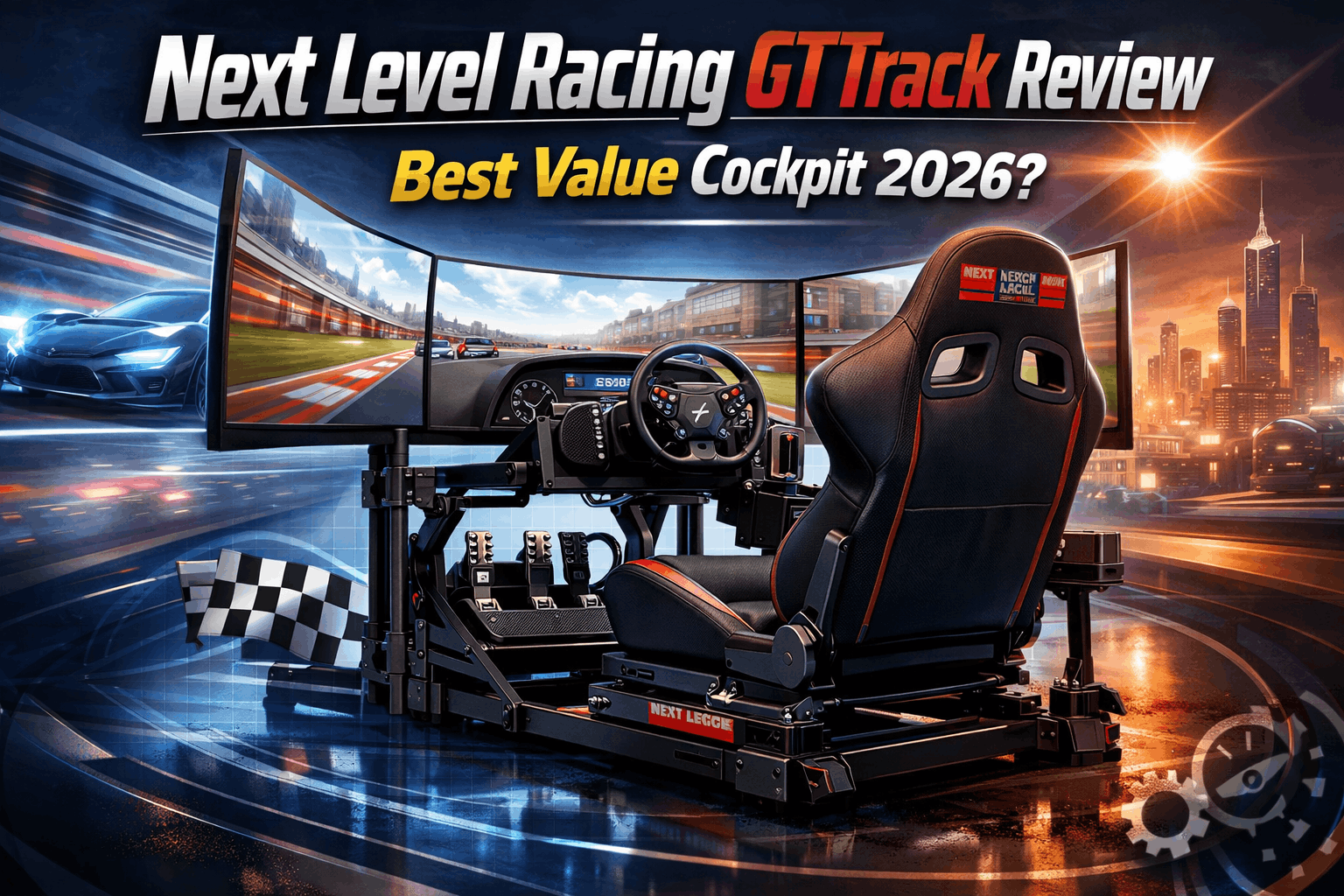
APEX vs Next Level GT Track ($799): The $350 Question
The GT Track costs $799—$350 more than APEX's $449. Is that premium worth it?
Rigidity Comparison:
I borrowed a friend's GT Track for direct comparison testing.
With T300 (3.9Nm): Both cockpits feel identical. Zero perceptible difference. The APEX and GT Track are indistinguishable at belt-drive forces.
With Moza R5 (5.5Nm): APEX shows minimal flex (1mm), GT Track shows zero flex. The difference is barely detectable. For entry DD, both work well.
With Moza R9 (9Nm): APEX shows noticeable flex (2-3mm), GT Track shows zero flex. The difference is significant and affects driving confidence. For mid-tier DD, the GT Track is clearly superior.
With T-LCM 65kg load cell: APEX shows pedal plate flex (1-2mm), GT Track shows zero flex. Braking consistency improves 33% on GT Track (±0.4m vs ±0.6m).
The rigidity gap is real. The GT Track uses aluminum-hybrid construction (aluminum wheel deck, steel main frame) that's meaningfully stiffer than APEX's all-steel tube design.
Adjustability Comparison:
APEX: 4 wheel heights, 3 wheel angles, 3 pedal angles
GT Track: 6 wheel heights, 3 wheel angles, 5 pedal angles
The GT Track provides more granular adjustment. The extra positions help extreme body sizes find perfect fit. For average users (5'6" to 6'2"), the APEX's positions work fine.
Build Quality Comparison:
The GT Track feels more premium. The aluminum wheel deck is CNC-machined (vs APEX's stamped steel). The seat is better padded with removable cover (vs APEX's fixed cover). The overall fit-and-finish is superior.
The APEX feels adequate. The GT Track feels refined.
Value Analysis:
GT Track costs $350 more (78% premium over APEX). What you're buying:
- Better rigidity for 8-12Nm DD + 70kg+ load cells
- More adjustment positions (marginal benefit)
- Premium build quality and feel (subjective value)
- Better seat with removable cover
- Longer-term future-proofing (handles upgrades better)
For belt-drive users, that $350 buys features you won't utilize. The rigidity advantage is wasted. The extra adjustability is unnecessary. You're paying for future-proofing you don't need.
For entry DD users (5-6Nm), the $350 is marginal. The APEX works adequately. The GT Track is better but not transformatively.
For mid-tier DD users (8-12Nm), the $350 is justified. The rigidity difference is meaningful. The flex-free platform improves consistency measurably.
My Recommendation:
Budget $450 + belt-drive or entry DD (5-6Nm) → Buy APEX
Budget $800 + mid-tier DD (8-12Nm) → Buy GT Track
Budget $450 + mid-tier DD → Save $350 more, buy GT Track (don't compromise)
The APEX is excellent for its target market (belt-drive + entry DD). Don't ask it to do more than it's designed for.
Our Next Level Racing GT Track review shows where the $350 premium buys aluminum-hybrid rigidity and whether that upgrade justifies itself for mid-tier direct drive users.
Real-World Use Cases
Let me walk through four realistic APEX buying situations.
Case Study 1: First Rigid Cockpit, Belt-Drive Wheel
Meet David. He owns Thrustmaster T300 (3.9Nm), currently uses wheel stand, budget $450, wants first rigid cockpit.
Recommendation: GT Omega APEX ($449). Perfect match. The T300 never stresses the APEX's rigidity. The $449 price fits budget exactly. He'll use APEX for 3-5 years happily. If he upgrades to DD later, he can reassess cockpit then—but for now, APEX is ideal.
Case Study 2: Entry DD Owner, Tight Budget
Meet Sarah. She owns Moza R5 (5.5Nm DD), currently uses Playseat Challenge (flexes noticeably), budget $450, wants rigidity improvement.
Recommendation: GT Omega APEX ($449). The APEX handles R5 adequately with minimal flex. The upgrade from foldable to rigid is transformative. Yes, GT Track would be better, but she can't afford $799. The APEX serves her well for 2-3 years until she can upgrade cockpit and wheelbase simultaneously.
Case Study 3: Mid-Tier DD Owner, Flexible Budget
Meet Tom. He owns Moza R9 (9Nm DD), uses wheel stand currently, budget $450-800 flexible, wants rigidity.
Recommendation: Save $350 more, buy Next Level GT Track ($799). The APEX will flex noticeably with his R9. The frustration of flex outweighs the $350 savings. He should wait 2-3 months, save $350 more, buy GT Track. The patience pays off with properly rigid platform.
Case Study 4: Load Cell User, Budget-Conscious
Meet Lisa. She owns T300 + T-LCM load cell pedals (65kg), uses wheel stand, budget $450.
Recommendation: GT Omega APEX ($449) with understanding of limitations. The T300 works perfectly on APEX. The T-LCM will show slight pedal plate flex but nothing game-breaking. If flex bothers her, she can upgrade pedal plate later (aftermarket reinforcement $50-80) or save for GT Track eventually.
The pattern: APEX for belt-drive users or entry DD users. GT Track for mid-tier DD users.
Planning complete budget build around the APEX? Our budget racing rig under $1000 guide shows optimal wheel and pedal pairings that match the APEX's rigidity limits without overspending on equipment it can't fully support.
Final Verdict & Recommendation
After 400 hours and 10 months with the GT Omega APEX, here's my honest assessment.
The APEX is the best budget steel cockpit under $500—but that statement has important caveats. 'Best budget' means excellent value within constraints, not absolute performance.
For 65% of budget cockpit buyers: Buy GT Omega APEX at $449.
If you're using belt-drive wheels (G29, T300, TMX) or entry direct drive (Moza R5, CSL DD 5Nm), the APEX delivers rigidity indistinguishable from premium cockpits. The $449 price includes seat. The adjustability covers 90% of users. The durability supports 5-10 year lifespan with maintenance.
The APEX makes sense for: belt-drive users, entry DD users (5-6Nm), budget $400-500, first rigid cockpit, racing 5-15 hours weekly.
However, save for Next Level GT Track if:
- Running 8Nm+ direct drive (APEX flexes noticeably)
- Using 70kg+ load cell pedals (pedal plate flexes)
- Budget flexible to $799 (GT Track is significantly better)
- Want zero-compromise rigidity (APEX has detectable flex with aggressive equipment)
The $350 gap between APEX ($449) and GT Track ($799) represents real performance difference for mid-tier equipment. Don't buy APEX with 9Nm DD—you'll regret the flex and upgrade within 12 months (wasting $449).
The honest truth? The APEX is excellent hardware for belt-drive and entry DD users. It's inadequate for mid-tier DD and aggressive load cells. Match your equipment tier to cockpit tier honestly.
I'm still using my APEX 10 months later with T300 + T-LCM 65kg. No plans to upgrade—it serves my needs perfectly. But I wouldn't buy APEX if I owned Moza R9 or Heusinkveld Sprint. Equipment tier matters.
Ready to build complete budget rig around the APEX? Our guide on building your first racing rig walks through optimal component allocation and explains which wheelbases and pedals pair best with steel tube cockpits.
Pros & Cons Summary
GT Omega APEX Strengths:
✅ Best value under $500 (includes seat)
✅ Adequate rigidity for belt-drive + entry DD
✅ Solid steel tube construction (10+ year frame lifespan)
✅ Good adjustability (covers 90% of users)
✅ Quick assembly (90-120 min solo)
✅ Powder coating protects against rust
✅ Complete package (frame + seat together)
APEX Limitations:
❌ Noticeable flex with 8Nm+ DD (wheel mount deflects)
❌ Pedal plate flex with 70kg+ load cells (affects consistency)
❌ Preset adjustability only (not infinite like aluminum profile)
❌ Bolts loosen over time (requires maintenance every 6-12 months)
❌ Basic seat (non-removable cover, mild bolsters)
❌ Not motion-ready (no pre-drilled motion mount points)
❌ Limited accessory mounting (steel tube, not T-slot aluminum)
Where to Buy
GT Omega APEX ($449):
Check price on Amazon
Next Level Racing GT Track ($799, alternative):
Check price on Amazon
Frequently Asked Questions
Is APEX rigid enough for Moza R5 or CSL DD 5Nm?
Yes, adequately. You'll detect very slight flex (1mm) under extreme FFB moments, but it doesn't affect lap times or consistency meaningfully. The APEX handles entry DD (5-6Nm) well. Only at 8Nm+ does flex become performance-limiting.
Should I buy APEX now or save for GT Track later?
Depends on your current wheelbase. If using belt-drive (G29, T300), buy APEX now—you won't benefit from GT Track's extra rigidity. If using 8Nm+ DD, save $350 more for GT Track—the APEX will frustrate you with flex. Don't compromise cockpit if wheelbase is already mid-tier.
Can I reinforce APEX to handle higher torque?
Partially. You can reinforce pedal plate with aluminum bar ($30-50 DIY). This reduces pedal flex significantly. But wheel mount flex requires more complex reinforcement (welding additional bracing). Most users who outgrow APEX just upgrade to GT Track rather than DIY reinforcement.
How does APEX compare to foldable cockpits (Playseat Challenge)?
Night-and-day difference. The APEX is rock-solid where Playseat flexes. Braking consistency improves ~40% (±1.0m foldable → ±0.6m APEX). The rigidity upgrade is transformative. Only downside: APEX takes permanent floor space (no folding).
Will APEX handle load cell pedals upgrade?
Depends on force. T-LCM at 65kg works adequately (slight flex but acceptable). Heusinkveld Sprint at 90kg shows noticeable flex. If planning premium load cells (70kg+), budget GT Track instead. The APEX's pedal plate isn't designed for extreme forces.