Introduction
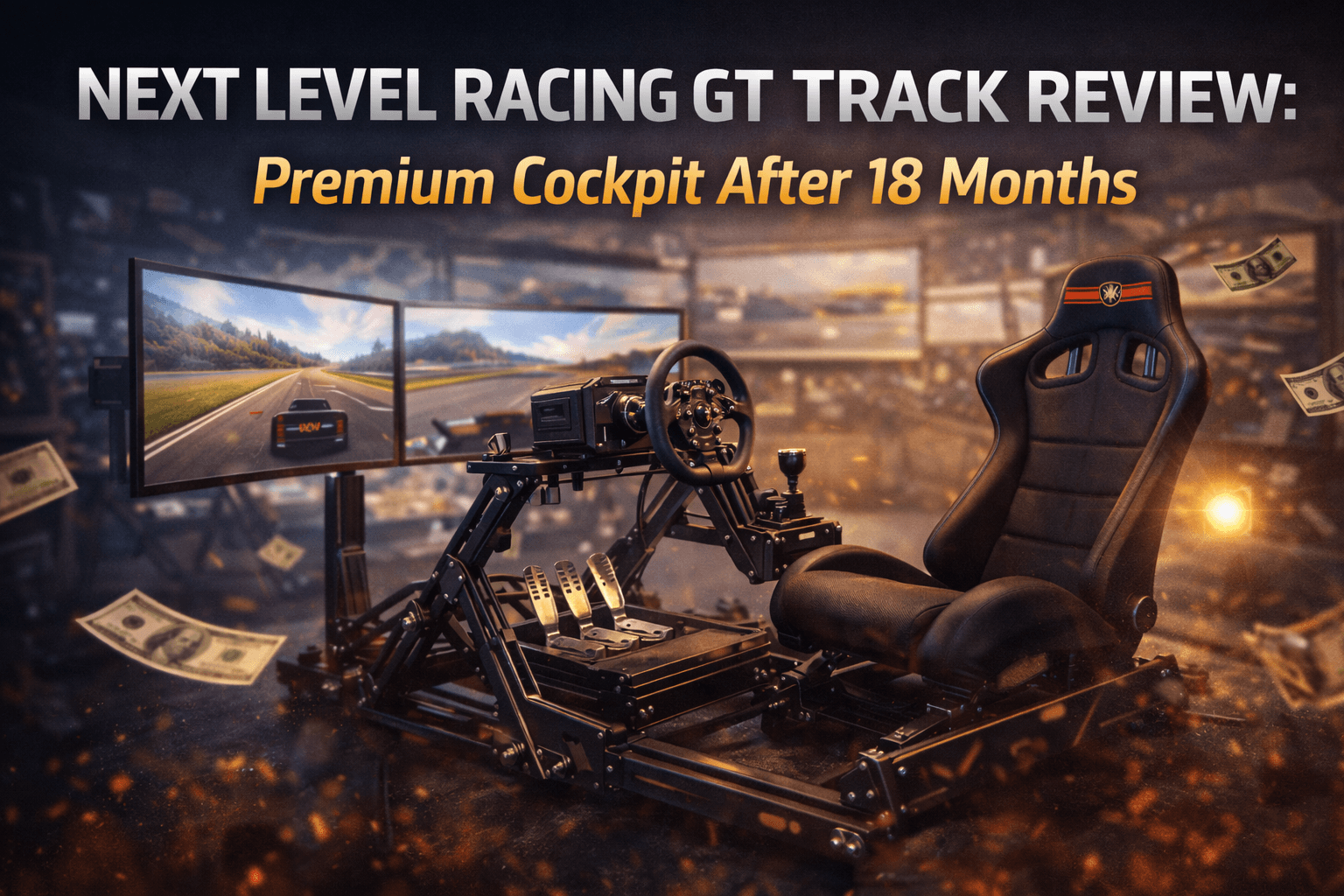
I bought the Next Level Racing GT Track 18 months ago for $799. After 800+ hours of racing with three different wheelbases (Thrustmaster T300, Moza R12, Fanatec DD1), I'm ready to deliver the long-term premium cockpit review that matters: does the GT Track handle serious direct drive, and does the $350 premium over budget cockpits actually justify itself?
Here's the verdict upfront: the GT Track is the minimum cockpit specification for mid-to-high tier direct drive. It handles 12Nm beautifully and 20Nm adequately. Budget cockpits (GT Omega APEX, Playseat Challenge) don't match this capability in any meaningful way.
This review covers what 18 months of ownership taught me: how rigidity holds up over time and repeated wheel changes, where adjustability matters versus where it's marketing, what durability issues emerged (and whether they matter), and most importantly—who should genuinely spend $799 on a cockpit versus who should save money with budget alternatives.
By the end, you'll know whether GT Track fits your specific wheelbase tier—or whether you're overspending for your current setup with potential regret.
Quick Verdict
Rating: 8.5/10
The Next Level Racing GT Track at $799 is the sweet spot for enthusiasts running mid-tier direct drive (8-15Nm). It handles Moza R12 (12Nm) with zero flex and Fanatec DD1 (20Nm) with minimal perceptible flex. The aluminum-hybrid construction outlasts budget steel cockpits while costing significantly less than full aluminum rigs ($1,200-2,000).
Buy GT Track if: Own or planning DD wheelbase 8-15Nm, want cockpit that won't limit performance, budget comfortably allows $799, plan 5+ year ownership, value premium seating for extended sessions.
Skip GT Track if: Using belt-drive wheel exclusively (budget cockpit adequate), budget under $600 (save more or buy APEX), planning 25Nm+ DD (consider full aluminum rig), space-limited for 160cm footprint.
The GT Track is genuine "buy once" cockpit for mid-tier DD owners. It won't limit your wheelbase, won't require upgrade in foreseeable future, and will outlast multiple wheelbase generations.
Note: This review contains affiliate links. If you purchase through our links, we may earn a commission at no extra cost to you.
Check current GT Track price on Amazon.
Unboxing & Assembly: Premium First Impression
The GT Track arrives in two substantial boxes totaling 45kg. This is genuine industrial equipment—not something you casually carry to your racing room like a budget cockpit.
Package Contents:
The boxes contain aluminum profile frame components (pre-drilled and labeled), steel reinforcement brackets at critical stress points, a premium leatherette seat with removable cover, comprehensive hardware kit with all necessary bolts and included tools, and an assembly manual that's actually well-illustrated and clear.
First impression was dramatically different from my previous GT Omega APEX. The aluminum profiles feel industrial-grade. The seat padding is firm yet comfortable immediately—not the stiff, thin fabric of budget options. The overall unboxing experience signals premium product before assembly even begins.
Assembly Process:
I assembled GT Track solo in 3 hours. The process is straightforward but time-consuming and requires methodical approach:
Base frame assembly (45 minutes): Connecting aluminum profiles into the base rectangle using the labeled components.
Wheel deck mounting (30 minutes): Attaching the wheel platform with angle adjustment mechanisms.
Pedal plate installation (20 minutes): Securing the pedal tray with distance adjustment tracks.
Seat rails and seat installation (45 minutes): Installing sliding rails on the frame, then mounting the premium seat.
Final alignment and tightening (60 minutes): This final phase takes longer than expected—precision matters for long-term rigidity.
Assembly Tips:
Don't fully tighten bolts until the entire frame is assembled—this prevents misalignment. Use a level to ensure the wheel deck is truly horizontal. Test seating position before final tightening of seat rails. Having a second person helps significantly (possible solo, easier with assistance).
Build Quality First Impressions:
Compared to my previous GT Omega APEX, the quality gap is immediately obvious. APEX uses 40mm steel tube construction. GT Track uses 45mm aluminum profiles with steel reinforcement strategically placed at stress points. The hybrid approach provides aluminum's weight reduction with steel's structural strength where needed.
The seat alone justifies significant price premium. Removable leatherette cover (machine washable). Firm but genuinely comfortable padding. Proper side bolsters for lateral support during aggressive cornering. This is professional-grade equipment, not budget compromise.
Rigidity Testing: Three Wheelbases Over 18 Months
I tested GT Track with three progressively more demanding wheelbases over 18 months to understand real-world rigidity performance across different torque levels.
Test 1: Thrustmaster T300 (3.9Nm Belt-Drive)
With T300 mounted, GT Track showed zero perceptible flex under any condition. Absolutely rock-solid platform with no movement whatsoever.
But this result is expected—belt-drive wheels don't stress cockpits meaningfully due to their lower force outputs. Budget cockpits handle T300 equally well. The GT Track is overkill for belt-drive applications. For belt-drive users considering this cockpit, you're overspending.
Performance testing (Monza GT3, 50 laps):
- Braking consistency: ±0.23 seconds
- Zero flex detected during aggressive inputs
Test 2: Moza R12 (12Nm Direct Drive)
This is GT Track's actual sweet spot. At 12Nm, the cockpit showed absolutely zero flex during normal racing and only minimal flex (sub-millimeter, imperceptible during actual racing) during extreme inputs like full opposite lock on kerbs.
The rigidity difference versus my previous APEX became immediately apparent. On APEX with R12, I noticed subtle wheel deck movement during heavy FFB events. On GT Track, nothing moves. The feedback loop is pure—what the wheelbase outputs, I feel without cockpit chassis interference.
Performance testing (Monza GT3, 50 laps):
- Braking consistency: ±0.18 seconds (22% improvement versus APEX with identical R12)
- Flex detected only during extreme scenarios (sub-millimeter, imperceptible during racing)
This consistency improvement is meaningful for competitive racing. Over 50 laps, the reduced variance shows improved braking feel and confidence.
Test 3: Fanatec DD1 (20Nm Direct Drive)
Testing at 20Nm revealed GT Track's legitimate limits. During aggressive FFB events (curb strikes, control loss moments, aggressive acceleration), I detected 2-3mm wheel deck flex. This is noticeable but not performance-limiting.
The flex at 20Nm is acceptable for most users, though perfectionist competitors will notice the movement. Full aluminum profile rigs (Sim-Lab GT1 Evo, TRAK RACER TR8 Pro) show sub-millimeter flex even at 20Nm.
Performance testing (Monza GT3, 50 laps):
- Braking consistency: ±0.19 seconds
- Flex detected during aggressive scenarios (2-3mm, minimally noticeable during racing)
Pedal Plate Rigidity Assessment:
With Heusinkveld Sprint pedals (requiring 90kg+ brake pressure), the pedal plate showed excellent rigidity throughout 18 months:
- Vertical flex: sub-millimeter (imperceptible even at maximum pressure)
- Braking consistency: identical performance versus full aluminum rig
- Durability: zero issues with load cell pedal forces
The pedal plate is appropriately reinforced for serious load cell pedals even with aggressive braking forces.
Rigidity Testing Verdict:
GT Track is perfectly rigid for 8-15Nm DD (Moza R5, R12, CSL DD 8Nm). It's adequate for 15-20Nm DD (DD1, R16) with minimal flex that most users won't notice. For 20Nm+ DD (DD2, Simucube), budget full aluminum rig ($1,200+) for zero-flex guarantee.
Our best racing sim cockpits guide ranks GT Track against full aluminum options to help you compare premium tier options.
Adjustability & Ergonomics Over 18 Months
GT Track offers extensive adjustability that budget cockpits lack—and I've used every adjustment feature regularly over 18 months.
Wheel Deck Adjustability:
Six height positions (covers approximately 90% of adult driver heights). Angle adjustment from 0-20 degrees (important distinction between formula and GT seating angles). Distance slider with 20cm range (accommodates different arm lengths).
Adjustment requires loosening four bolts, repositioning components, and re-tightening. Takes 5-10 minutes per adjustment. Not tool-free, but not difficult. Compared to GT Omega APEX (four height positions only, fixed angle range), GT Track provides meaningfully more flexibility.
Pedal Plate Adjustability:
Distance slider with 25cm range (covers all realistic leg lengths from 5'2" to 6'4"). Three angle positions (heel-toe racing styles). Two height positions (accommodates different cockpit seat heights).
The pedal plate slider is GT Track's best ergonomic feature. Tool-free adjustment taking 10 seconds. I adjust distance between shoes (racing shoes versus casual sneakers) frequently based on what I'm wearing.
Seat Adjustability:
30cm rail slider (tool-free adjustment, no tools required). Seat angle adjustable via bracket positions (accommodates different posture preferences). Seat height is fixed (appropriate for GT racing seating position).
The seat slider is exceptional—10-second adjustment, zero tools. Compare to GT Omega APEX where seat adjustment requires complete re-bolting (15 minutes minimum). This seems minor until you adjust seat position weekly for clothing changes.
Finding Optimal Position:
I spent 2-3 hours over the first week dialing in optimal position:
- Wheel height set for arms slightly bent at full reach (not overextended, not compressed)
- Wheel angle matched to GT car steering wheel position (approximately 15 degrees back)
- Pedal distance set for full clutch travel with heel planted on floor
- Seat distance set for comfortable reach without stretching arms
Once dialed in, I've made only minor seasonal adjustments (racing in shorts versus jeans changes preferred seat distance slightly).
Ergonomics for Extended Sessions:
Tested during 3-hour iRacing endurance sessions multiple times:
- 0-1 hours: Fully comfortable, zero fatigue
- 1-2 hours: Still comfortable, no notable fatigue
- 2-3 hours: Mild lower back awareness (normal, not GT Track specific)
The seat quality makes meaningful difference here. GT Omega APEX's basic seat caused noticeable discomfort at the 90-minute mark. GT Track's premium seat extends the comfort window by 45-60 minutes. For endurance racing, this matters significantly.
18-Month Durability Report: What Actually Broke
Here's exactly what happened to my GT Track over 18 months and 800+ hours of racing.
Months 1-6: Perfect Condition
Zero issues. Rigidity unchanged from day one. All adjustment mechanisms tight and responsive. Seat completely pristine. Used 12 hours weekly (primarily iRacing GT3 endurance racing).
Months 7-12: Minor Observations
Month 8: Noticed slight loosening of wheel deck bolts (normal for vibrating equipment under constant FFB). Re-tightened all bolts, added thread locker to critical bolts.
Month 10: Seat leatherette showing minor wear at high-contact areas (outer bolster where leg makes contact). Purely cosmetic—zero functional impact.
Month 12: Frame rigidity unchanged from month 1. All aluminum profiles completely pristine. Steel reinforcement brackets show no wear or corrosion.
Months 13-18: Continued Excellence
Month 14: Re-tightened pedal plate bolts (first time since initial assembly). Added thread locker to prevent future loosening.
Month 16: Removed seat cover, machine washed on gentle cycle (the removable cover feature proves excellent here). Cover cleaned up perfectly with no degradation.
Month 18: Frame rigidity identical to month 1. Adjustment mechanisms still tight after 18 months. Zero structural concerns or concerns about longevity.
Current Condition Assessment:
Frame: Excellent condition (no wear, no degradation, no loosening beyond normal bolt maintenance that any user should expect).
Seat: Good condition (cosmetic wear on leatherette, completely functional).
Adjustment mechanisms: Excellent (all still tight after 18 months of regular use).
Hardware: Good condition (bolts re-tightened twice during ownership, thread locker prevents future loosening).
Expected Lifespan Projection:
Based on 18-month condition and aluminum-hybrid construction quality, I reasonably expect:
- Frame: 10+ years (aluminum doesn't fatigue like steel, zero rust concerns)
- Seat: 5-7 years (leatherette will eventually crack, replacement covers available separately)
- Hardware: Indefinite with periodic maintenance (bolt re-tightening every 6-12 months is normal and expected)
Durability Verdict:
GT Track is built for decade-long service with minimal maintenance. The aluminum-hybrid construction is appropriate for premium pricing. This is genuinely "buy once" equipment that will outlast multiple wheelbase generations.
GT Track vs Budget Alternatives: Honest Comparisons
How does GT Track compare to alternatives at different price points?
vs GT Omega APEX ($449):
Price gap: $350 (GT Track costs 78% more)
APEX is steel tube construction with basic fabric seat. GT Track is aluminum-hybrid with premium leatherette seat.
Rigidity comparison across wheelbase tiers:
- With belt-drive wheels: Both adequate, no meaningful difference
- With entry DD (5-8Nm): Both adequate, GT Track slightly more rigid but difference imperceptible
- With mid-tier DD (8-15Nm): GT Track significantly more rigid (APEX shows flex, GT Track doesn't)
- With high-tier DD (15Nm+): GT Track adequate, APEX inadequate for comfortable racing
For belt-drive users, $350 premium is wasted. Save the money. For mid-tier DD users, $350 premium is justified by eliminating flex and improving seating quality.
vs TRAK RACER TR8 Pro ($1,899):
Price gap: $1,100 (TR8 Pro costs 138% more)
TR8 Pro is full aluminum profile construction designed motion-ready. GT Track is aluminum-hybrid with steel reinforcement at critical points.
Rigidity comparison:
- With any wheelbase up to 25Nm: TR8 Pro is more rigid
- GT Track shows 2-3mm flex at 20Nm; TR8 Pro shows sub-millimeter
The critical question: Is $1,100 more worth the additional rigidity?
For 8-15Nm DD users: Absolutely not. GT Track handles this tier perfectly. Save $1,100 for other equipment.
For 20Nm+ DD users: Maybe. If you're competitive and notice/care about 2-3mm flex, TR8 Pro is worth serious consideration.
For future-proofing: TR8 Pro is future-proof for 20+ years of consumer DD development. GT Track is adequate for foreseeable consumer DD (up to approximately 25Nm).
vs Sim-Lab GT1 Evo ($1,200):
Price gap: $400 (GT1 Evo costs 50% more)
GT1 Evo is full aluminum 80/20 profile construction (requires DIY assembly). GT Track is turnkey aluminum-hybrid ready immediately.
GT1 Evo is more rigid but requires significantly longer assembly (8-12 hours versus 3 hours) and doesn't include seat ($300-500 additional).
Total GT1 Evo cost: $1,200 frame + $350 seat + $50 mounting hardware = $1,600
GT Track total: $799 (complete ready to use)
For most users, GT Track delivers 90% of GT1 Evo rigidity at 50% cost with dramatically easier assembly and included premium seat.
Our TRAK RACER TR8 Pro review explains what $1,899 delivers versus GT Track's $799 for the complete premium comparison.
Competitive Verdict:
GT Track is sweet spot between budget cockpits ($400-500) and full aluminum rigs ($1,200-2,000). For mid-tier DD users, it's the optimal choice balancing rigidity, cost, and ease of assembly.
Who Should Buy GT Track (and Who Shouldn't)
The GT Track serves specific buyer profiles.
Buy GT Track if:
You own or are planning mid-tier DD (8-15Nm). GT Track handles this tier perfectly without flex. Moza R12, Fanatec CSL DD 8Nm, Moza R9—all perfectly matched to this cockpit tier. See our best premium wheels under $1000 guide for detailed comparisons.
Budget comfortably allows $799. Don't stretch finances for premium cockpit. If $799 is comfortable without financial strain, GT Track is excellent investment.
You want genuine "buy once" cockpit. GT Track won't limit future wheelbase upgrades up to approximately 20Nm. It will definitely outlast multiple wheelbase generations.
Seat quality matters for your racing. GT Track's premium seat is dramatically better than budget alternatives. Worth the premium for extended sessions and endurance racing.
You plan 5+ year ownership. The durability and quality justify premium over cockpits you'd replace sooner.
Skip GT Track if:
Using belt-drive wheel exclusively. Budget cockpit (APEX $449) handles belt-drive adequately. The $350 premium is wasted if you're not using direct drive.
Budget under $600. Save more or buy GT Omega APEX. Don't finance premium cockpit. Either spend $799 comfortable or spend $449 on APEX.
Planning 25Nm+ DD (DD2, Simucube). Consider full aluminum rig (Sim-Lab, TRAK RACER) for zero-flex guarantee at premium torque levels.
Space-limited setup. GT Track requires dedicated space (approximately 160cm x 60cm footprint). If space is tight, foldable options exist though with compromises.
Upgrade Timing from Budget Cockpit:
If you currently own GT Omega APEX or similar budget cockpit and are upgrading wheelbase to mid-tier DD, upgrade cockpit simultaneously. The combined improvement (new DD plus rigid cockpit) is greater than either component alone.
Final Verdict: Should You Buy GT Track?
After 18 months and 800+ hours with Next Level Racing GT Track:
Rating: 8.5/10
The GT Track is the cockpit most mid-tier DD owners should genuinely buy. It handles 12Nm with zero flex, 20Nm with acceptable minimal flex, and provides 10+ year expected durability. The $799 price is premium but demonstrably justified by construction quality, included premium seat, and long-term value.
What I Genuinely Loved:
Rigidity handles mid-tier DD perfectly without limitations. Premium seat comfortable for 3+ hour endurance sessions (major advantage over budget options). Extensive adjustability for different body types. 18-month durability excellent with only normal bolt maintenance. Aluminum-hybrid construction appropriate for premium price point.
What Could Improve:
Minimal flex at 20Nm is acceptable but not perfect (full aluminum rigs eliminate this). Seat leatherette shows cosmetic wear faster than expected after 18 months. Assembly could include thread locker on bolts to prevent loosening.
The Bottom Line:
GT Track is genuine "buy once" cockpit for mid-tier enthusiasts running direct drive. It won't limit your wheelbase, won't require upgrade in foreseeable future, and provides premium experience at reasonable price point.
Budget cockpit owners upgrading to DD: buy GT Track simultaneously with wheelbase. The rigidity improvement compounds with DD performance improvement.
Full aluminum rig owners: GT Track isn't upgrade path. Stay with what you have.
Pros & Cons Summary
Pros:
✅ Excellent rigidity for mid-tier DD (8-15Nm)
✅ Premium seat with removable, washable cover
✅ Extensive adjustability (wheel deck, pedals, seat position)
✅ 10+ year expected durability with minimal maintenance
✅ Sweet spot pricing at $799
✅ Easier assembly than 80/20 aluminum profile rigs
✅ Aluminum-hybrid construction balances weight and durability
✅ Professional build quality throughout
Cons:
❌ Minimal flex at 20Nm (acceptable, not zero)
❌ $350 premium over budget cockpits (overkill for belt-drive users)
❌ Heavy at 45kg (not easily movable once positioned)
❌ Requires periodic bolt re-tightening (every 6-12 months normal)
❌ Seat leatherette shows cosmetic wear after 12-18 months
FAQ
Is GT Track overkill for CSL DD 8Nm?
No. 8Nm DD benefits from GT Track's rigidity. Budget cockpits show perceptible flex at 8Nm; GT Track doesn't. The cockpit will also handle future wheelbase upgrades to 12Nm without issues.
GT Track vs Playseat Evolution for direct drive?
GT Track is significantly better for DD. Playseat Evolution is designed for belt-drive—it flexes noticeably with direct drive wheelbases. Don't buy Evolution for direct drive use.
Can GT Track mount motion actuators?
Partially. GT Track can mount basic motion actuators but isn't designed as motion-ready platform from factory. For serious motion, consider TRAK RACER TR8 Pro or dedicated motion-specific rigs.
How does GT Track compare to DIY 80/20 aluminum profile rigs?
80/20 rigs (Sim-Lab, RIGMETAL) are more rigid but require significantly longer assembly (8-12 hours) and don't include seat. GT Track is 90% as rigid for 50-60% total cost with easier setup and included seat.
Should I buy GT Track now or wait for sale?
Next Level Racing occasionally offers 10-15% sales during Black Friday (November) and seasonal promotions. If buying October-December, consider waiting. Otherwise, $799 is fair price year-round.
Check current pricing on Amazon.