Quick Verdict
Rating: 8.5/10
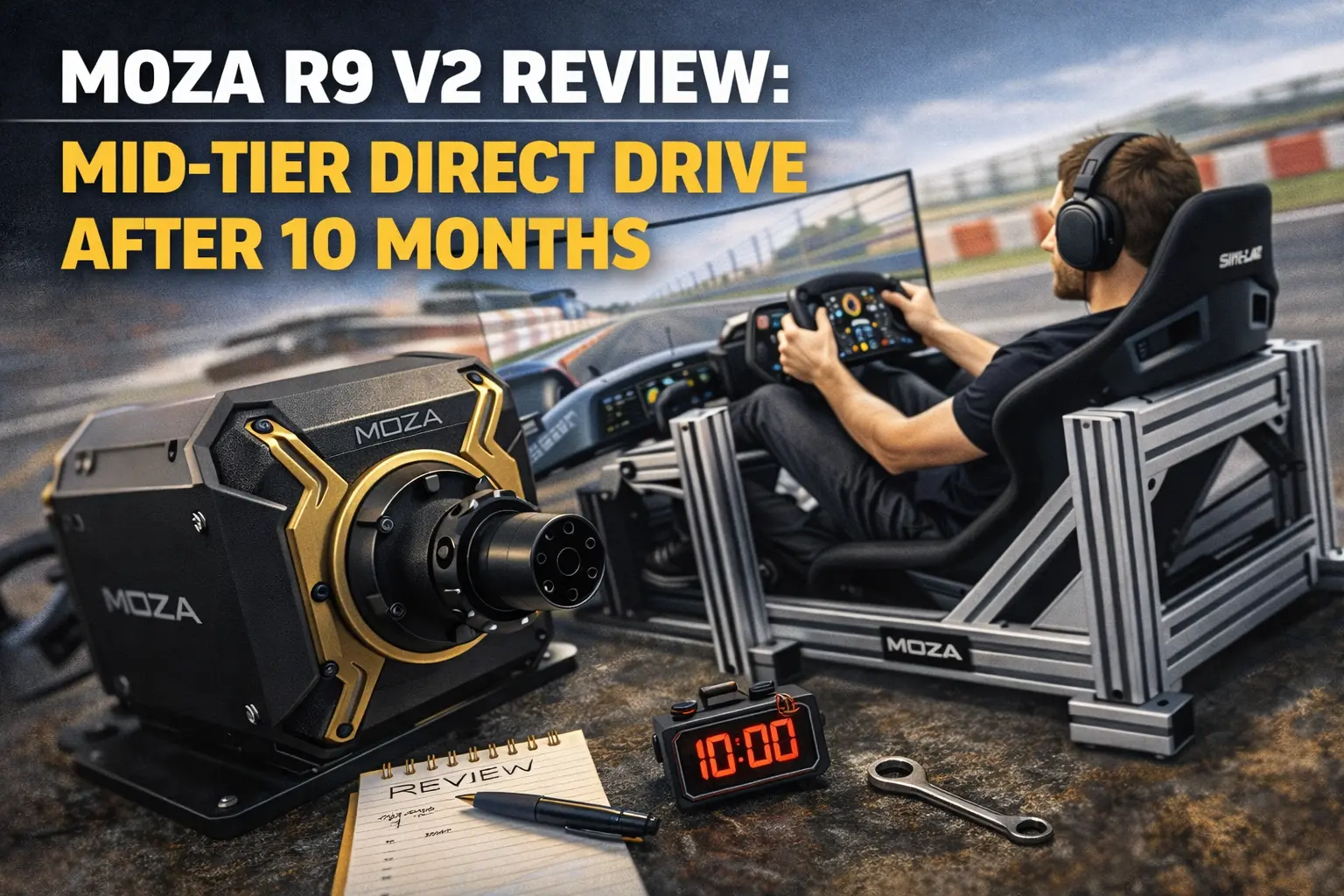
The Moza R9 V2 at $400 delivers legitimate direct drive experience at the market’s most aggressive price point. The FFB quality genuinely competes with the Fanatec CSL DD despite costing $100+ less. Ten months of ownership have proven the hardware reliable and the software now mature enough for recommendation without caveats.
Buy R9 V2 if: Budget matters and you want maximum DD value, you’re comfortable with Moza ecosystem (or going ecosystem-agnostic), you race primarily GT/formula content where 9Nm suffices, you appreciate the included wheel compatibility options.
Skip R9 V2 if: You want the established Fanatec ecosystem and wheel selection, you need 10Nm+ for rally or drift-heavy use, you prioritize avoiding any software learning curve, you prefer larger company support infrastructure.
The Value Statement:
At $400 for the base unit (wheels sold separately), the R9 V2 delivers 90% of CSL DD performance at 75% of the price. The 10% you sacrifice is ecosystem breadth and software polish—worthwhile trade-offs for many racers.
Force Feedback Quality: The Core Experience
Direct drive wheelbases live or die on FFB quality. After 500+ hours with the R9 V2, I can describe its FFB character in detail—and explain how it compares to both my previous belt-drive (Thrustmaster T300) and sessions with the Fanatec CSL DD.
The Direct Drive Transformation:
Coming from belt-drive, the R9 V2 immediately revealed what I’d been missing. The response is instant—no perceptible delay between what the car does and what I feel. The T300’s belt introduced maybe 10-15ms of latency and smoothed details the R9 V2 reproduces clearly.
Curb strikes feel distinct rather than vaguely suggested. Tire slip begins as subtle texture before becoming obvious sliding—the gradation of feedback that belt-drives compress into binary grip/no-grip. Weight transfer communicates through the wheel before the visual confirms the car’s rotation.
This transformation alone justified the upgrade cost. The R9 V2 delivers the “direct drive revelation” that converts belt-drive users into DD advocates.
FFB Character Description:
The R9 V2’s FFB signature leans toward detail and crispness rather than smoothness and weight. Small effects—road texture, minor surface changes, aerodynamic load shifts—come through clearly. The motor responds quickly to rapidly changing forces.
This character suits GT and formula racing excellently. Feeling the exact moment rear tires begin sliding enables precise correction. Sensing weight transfer through FFB helps threshold braking consistency. The detailed feedback loop improves driving.
For rally and drift, the character works but feels slightly different than the “heavier” FFB some competitors provide. The R9 V2 communicates everything but with crispness rather than weight. Some users prefer this; others prefer the denser feel of higher-end wheelbases.
9Nm Torque Assessment:
The R9 V2’s 9Nm peak torque is adequate for most racing but occasionally reveals its ceiling.
In GT3/GT4 racing: 9Nm is completely sufficient. I run 75-85% FFB strength and never wish for more torque. The forces feel substantial and realistic.
In formula racing: Lower-downforce formula cars feel appropriately light. High-downforce cars (F1) benefit from full 9Nm but don’t demand more.
In rally: Here 9Nm occasionally feels limiting. Big impacts—landing jumps, major curb strikes—can hit the torque ceiling, causing momentary clipping where the FFB “tops out” before the impact would naturally resolve. It’s noticeable but not race-ruining.
In drift: Extended slides with full opposite lock use significant torque. Aggressive drift styles occasionally clip. Drift-focused users might prefer higher-torque options.
Comparison to Fanatec CSL DD (Direct Testing):
I conducted four comparison sessions with a friend’s CSL DD 8Nm, swapping wheelbases mid-session to compare identical scenarios.
Detail reproduction: Nearly identical. Both wheelbases communicate fine details effectively. I couldn’t reliably distinguish them in blind testing of surface texture or minor effects.
Weight/density: Slight difference. The CSL DD feels marginally denser or weightier in center feel. The R9 V2 feels marginally crisper or quicker. Neither is objectively better—it’s preference.
Torque ceiling: R9 V2’s 9Nm versus CSL DD’s 8Nm is perceptible in extreme scenarios. The extra 1Nm provides marginally more headroom before clipping. In normal racing, indistinguishable.
Response speed: Effectively identical. Both are direct drive with instant response. No perceptible advantage either direction.
FFB Verdict:
The R9 V2’s FFB quality legitimately competes with the CSL DD. In blind testing, I could not reliably identify which wheelbase I was using during normal racing. The hardware delivers—this is genuine direct drive performance, not compromised budget approximation.
Pit House Software: The Honest Assessment
The Moza R9 V2’s hardware is excellent. The Pit House software required patience—and this honest assessment covers both the frustrations and the improvements across 10 months.
Initial Experience (Month 1-2): Frustrating
My first two months with Pit House were genuinely frustrating. The software was functional but rough: FFB profiles for specific sims required manual importing rather than being included by default. Profile switching between sims was manual process. Some settings didn’t save reliably—I’d configure FFB, close software, reopen to find defaults restored. Firmware updates occasionally required repeated attempts.
I seriously considered returning the R9 V2 during Month 2. The hardware felt great, but fighting software to maintain configuration dampened enthusiasm.
Middle Period (Month 3-6): Improving
Moza pushed consistent updates through this period. Each update addressed specific complaints: settings persistence improved, automatic game detection was added, default profiles improved, and the firmware update process was streamlined. By Month 6, the software transformed from frustration to functional. Not perfect—still less polished than Fanatec’s mature ecosystem—but no longer requiring constant attention.
Current Experience (Month 7-10): Mature Enough
Today, Pit House works reliably for most users. My typical workflow: launch Pit House (auto-starts with Windows), software detects game launch and loads appropriate profile, race without thinking about software, occasionally adjust FFB strength in-game if needed. This is acceptable software experience. It’s not as seamless as Fanatec’s integration, but it’s no longer barrier to enjoyment.
Honest Caveat:
I should note that some users have reported recent performance stuttering with Pit House running (particularly in VR). A small percentage report 30-40ms latency spikes. The workaround exists (settings are stored on the wheel, so Pit House can be uninstalled and the wheelbase functions normally with calibration intact), but this is frustrating for users expecting plug-and-play experience.
Moza appears to be investigating these performance issues. The NexGen 4.0 FFB update (April 2025) included performance optimization attempts. Whether issues persist with latest software versions remains to be seen.
Remaining Limitations:
Pit House still lacks features Fanatec offers: no mobile app for configuration, limited telemetry integration compared to FanaLab, smaller community profile database, and less documentation. These limitations matter more to some users than others. I rarely touch software after initial setup—the limitations don’t affect my daily experience. Users who frequently adjust settings or appreciate deep telemetry integration might find Pit House limiting.
Software Verdict:
Pit House went from liability to acceptable across my ownership period. New buyers today receive meaningfully better software than I experienced initially. The software no longer disqualifies recommendation, though it remains less polished than Fanatec’s mature ecosystem, and performance issues persist for a subset of users.
Build Quality and 10-Month Reliability
Hardware reliability concerns legitimately existed for Moza as newer market entrant. Ten months of ownership provides substantive durability data.
Construction Assessment:
The R9 V2 uses aluminum housing with steel internal components. The unit feels substantial—3.8kg of dense, quality-feeling hardware. The quick-release mechanism operates smoothly with positive engagement.
Compared to the CSL DD I’ve handled, construction quality feels equivalent. Neither unit feels cheap or compromised. Both feel like properly engineered direct drive wheelbases. The R9 V2’s full aluminum housing is actually premium versus the CSL DD’s composite housing.
Reliability Record (10 Months):
Issues experienced: Zero
No motor problems, no electronic failures, no quick-release loosening, no firmware corruption, no overheating. The unit works identically to day one. This reliability record matches what I’d expect from quality hardware. The R9 V2 hasn’t required warranty service, hasn’t developed concerning noises, and hasn’t degraded perceptibly.
Thermal Performance:
Direct drive motors generate heat under load. The R9 V2’s active cooling system (advantage over CSL DD’s passive cooling) handles my use pattern without issue:
Typical session (1-2 hours): Unit warm to touch, never hot, no performance degradation
Extended session (3+ hours): Unit noticeably warm, still no performance degradation
Ambient conditions: Tested in summer conditions (room temp ~28°C) without thermal throttling
I’ve never experienced thermal throttling where the unit reduces torque due to heat. Either my use pattern stays within thermal limits, or the cooling system is genuinely effective.
Quick-Release Assessment:
The R9 V2’s quick-release has proven reliable and consistent. Engagement is positive with no play or wobble. After 10 months of regular wheel swaps, the mechanism shows no wear or loosening. The QR uses Moza standard—compatible with Moza wheels and third-party options using Moza mounting.
Build Quality Verdict:
The R9 V2’s hardware quality matches its mid-tier direct drive positioning. It’s not built to Simucube or high-end Fanatec standards, but it’s not trying to be. For the $400 price point, the construction quality is appropriate and the reliability has been flawless.
R9 V2 vs Fanatec CSL DD: The Direct Comparison
The Fanatec CSL DD is the R9 V2’s direct competitor. Here’s how they compare across categories that actually matter.
Price Comparison:
R9 V2 base: $400
CSL DD base (5Nm): $350
CSL DD with boost kit (8Nm): $500
Direct comparison at similar torque shows R9 V2 at $400 for 9Nm versus CSL DD 8Nm at $500. The R9 V2 costs $100 less while providing 1Nm more torque. This is the core value proposition.
FFB Quality Comparison:
As detailed earlier, FFB quality is effectively equivalent. The R9 V2 leans slightly crisper; CSL DD leans slightly denser. Neither is objectively superior—preference determines winner. In blind testing, I could not reliably identify which wheelbase was active.
Software Comparison:
Fanatec’s software ecosystem is more mature. FanaLab provides features Pit House lacks. Automatic game detection has worked longer. Community resources are more extensive. Fanatec wins this category clearly.
Ecosystem Comparison:
Fanatec offers broader wheel selection (15+ options) versus Moza (8+). Fanatec has established peripheral compatibility and larger user community. Fanatec wins ecosystem breadth.
Torque Comparison:
R9 V2: 9Nm peak
CSL DD: 5Nm base, 8Nm with boost kit
At equivalent price ($400), R9 V2 provides 80% more torque than base CSL DD. Even against boosted CSL DD ($500), R9 V2 provides more torque at lower price. R9 V2 wins torque category.
Build Quality Comparison:
Both units feel appropriately built for mid-tier direct drive. R9 V2 has full aluminum housing; CSL DD has composite. Neither has clear quality advantage—both are durable and reliable.
Support/Warranty Comparison:
Fanatec has longer track record with established support infrastructure. Moza support has improved but remains younger company with smaller support team. Fanatec wins support category.
Overall Comparison Summary:
R9 V2 advantages: Price, torque, value proposition, thermal management
CSL DD advantages: Software, ecosystem, support infrastructure
Equivalent: FFB quality, build quality
Who Should Buy Which:
Buy R9 V2 if: Budget matters most, you don’t need Fanatec ecosystem, you’re comfortable with younger company/software.
Buy CSL DD if: Ecosystem and software polish matter, you want Fanatec wheel selection, you value established company infrastructure.
Neither choice is wrong. Both deliver legitimate direct drive experience. The decision depends on which advantages and trade-offs matter to your specific situation.
Ecosystem and Wheel Compatibility
Buying a wheelbase means buying into an ecosystem. Here’s what the Moza ecosystem offers R9 V2 owners.
Moza Wheel Selection:
Current Moza wheel lineup includes:
- ES Steering Wheel (round, entry-level): ~$180
- CS V2 Steering Wheel (round, mid-tier): ~$250
- RS V2 Steering Wheel (round, premium): ~$350
- FSR Steering Wheel (formula, entry): ~$230
- KS Steering Wheel (GT, premium): ~$400
The selection covers primary use cases but is smaller than Fanatec’s range. Users wanting very specific wheel styles may find Fanatec’s broader selection advantageous.
Third-Party Wheel Compatibility:
Moza uses proprietary quick-release, but adapters exist for other wheel standards. Users wanting Cube Controls, Ascher Racing, or other third-party wheels can adapt them to Moza—at additional cost and complexity.
This is identical situation to Fanatec, which also uses proprietary QR requiring adapters for third-party wheels.
Peripheral Ecosystem:
Moza offers ecosystem peripherals including HBP Handbrake ($150), shifters in sequential and H-pattern options, and pedals with SR-P and SR-P Lite options. The peripheral ecosystem is functional but smaller than Fanatec’s range.
Ecosystem-Agnostic Approach:
Many R9 V2 users (myself included) run mixed ecosystem—Moza wheelbase with third-party pedals and accessories. The R9 V2 works perfectly with any USB peripherals regardless of brand. This approach sacrifices some integration convenience for best-in-class component selection.
Final Verdict
Rating: 8.5/10
After 10 months and 500+ hours with the Moza R9 V2:
Strengths:
Outstanding value proposition—$400 for 9Nm genuine direct drive
FFB quality matching more expensive competitors
Reliable hardware with zero issues across 10 months
Software that has improved dramatically through updates
Active cooling system (advantage over passive alternatives)
Limitations:
Smaller ecosystem than Fanatec
Software less polished than established competitors
9Nm occasionally limits rally/drift scenarios
Younger company with less support infrastructure
Performance issues reported by some users (Pit House optimization needed)
The Bottom Line:
For budget-conscious racers wanting direct drive, the R9 V2 represents best value available. The $100+ savings versus comparable Fanatec provides meaningful budget for wheel or other upgrades. The FFB quality doesn’t compromise for the price.
For racers prioritizing ecosystem, software polish, or support infrastructure, the Fanatec CSL DD’s premium buys those advantages.
Both are excellent choices. The R9 V2 wins on value; the CSL DD wins on ecosystem. Choose based on which advantages matter to your situation.
FAQ: R9 V2 Questions
Is Moza R9 V2 as good as Fanatec CSL DD?
For FFB quality, yes—they’re effectively equivalent in blind testing. For software and ecosystem, CSL DD has advantages. For value, R9 V2 wins. Neither is clearly “better”—they excel in different areas. Choose based on priority.
Is 9Nm enough torque for sim racing?
For GT, formula, and most road racing: yes, completely sufficient. For dedicated rally or drift use, 9Nm occasionally clips during extreme impacts. Most users find 9Nm adequate; only edge-case scenarios reveal the ceiling.
Has Moza software improved?
Dramatically. The initial experience (frustrating) differs significantly from current experience (acceptable). Moza has pushed consistent updates improving stability and features. New buyers today receive meaningfully better software than early adopters experienced, though some performance issues persist.
Can I use Fanatec wheels with Moza R9 V2?
Not directly—different quick-release systems. Adapters exist allowing Fanatec wheel mounting on Moza bases, but this adds cost and complexity. Most R9 V2 users either buy Moza wheels or adapt third-party (Cube Controls, Ascher) wheels.
How does R9 V2 compare to belt-drive wheelbases?
Transformatively better. Direct drive provides instant response, higher detail, and more realistic feel than any belt-drive. The R9 V2 represents the most affordable entry into this performance tier. The upgrade from belt to direct drive is more significant than upgrading within direct drive tiers.
Note: This review contains affiliate links. If you purchase through our links, we may earn a commission at no extra cost to you.
Comparing broader direct drive options? Our direct drive vs belt drive vs gear drive guide covers the full spectrum from budget to premium.
Building a complete setup? Our best sim racing wheels under $500 guide helps match your wheelbase choice with the right wheel.
Ecosystem decision matters? Our Fanatec vs Moza ecosystem comparison covers software, wheels, and peripheral differences comprehensively.
Interested in Moza’s premium GT wheel? Our Moza KS steering wheel review covers their flagship offering in detail.