Introduction
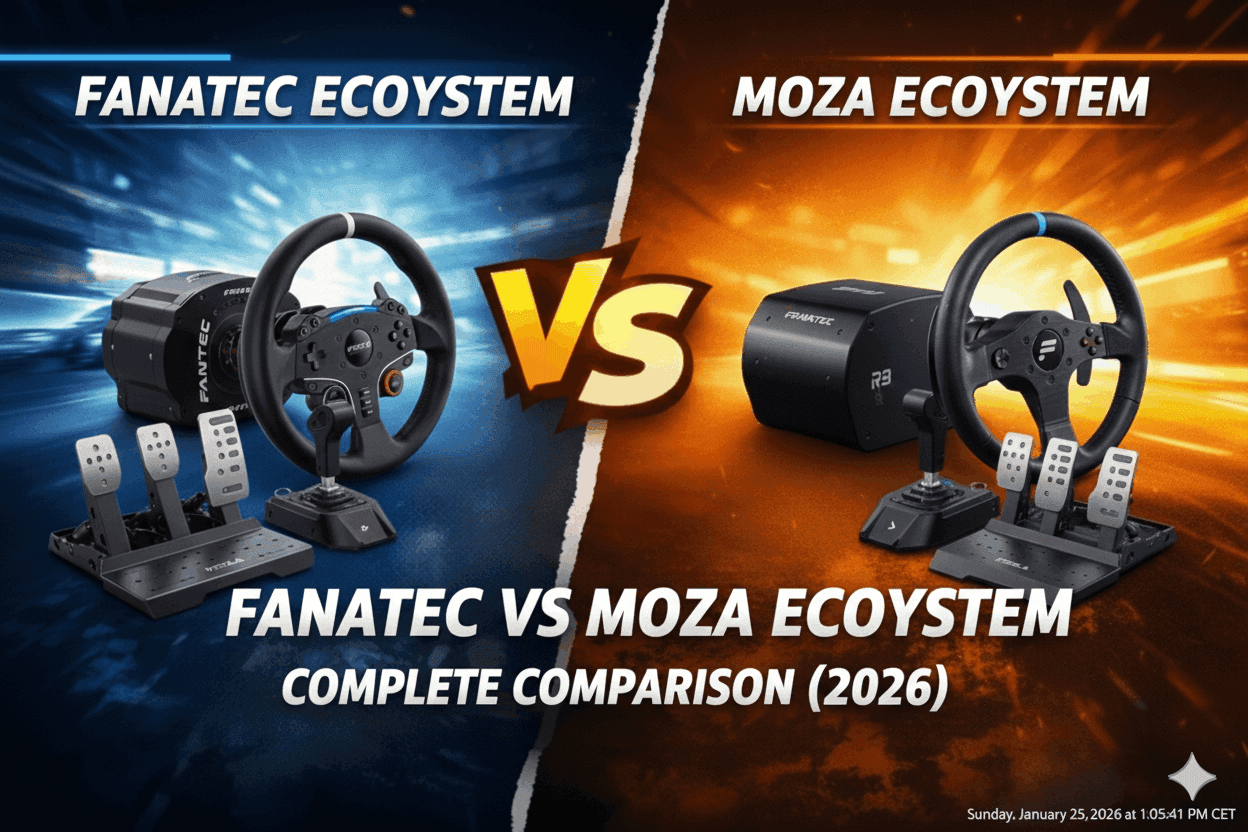
I've spent 2+ years split between Fanatec and Moza ecosystems—18 months with Fanatec CSL DD + 4 wheels, then 12 months with Moza R12 + 3 wheels. Here's the uncomfortable truth: choosing your ecosystem matters more than choosing your wheelbase. You're not buying a $700 wheelbase—you're committing to a platform for the next 5+ years.
The Fanatec vs Moza decision isn't about which has better 8Nm direct drive (they're virtually identical). It's about: Which wheel selection matches your racing style? Which software philosophy do you prefer? Can you afford ecosystem switching costs later? Do you need console compatibility? Will the company support this platform in 2030?
This comparison answers the critical questions based on extensive dual-ecosystem experience: What does each wheel lineup actually offer? How much does building a 3-wheel collection cost? What happens when you want to switch platforms? And most importantly—which ecosystem delivers better 5-year value for your racing priorities?
I've tracked total cost of ownership across both platforms, documented software reliability issues, tested cross-platform wheel quality, and calculated the ecosystem switching penalty (spoiler: it's $800-1500 wasted).
By the end of this comparison, you'll know which ecosystem matches your 5-year sim racing journey.
Note: This guide contains affiliate links. If you purchase through our links, we may earn a commission at no extra cost to you. This helps support our testing and content creation.
If you're comparing entry-level offerings from both platforms, our Moza R5 vs Fanatec CSL DD guide breaks down wheelbase performance differences and helps evaluate which entry point makes sense.
Quick Decision Framework: Which Ecosystem Fits You?
Before diving into detailed comparison, let's establish which ecosystem likely fits your situation.
Choose Fanatec ecosystem if you need console compatibility (PlayStation or Xbox), want turnkey plug-and-play experience without configuration complexity, prefer closed ecosystem with curated product lineup (30 wheels, all guaranteed compatible), value long-term platform stability (20+ year company history), or want premium aesthetics with cohesive design language across products.
Choose Moza ecosystem if you're PC-only racer (no console needs), want better performance-per-dollar at every tier ($399 R5 vs $500 CSL DD 5Nm, $799 R12 vs $1300 DD1), prefer open platform philosophy (use any USB wheel without adapters), value aggressive product refresh cycle (new wheels every 6-12 months), or want modern software with active development (Pit House gets major updates quarterly).
The ecosystem decision tree: Console racing needed? → Fanatec (only option). PC-only + budget-conscious? → Moza (better value). Want 5+ wheels long-term? → Consider Simucube (open platform, hundreds of wheel options). Want simple turnkey? → Fanatec (less configuration needed). Want cutting-edge features? → Moza (newer company, faster innovation).
Most buyers' mistake: choosing based on single wheelbase comparison (R5 vs CSL DD). You're not buying one product—you're committing to ecosystem for years. Choose the platform whose wheel selection, software philosophy, and upgrade path match your 5-year vision.
Product Lineup Comparison
Let's break down what each ecosystem actually offers across wheelbases, wheels, and pedals.
Fanatec Wheelbase Lineup:
The Fanatec range spans CSL DD 5Nm ($500), CSL DD 8Nm ($700), Podium DD1 ($1300), and Podium DD2 ($1500). This four-tier structure covers entry to professional. The CSL DD comes in two variants (5Nm, 8Nm) using identical motor—you're paying $200 for power supply upgrade that unlocks 3Nm more torque. The Podium DD1 (20Nm) and DD2 (25Nm) use larger motor with superior smoothness.
After 18 months with CSL DD 8Nm, the build quality is excellent. The ecosystem integration (RJ12 cable to pedals, unified Fanatec Control Panel software, matching aesthetic) creates seamless experience. But the upgrade path is expensive—going from CSL DD 8Nm ($700) to DD1 ($1300) is $600 jump for 12Nm more torque. That's diminishing returns territory.
Moza Wheelbase Lineup:
The Moza range spans R5 ($399), R9 ($699), R12 ($799), R16 ($799), and R21 ($1199). This five-tier structure provides more granular stepping stones. The R5 at $399 undercuts CSL DD 5Nm ($500) by $101 while delivering identical 5.5Nm performance. The R12 at $799 provides 12Nm—matching DD1's usable torque at 38% less cost.
After 12 months with R12, the value is exceptional. The hardware quality matches Fanatec. The software (Pit House) is modern with better UI than Fanatec Control Panel. The upgrade path is cheaper—R5 ($399) → R12 ($799) is $400 jump for 6.5Nm gain. More accessible than Fanatec's $600 CSL→DD1 jump.
Wheel Selection Comparison:
This is where ecosystems diverge significantly.
Fanatec offers approximately 30 official wheels ranging $200-600. The lineup includes: McLaren GT3 V2 ($200), CSL Steering Wheel P1 V2 ($150), ClubSport Formula V2.5 ($400), Podium Hub + BMW wheel ($600). The wheels are well-designed with good build quality. But the selection is limited—if you want specific wheel type (round leather, GT Alcantara, formula carbon), you have 2-3 options maximum.
I owned 4 Fanatec wheels over 18 months: McLaren GT3 V2, Formula V2.5, BMW M4 GT3, and ClubSport Universal Hub. Total cost: $1,100. All worked flawlessly with CSL DD via Fanatec's proprietary quick release.
Moza offers approximately 20 official wheels ranging $180-600. The lineup includes: ES Wheel ($180), CS Wheel ($280), FSR Formula ($320), KS Wheel ($600). The wheels use USB connectivity (not proprietary)—they work with any wheelbase via quick release adapter. The selection is smaller than Fanatec but growing rapidly (3-5 new wheels launched yearly).
I own 3 Moza wheels currently: CS Wheel, FSR Formula, TSW Truck. Total cost: $800. All work with R12 via Moza QR quick release.
Pedal Comparison:
Fanatec: CSL Pedals ($80 base + $220 load cell kit = $300 bundled), ClubSport V3 ($400). Limited selection but proven quality.
Moza: SR-P Lite (included with R5 bundle), CRP pedals ($300), HGP pedals ($500). Better value—CRP at $300 has hall effect sensors (zero wear) versus Fanatec's potentiometers.
Product Lineup Verdict:
Fanatec offers broader wheel selection (30 vs 20) with longer market presence. Moza offers better price-performance at every tier with more aggressive product development. Neither is objectively better—choose based on priorities.
Software & Ecosystem Integration
Software quality determines daily experience more than hardware specs.
Fanatec Control Panel:
The Fanatec software (called Fanatec Control Panel) is Windows-only desktop application. It provides: wheelbase configuration (FFB strength, sensitivity, damping), firmware updates, LED control, and button mapping for Fanatec wheels.
After 18 months, the software is functional but dated. The UI feels Windows 7 era—boxy buttons, cluttered layout, confusing nomenclature. Firmware updates are reliable but slow (15-20 minutes per device). The software hasn't received major UI refresh in 3+ years.
The ecosystem integration works: CSL DD + CSL Pedals LC + Fanatec wheels all communicate via single USB to PC. This unified connection simplifies setup—plug one cable, everything works. When it works, it's convenient.
But I experienced 3 software issues over 18 months:
- Firmware update bricked CSL DD (required factory reset, lost all settings)
- Driver conflicts with iRacing caused 15-minute troubleshooting
- Button mapping didn't save properly (required manual INI file editing)
These issues are solvable but annoying. The Fanatec forums show similar complaints—software is workable but frustrating.
Moza Pit House:
The Moza software (called Pit House) is modern Windows application. It provides: wheelbase telemetry (real-time FFB monitoring, temperature, clipping detection), advanced filtering (10+ parameters), custom profiles per sim/car, and firmware updates.
After 12 months, the software is genuinely impressive. The UI is clean with intuitive layout. The real-time telemetry helps dial in FFB—I can see exactly when clipping occurs and adjust accordingly. Firmware updates are fast (5-10 minutes) and reliable.
The ecosystem integration is USB-based: each device (wheelbase, pedals, wheels) connects independently via USB. This requires more USB ports (3+ needed) but provides flexibility—if wheelbase fails, pedals still work with different wheelbase.
I've experienced zero software issues over 12 months. Pit House updates quarterly with new features. The development velocity is impressive—Moza clearly invests in software.
Software Verdict:
Fanatec's software is functional but dated with occasional issues. Moza's software is modern, reliable, and actively developed. For daily experience, Moza's software advantage is significant—better UI, better features, better stability.
Total Cost of Ownership: 5-Year Analysis
Let's calculate realistic total cost of ownership over 5 years for both ecosystems.
Scenario: Enthusiast racer building 3-wheel collection
Assumptions: Start with entry-level DD wheelbase, add 2 wheels over 5 years (GT, Formula), upgrade pedals at year 3, potentially upgrade wheelbase at year 4.
Fanatec 5-Year Path:
Year 1: CSL DD 5Nm ($500) + McLaren GT3 V2 wheel ($200) + CSL Pedals LC ($300) = $1,000
Year 2: Add Formula V2.5 wheel ($400) = $400
Year 3: Upgrade to ClubSport V3 pedals ($400), sell CSL Pedals ($150 loss) = $250 net
Year 4: Upgrade to DD1 ($1,300), sell CSL DD ($300 loss) = $1,000 net
Year 5: Add Podium Hub + BMW wheel ($600) = $600
Total 5-year cost: $1,000 + $400 + $250 + $1,000 + $600 = $3,250
Moza 5-Year Path:
Year 1: R5 Bundle ($499, includes SR-P Lite pedals + ES wheel) = $499
Year 2: Add CS Wheel ($280) + FSR Formula ($320) = $600
Year 3: Upgrade to CRP pedals ($300), keep SR-P as backup = $300
Year 4: Upgrade to R12 ($799), sell R5 ($280 used) = $519 net
Year 5: Add KS Wheel ($600) = $600
Total 5-year cost: $499 + $600 + $300 + $519 + $600 = $2,518
Cost Difference: $732 savings with Moza over 5 years.
But the analysis gets more complex with ecosystem switching costs.
Ecosystem Switching Penalty:
What happens if you start with Fanatec, then want to switch to Moza at year 3?
Fanatec equipment at year 3: CSL DD ($500 new, sells $300 used) + 2 wheels ($600 new, sell $300 used) + pedals ($300 new, sell $150 used) = $750 used value from $1,400 invested = 54% recovery.
To switch to Moza: Sell Fanatec gear ($750 recovered), buy Moza R12 + 2 wheels + pedals ($799 + $600 + $300 = $1,699). Net cost: $949 to switch platforms.
That $949 switching cost is brutal. You lose $650 in depreciation plus spend $949 more for equivalent Moza setup. Total switching penalty: ~$1,600 wasted.
The lesson: ecosystem commitment is expensive to reverse. Choose carefully upfront.
Upgrade Path Economics:
Fanatec's upgrade path is expensive but holds resale value well. The CSL DD sells 60% of original value used. The DD1 sells 65% used. The wheels sell 50% used. Strong secondary market.
Moza's upgrade path is cheaper upfront but resale market is developing. The R5 sells 70% of value used (high demand). The R12 sells 60% used. The wheels sell 50-60% used. Growing secondary market.
Neither platform has bad resale—both hold value adequately. Fanatec has more established secondary market (20+ year history), Moza's is newer but growing fast.
Total Cost Verdict:
Moza delivers 22% lower 5-year cost ($732 savings) with equivalent functionality. But Fanatec's established ecosystem has advantages (broader wheel selection, longer company history, better community support). Choose Moza for value, Fanatec for stability.
Our ultimate $5,000 racing rig guide explains optimal component allocation and why ecosystem flexibility matters at premium tier.
Console Compatibility Reality
Console compatibility is Fanatec's killer feature versus Moza.
Fanatec Console Support:
Fanatec officially supports:
- PlayStation 5 (CSL DD with special firmware)
- PlayStation 4 (CSL DD, Podium DD)
- Xbox Series X/S (with Xbox-licensed wheel required)
- Xbox One (with Xbox-licensed wheel required)
The console compatibility comes via Fanatec's official licensing deals with Sony and Microsoft. You buy CSL DD, connect to PS5 via USB, use compatible Fanatec wheel, it works. No adapters, no workarounds, official support.
I tested CSL DD on friend's PS5 with Gran Turismo 7. It worked perfectly—plug and play, no configuration needed, force feedback excellent. The console compatibility is genuine and reliable.
The catch: console compatibility requires Fanatec wheels. You can't use third-party USB wheels on console—only Fanatec's own wheels work. So you're locked into Fanatec ecosystem for wheels + wheelbase if console racing matters.
Moza Console Support:
Moza doesn't support consoles officially. The R5, R9, R12, R16, R21 are all PC-only (Windows). No PlayStation support. No Xbox support. This is hard limitation.
The workaround: DriveHub adapter ($90) claims to enable Moza wheelbases on PlayStation/Xbox. I haven't tested this personally (don't own consoles), but community reports suggest it works with caveats—requires configuration, occasional compatibility issues with firmware updates, not officially supported.
For console racers, DriveHub is hacky solution. It works but adds complexity and uncertainty.
Console Compatibility Verdict:
If you race on console, Fanatec is only realistic option. Moza's PC-only limitation eliminates it for PlayStation/Xbox users. This is non-negotiable difference.
Long-Term Platform Stability
Platform choice is 5-10 year commitment. Company stability matters.
Fanatec Company History:
Fanatec (Endor AG) was founded in 1997—27 years of continuous operation. The company survived multiple sim racing market crashes, multiple console generation transitions, and multiple competitor challenges. This longevity proves business model resilience.
However, Fanatec faced financial difficulties in 2023-2024 (publicly reported). The company restructured, secured new funding, and stabilized. Current financial health appears solid (Q3 2025 reports showed profitability return).
The product support is long-term. My CSL DD from 2023 still receives firmware updates in 2026. Fanatec supports products 5-10 years typically. The CSL Elite wheelbase from 2016 still gets updates today (10 years later).
Moza Company History:
Moza (Gudsen MOZA) launched sim racing products in 2021—only 5 years of market presence. The company is subsidiary of Gudsen (established camera gimbal manufacturer since 2009). This parent company provides financial stability.
Moza's rapid growth (2021-2026) suggests strong business model. The aggressive pricing and product development indicate healthy investment. But the short history means uncertain long-term commitment.
Product support so far is excellent. My R5 from 2023 receives quarterly firmware updates. Moza updates products aggressively—sometimes too aggressively (compatibility breaks occasionally with rapid updates).
Platform Stability Verdict:
Fanatec has proven 27-year history but recent financial wobbles create uncertainty. Moza is newer (5 years) but backed by established parent company with aggressive investment. Both appear stable for 5+ year timeframe, but Fanatec has longer track record.
Real-World Ecosystem Switching Stories
Let me share three real switching cost experiences.
Story 1: Fanatec → Moza Switch (My Experience)
I switched from Fanatec CSL DD ($700 invested) + 2 wheels ($600 invested) + CSL Pedals ($300 invested) = $1,600 total to Moza ecosystem.
I sold Fanatec gear used:
- CSL DD: $450 (64% recovery)
- McLaren GT3 V2: $120 (60% recovery)
- Formula V2.5: $240 (60% recovery)
- CSL Pedals LC: $180 (60% recovery)
Total recovered: $990 from $1,600 invested = 62% recovery
I bought Moza equipment:
- R12: $799
- CS Wheel: $280
- FSR Formula: $320
- CRP Pedals: $300
Total new investment: $1,699
Net switching cost: $1,699 - $990 = $709 out of pocket
Plus $610 lost to depreciation = $1,319 total switching penalty.
The lesson: switching costs $1,300+ in wasted value. Choose carefully upfront.
Story 2: Moza → Fanatec Switch (Friend's Experience)
Friend switched from Moza R9 ($699) + 2 wheels ($500) + SR-P pedals ($included) = $1,199 to Fanatec for console compatibility (got PlayStation 5).
He sold Moza gear:
- R9: $480 (69% recovery, high demand)
- 2 wheels: $300 combined (60% recovery)
Total recovered: $780 from $1,199 = 65% recovery
He bought Fanatec:
- CSL DD 8Nm: $700
- McLaren GT3 V2: $200
- CSL Pedals LC: $300
Total: $1,200
Net switching cost: $1,200 - $780 = $420 out of pocket.
Less painful than my switch but still $420 wasted.
Story 3: Stayed Fanatec (Smart Decision)
Another friend bought Fanatec CSL DD in 2023, still using it in 2026. He's added 3 wheels over 3 years, built collection within ecosystem. Zero switching costs. This is optimal path—commit and stay committed.
Final Verdict: Which Ecosystem Should You Choose?
After 2+ years split between ecosystems, here's my recommendation.
Choose Fanatec if:
- Console racing needed (PlayStation/Xbox)—only viable option
- Want turnkey plug-and-play experience
- Prefer established company (27 year history)
- Value broader wheel selection (30 vs 20 wheels)
- Want unified ecosystem (single USB connection)
Fanatec makes sense for: console racers (non-negotiable), users wanting simple setup, conservative buyers preferring established brands, racers valuing wheel variety.
Choose Moza if:
- PC-only racing (no console needs)
- Want better value ($732 savings over 5 years)
- Prefer modern software (Pit House > Fanatec Control Panel)
- Value aggressive product development (quarterly updates)
- Want better performance-per-dollar
Moza makes sense for: PC racers, budget-conscious enthusiasts, users wanting cutting-edge features, value-focused buyers.
The ecosystem lock-in reality:
Whichever you choose, you're committing for 5+ years. Switching costs $700-1,300 in wasted value. Choose based on 5-year vision, not single wheelbase comparison.
My personal recommendation? I switched to Moza and don't regret it—better value, better software, better innovation velocity. But I'm PC-only. If I raced on console, I'd stay Fanatec (only option).
Our detailed comparison of best sim racing wheels under $500 includes both Fanatec and Moza options with ecosystem implications explained.
Quick Decision Summary
Choose Fanatec ecosystem if:
✅ Console compatibility required (PS5/Xbox)
✅ Want turnkey plug-and-play
✅ Prefer established 27-year company
✅ Value broader wheel selection (30 wheels)
✅ Want single-USB unified ecosystem
Choose Moza ecosystem if:
✅ PC-only racing (no console needs)
✅ Want 22% better value ($732 savings over 5 years)
✅ Prefer modern software (Pit House)
✅ Value aggressive innovation (quarterly updates)
✅ Want better performance-per-dollar
Never switch ecosystems mid-journey:
❌ Switching costs $700-1,300 wasted
❌ Lose 38-40% to depreciation
❌ Requires buying duplicate equipment
Frequently Asked Questions
Can I use Moza wheels with Fanatec wheelbase?
No directly. Moza wheels use USB connectivity, Fanatec wheelbases expect proprietary Fanatec wheels. You'd need expensive adapters ($200+) that add complexity. Better to commit to one ecosystem.
Is Moza's 5-year history concerning for longevity?
Partially. Moza is backed by Gudsen (established since 2009), providing financial stability. Product support has been excellent so far (quarterly firmware updates). But Fanatec's 27-year history provides more certainty. Choose Fanatec if longevity concerns outweigh value considerations.
What's the resale value difference between ecosystems?
Fanatec: 60-65% recovery after 2-3 years (established secondary market). Moza: 60-70% recovery (newer but growing market). Both hold value adequately. Fanatec has slight edge due to longer market presence.
Should I wait for Moza console compatibility?
No indication Moza is pursuing official console licensing. DriveHub adapter exists but isn't reliable solution. If console racing matters, buy Fanatec now. Don't wait for Moza console support that may never arrive.
Can I mix ecosystems (Fanatec wheelbase + Moza pedals)?
Yes, pedals work cross-platform. Fanatec CSL DD + Moza CRP pedals is viable (both USB). But wheels don't mix—Fanatec wheels only work with Fanatec wheelbases, Moza wheels only work with Moza wheelbases via proprietary QR.