Quick Verdict
Rating: 8.0/10
The Moza KS at €550/$600 delivers premium GT wheel experience with excellent materials, satisfying magnetic paddle shifters, and clean design. Build quality matches or exceeds Fanatec alternatives at similar price. However, strong alternatives limit universal recommendation.
Buy KS if: Moza ecosystem user wanting flagship GT wheel, specifically value magnetic paddles over mechanical click, prefer premium leather and materials, need 70 programmable inputs.
Skip KS if: Budget-conscious (Moza CS at €280 delivers 85% experience), prefer more controls (Fanatec BMW M4 GT3 has more rotaries), want mechanical paddle feel (Fanatec alternatives deliver this).
Update (January 2026): Moza just released KS Pro at €330 with 2.99” HD display, more rotaries, and improved paddles. Original KS is now harder to recommend.
The KS is genuinely premium wheel held back slightly by limited functionality for the price and the new KS Pro’s exceptional value.
Note: This review contains affiliate links. If you purchase through our links, we may earn a commission at no extra cost to you. This helps support our testing and content creation.
Understanding direct drive wheelbases? Read our direct drive vs belt drive vs gear drive guide for technical comparison.
Build Quality and Materials: Premium Positioning
The KS build quality is immediately apparent—this feels like premium equipment.
Materials and Construction
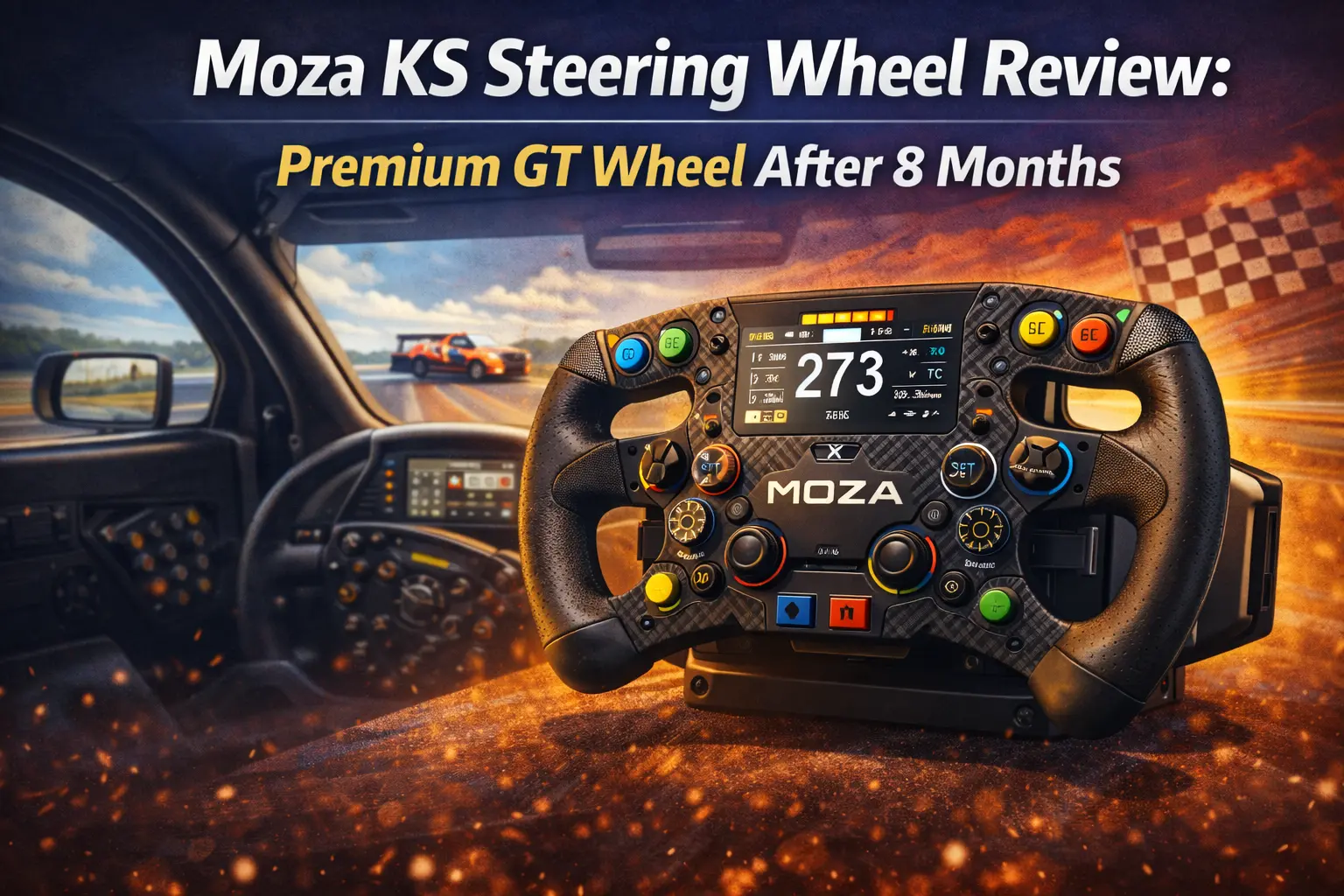
The wheel uses carbon fiber-reinforced plastic for the hub (lightweight, durable), with TPE rubber grips featuring ergonomic indentations. The rim diameter is 300mm in butterfly GT style. Weight is remarkably light at 2.6kg.
The actual grip material wraps the rim in microfiber-style leather. After 8 months, the leather quality holds up well with gloves (I race in thin racing gloves for protection). The leather is softer than genuine automotive leather but provides good grip and doesn’t show wear like Alcantara would.
Button caps are material-appropriate with satisfying tactile feel. No cheap plastic anywhere on control surfaces. The RGB buttons have 0.25mm short travel with firm mechanical feedback—crisp, responsive, purposeful.
The magnetic paddle shifters use aluminum alloy with anodized finish. Hall sensor technology provides 0.03mm precision. The quick release interface (Moza QR system) engages cleanly and locks positively. Zero play when mounted.
Want to protect your wheel investment? Our best sim racing gloves guide explains when gloves matter for wheel protection.
Comparison to Entry Wheels
Coming from Moza ES wheel (included with R5 bundle), the quality gap is substantial. ES is adequate entry wheel; KS is genuine premium equipment. The €270 price difference is justified by materials alone. The ES feels plasticky by comparison.
8-Month Durability
After 300+ hours racing:
- Leather: Excellent condition (I use thin gloves)
- Buttons: Responsive as new, no degradation
- Paddles: Perfect function, no mechanical wear
- QR system: Clean connection, zero loosening
- Grips: Indentations maintain texture
Zero failures, zero maintenance required. The wheel feels like day-one condition after heavy use.
Paddle Shifters: Magnetic Hall Sensors
The magnetic paddle shifters are the KS’s defining feature—arguably the best magnetic paddle feel in the price range.
Mechanism
The paddles use magnetic resistance with Hall effect sensors (0.03mm precision) rather than mechanical switches. Pull against magnetic force to actuation point, then immediate return. No mechanical click or snap—smooth magnetic engagement.
Feel and Responsiveness
The magnetic feel is distinct from mechanical paddles. Smoother pull, faster return than spring-based mechanical paddles, more consistent actuation point. Some prefer mechanical click feedback; I’ve come to prefer magnetic smoothness after 8 months.
Shift speed is excellent. The magnetic return is faster than mechanical spring return. During aggressive GT3 racing, paddle response never feels slow or unresponsive. No missed shifts in 300+ hours of testing.
Adjustment and Customization
Paddle position is adjustable via mounting positions. This matters for different hand sizes and glove thicknesses. The original KS positioning is reported by some users as oddly placed—too close to wheel face. The new KS Pro addresses this with improved paddle positioning.
Magnetic strength isn’t adjustable—what you get is fixed. The stock strength feels appropriate for GT racing but may feel weak to users accustomed to mechanical click feedback.
Comparison to Fanatec
Fanatec BMW M4 GT3 wheel (€600) uses mechanical paddles with satisfying metallic click. Fanatec ClubSport RS uses magnetic paddles with similar Hall sensor technology. The preference is personal: mechanical click versus smooth magnetic engagement. If you like tactile feedback with audible confirmation, Fanatec delivers. If you prefer smooth, fast, quiet shifting, KS excels.
Practical Reality
In extended racing sessions, both magnetic and mechanical paddles deliver reliable shifts. The feel difference matters less than reliability. After 300+ hours, I’ve developed no preference—both work superbly.
Button Layout and Functionality
This is where KS shows weakness versus competition: the control count is adequate but limited compared to similarly-priced Fanatec options.
What KS Offers
- 10 programmable RGB buttons (0.25mm short travel)
- 3 rotary encoders (12-position)
- 2 thumb encoders (20-position)
- 2 depressible joysticks
- 2 magnetic shifter paddles + 2 analog clutch paddles
- Total: 70 programmable inputs
What’s Missing vs. Fanatec BMW M4 GT3 (€600)
Fanatec BMW M4 offers:
- More rotary encoders (4 vs. KS’s 3)
- Thumbwheel option
- More button variety
- Mechanical paddles (vs. KS magnetic)
The functionality gap is real but manageable. For most racing, KS controls are sufficient. Basic adjustments (brake bias, traction control, ABS) are accessible. But if you frequently adjust settings mid-race, the limited rotaries are noticeable.
Button Quality
KS compensates for quantity with quality. Button feel is excellent—satisfying click, appropriate travel, responsive feedback. The 0.25mm short travel prevents accidental presses during aggressive steering. Rotary encoders have defined detents.
Programmable Inputs
70 total programmable inputs is adequate for most racing disciplines. Through Moza Pit House software, extensive customization is possible. The programmability is sophisticated.
On-Track Performance and GT Racing Experience
Where KS excels: actual driving feel during extended GT racing.
Wheel Diameter and Geometry
300mm diameter is appropriate for GT racing—slightly larger than formula wheels, allowing natural GT grip and steering style. The butterfly design provides comfortable spoke positions without awkward hand positioning.
Grip Comfort
The microfiber leather grip is comfortable for extended sessions. I’ve completed 3+ hour endurance stints without grip fatigue. The grip diameter accommodates both bare hands and thin gloves. The ergonomic indentations provide secure hold in both scenarios.
Weight Balance
KS is remarkably light (2.6kg). Well-balanced—no heavy spots that create odd FFB sensations. The wheel tracks smoothly during self-centering and FFB oscillations. The lightness helps with responsiveness without sacrificing stability.
GT3 Racing Performance
Over 300 hours of GT3 racing (iRacing and ACC), the KS has been an excellent partner. Steering precision is accurate. Feedback transmission from wheelbase is clean. Controls are accessible during racing without hand repositioning.
Comfort Analysis
The wheel doesn’t cause fatigue even in marathon 4+ hour sessions. The microfiber leather breathes reasonably well. The ergonomic grips support wrist positioning for extended racing.
Lap Time Impact
The upgrade from Moza ES to KS didn’t transform lap times—this is a comfort and enjoyment upgrade, not a performance upgrade. Measured lap times were consistent before and after KS adoption. What changed: confidence, grip comfort, and satisfaction with the equipment.
KS vs Competitive Alternatives
vs. Fanatec BMW M4 GT3 (€600)
Same price, different strengths:
- Fanatec: More rotary encoders (4 vs. KS’s 3), mechanical paddles, broader Fanatec ecosystem compatibility
- KS: Better leather quality and grip comfort, magnetic paddles, lighter weight (2.6kg vs. heavier), Moza ecosystem
Verdict: Choose based on ecosystem preference and paddle preference (mechanical click vs. smooth magnetic). Fanatec for more controls; KS for better materials and magnetic feel.
vs. Fanatec ClubSport RS (€369)
ClubSport RS is €181 cheaper with comparable quality:
- ClubSport RS: Genuine automotive leather, magnetic paddles, established Fanatec reliability, fewer controls
- KS: More controls (70 vs. fewer), lighter weight, TPE grips vs. leather
Verdict: For GT racers on budget, ClubSport RS is better value. For users wanting maximum controls and Moza ecosystem, KS. Neither is clearly superior—different strengths.
vs. Moza CS (€280)
Moza’s entry GT wheel is compelling alternative:
- CS: €270 cheaper, delivers 85% of KS experience, same Moza compatibility
- KS: Premium leather materials, magnetic paddles, premium build feel
Verdict: For most Moza ecosystem users, CS is better value. KS justified only for those specifically wanting premium materials and willing to pay 2x for that upgrade. The functional difference is overstated.
vs. Moza KS Pro (€330) - NEW
This changes everything (just released January 2026):
- KS Pro: €220 cheaper than original KS, adds 2.99” HD display, improves to 5 rotaries (vs. 3), better paddle positioning, forged carbon paddles
- Original KS: Only justified if you specifically don’t want a display
Verdict: Original KS is essentially obsolete at €550. KS Pro at €330 offers better value and more functionality. If considering KS, buy KS Pro instead.
Market Positioning Reality
The original KS at €550 is difficult to recommend given:
- Moza CS at €280 delivers 85% experience for half cost
- Fanatec ClubSport RS at €369 offers comparable quality with more established support
- Moza KS Pro at €330 offers more functionality and features
- Fanatec alternatives offer more rotaries for similar price
The KS’s premium materials justify a price premium, but €550 is at the ceiling of value proposition.
Comparing Moza vs Fanatec ecosystems? Read our Moza R5 vs Fanatec CSL DD comparison for wheelbase analysis.
Software and Customization: Moza Pit House
The KS integrates with Moza Pit House control suite for extensive customization.
Customization Depth
All 70 inputs are programmable through Moza Pit House software. Button colors, lighting effects, encoder sensitivity, joystick responsiveness—all adjustable. The software is comprehensive.
Display Integration
Original KS has no display (just RGB buttons). KS Pro adds 2.99” HD display for telemetry. For original KS users wanting telemetry, no native display option exists. Third-party solutions require SimHub compatibility.
Ecosystem Integration
Moza ecosystem users get clean integration with R12 wheelbase, pedals, and other Moza hardware. The software cohesion is good within Moza ecosystem.
Limitations
Moza software is less mature than Fanatec’s established Control Panel. Occasional quirks reported in customization. Documentation could be clearer for advanced customization.
Pros & Cons Summary
Pros:
✅ Excellent build quality and materials
✅ Magnetic Hall sensor paddles (smooth, fast, quiet)
✅ 70 programmable inputs (comprehensive customization)
✅ Lightweight design (2.6kg)
✅ Premium leather-equivalent grip
✅ Comfortable for extended sessions (3+ hours)
✅ Excellent durability (8 months, zero failures)
Cons:
❌ €550 price hard to justify given CS at €280
❌ Fewer controls than similarly-priced Fanatec options
❌ Magnetic paddles (less tactile than mechanical click feedback)
❌ No integrated display on original KS
❌ Limited adjustment options on paddles
❌ Moza software less mature than Fanatec
❌ KS Pro release makes original KS poor value
Frequently Asked Questions
Is KS worth €320 more than Moza CS?
For most users, no. CS delivers 85% of experience at 47% cost. KS justified only for users specifically valuing premium materials, magnetic paddles, and 70 input count. For casual racers, CS is obvious choice.
KS vs. Fanatec BMW M4 GT3 at same price?
Different strengths. Fanatec has more controls and mechanical paddles; KS has better leather and magnetic paddles. Choose based on ecosystem (Moza vs. Fanatec) and paddle preference (magnetic vs. mechanical click).
Should I buy original KS or wait for KS Pro?
Buy KS Pro (€330). Original KS at €550 is now poor value. KS Pro adds display, more rotaries, improved paddles, and funky switches for €220 less. There’s no reason to choose original KS anymore.
Can I use KS with Fanatec wheelbase?
Not directly. KS uses Moza QR system. Adapters exist but add complexity and cost. KS is best for Moza ecosystem. If you own Fanatec wheelbase, choose Fanatec wheel instead.
How does leather wear with bare hands?
With gloves: minimal wear after 8 months. Without gloves: expect faster degradation from hand oils. Leather conditioner recommended for bare-hand use. The TPE leather is more durable than Alcantara alternatives.
Is 300mm diameter right for GT racing?
Yes. 300mm is standard GT wheel size—larger than formula wheels, appropriate for GT driving style and grip. The butterfly design accommodates varied hand positions.
Final Verdict
Rating: 8.0/10
After 8 months with Moza KS and 300+ hours GT racing:
What I Loved
- Excellent materials and build quality
- Magnetic paddle feel and responsiveness
- Comfortable grip for extended sessions
- Clean, purposeful design
- Durable and reliable
What Could Improve
- Limited controls vs. similarly-priced Fanatec
- No integrated display (unlike new KS Pro)
- Price point hard to justify given CS at €280
- Magnetic paddles less tactile than mechanical alternatives
The Bottom Line
KS is genuinely premium GT wheel with excellent materials, satisfying magnetic paddles, and clean design. Build quality justifies premium positioning. But the limited functionality (fewer controls than competitors) and strong alternatives (CS at €280, KS Pro at €330, Fanatec options) make original KS hard to recommend at €550.
For Moza ecosystem users: buy KS Pro (€330) instead of original KS. The Pro adds display, more controls, and better paddles for €220 less.
For mixed-ecosystem users: consider Fanatec ClubSport RS (€369) for comparable quality with more established support.
For budget Moza users: CS (€280) delivers 85% experience for half cost.
The KS is excellent wheel held back by pricing in increasingly competitive market.
Building your first rig around Moza? See our how to build your first racing rig guide for complete setup instructions.
Where to Buy:
Moza Products (Direct with our referral link):
- Moza KS Steering Wheel - €550
- Moza KS Pro (Recommended) - €330
- Moza R12 Wheelbase
- Moza CS Wheel (Budget Alternative) - €280
Compatible Accessories (Amazon):