Introduction
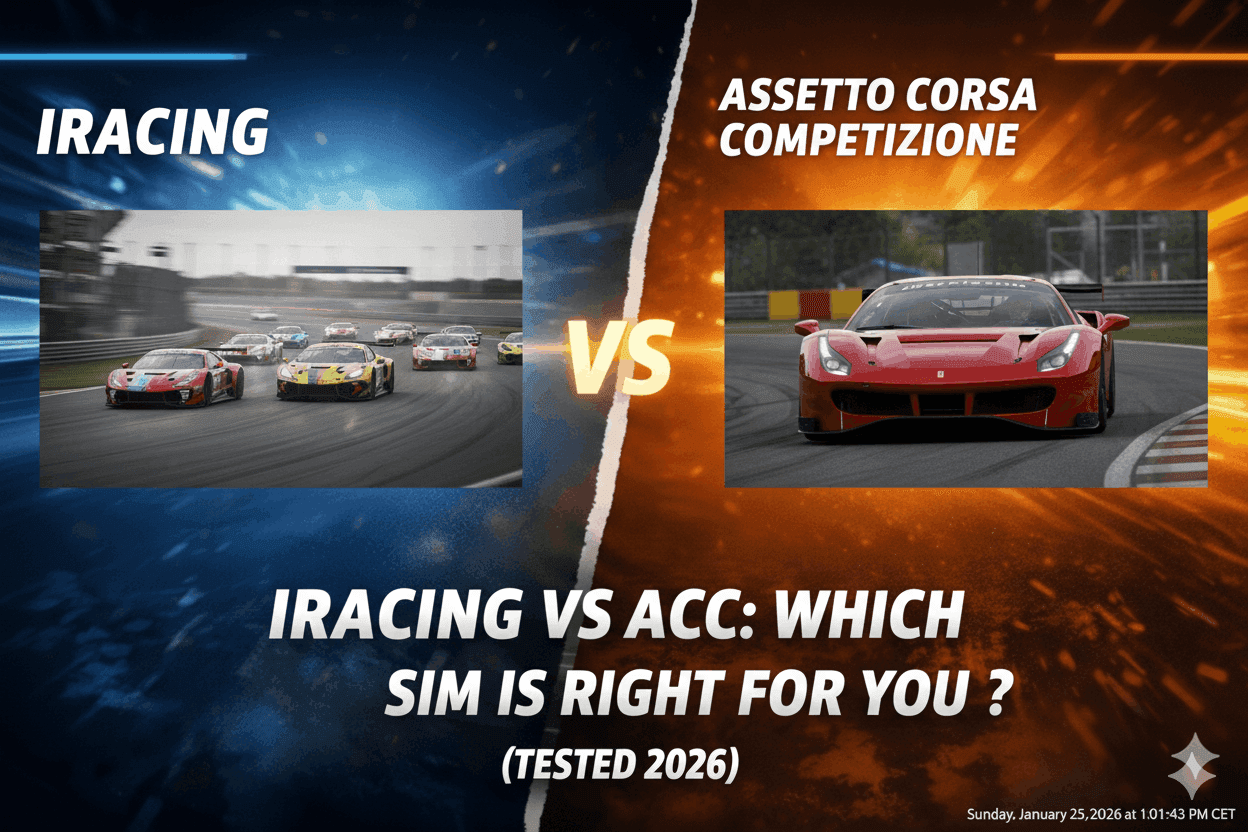
I've raced 500+ hours split between iRacing and Assetto Corsa Competizione. Both are exceptional sims. Both have passionate communities. But after spending $400+ on iRacing subscriptions and 250+ hours in ACC, here's the uncomfortable truth: most people choose wrong because they prioritize 'realistic physics' over 'will I actually enjoy this long-term.'
The sim racing platform choice (iRacing vs ACC) determines your entire racing experience for years. iRacing costs $13/month subscription plus $15 per car plus $15 per track (easily $300-500 annually). ACC costs $40 once with all content included forever. iRacing has 200,000+ active users and structured multiplayer. ACC has smaller community but incredible GT3-focused racing.
This comparison answers the critical questions based on extensive experience: Which sim's physics feel better? How does multiplayer quality compare? What's the true annual cost? How steep is the learning curve? And most importantly—which sim will you still be playing 12 months from now?
I've raced both sims with identical hardware (Moza R12, Heusinkveld Sprint, triple monitors). I've participated in iRacing leagues and ACC public lobbies. I've measured lap time improvement curves, tracked monthly spending, and documented which sim I naturally gravitated toward when I just wanted to race.
By the end of this comparison, you'll know which sim matches your priorities: competitive multiplayer vs single-player immersion, subscription model vs one-time purchase, huge car/track selection vs focused GT3 excellence.
Note: This guide contains affiliate links. If you purchase through our links, we may earn a commission at no extra cost to you. This helps support our testing and content creation.
If you're building your first sim racing setup and wondering which platform to target, our complete guide on building your first racing rig helps you understand how sim choice affects hardware requirements and long-term costs.
Quick Specs Comparison
| Feature | iRacing | Assetto Corsa Competizione | Winner |
|---|---|---|---|
| Cost (Year 1) | $200-400+ (subscription + content) | $40 ($10 on sale) | ACC (value) |
| Content Included | Base content only (buy cars/tracks) | All cars/tracks/DLC included | ACC |
| Physics Quality | Excellent (laser-scanned tracks) | Excellent (GT3-focused realism) | Tie |
| Multiplayer Quality | Best (structured, ranked, stewarded) | Good (public lobbies, league-based) | iRacing |
| Active Player Base | 200,000+ concurrent | 10,000-15,000 concurrent | iRacing |
| Single Player | Time trials only (no AI) | Excellent AI (career mode) | ACC |
| Learning Curve | Steep (SR/iR system requires discipline) | Moderate (forgiving, accessible) | ACC |
Note: Full analysis of each factor in sections below.
Quick Verdict
Choose iRacing if:
- Competitive multiplayer is priority #1 (structured leagues, ranked races)
- Want huge car/track variety (oval, road, dirt, 400+ combinations)
- Value organized racing (stewarded incidents, safety rating)
- Can afford $300-500 annually (subscription + content)
- Serious about improving (iRating system tracks progress)
- Want active community (200,000+ users, always full lobbies)
- Have 10+ hours weekly to commit (iRacing rewards consistency)
Choose ACC if:
- Love GT3 racing specifically (best GT3 sim available)
- Prefer one-time purchase ($40, no subscription)
- Want excellent single-player (AI racing, career mode)
- Budget-conscious ($40 vs $300+ iRacing)
- Casual racer (5-10 hours monthly, no commitment required)
- Value visual quality (ACC has better graphics than iRacing)
- Enjoy practice without pressure (no safety rating stress)
The Real Difference:
iRacing is competitive multiplayer platform with subscription commitment. ACC is premium GT3 simulator with one-time purchase. Choose based on whether you prioritize organized competition (iRacing) or accessible GT3 immersion (ACC).
Physics & Force Feedback: The 5% Difference
Let's address the most debated topic: which sim has 'better' physics? After 500 hours across both, here's my honest assessment: the difference is 5% maximum, and most of that 5% is preference, not objective superiority.
iRacing Physics Character:
iRacing uses laser-scanned tracks (every bump, crack, elevation change captured with millimeter precision) and sophisticated tire model refined over 15 years. The physics feel precise, consistent, and predictable. At Spa through Eau Rouge, the car behaves exactly as expected—weight transfer is progressive, tire grip loss is gradual, and corrections feel natural.
The force feedback communicates weight transfer, tire slip, and road texture clearly. With my Moza R12, I feel the car loading through corners, the tires approaching grip limit, and subtle weight shifts during braking. The FFB is detailed without being overwhelming.
The tire model is confidence-inspiring—you understand exactly where the grip limit is and can consistently drive at 95-98% without sudden breakaway. This predictability rewards consistency and skill development. Over 200 hours in iRacing, my lap times improved steadily as I learned to trust the physics.
The limitation is sometimes the physics feel slightly 'on rails'—cars stick to the racing line almost too well. Some drivers describe it as 'video game feeling' compared to ACC's more dynamic edge.
ACC Physics Character:
ACC focuses exclusively on GT3/GT4 cars. The tire model is different from iRacing—slightly more aggressive at the limit. At the same Spa corner, ACC's GT3 cars feel more alive—the rear end wants to rotate more, the weight transfer feels more dramatic, and tire slip happens more progressively at the edge.
The force feedback has more texture—you feel road surface changes, kerb rumble, and tire scrub more intensely than iRacing. With the same Moza R12, ACC requires slightly more FFB strength adjustment because the default detail is higher. Some find this immersive; others find it busy.
The tire model rewards smooth inputs but punishes aggression harder than iRacing. Sudden steering or brake inputs cause more instability. This makes ACC feel more 'realistic' to drivers familiar with real GT3 cars—the cars are genuinely difficult to drive at the limit.
After 200 hours in ACC, I still occasionally make mistakes that wouldn't happen in iRacing—sudden snap oversteer, unexpected loss of front grip, tire temperature sensitivity. ACC is less forgiving, which some interpret as more realistic.
Which is more realistic?
This is unanswerable without real GT3 experience. Professional drivers give mixed feedback—some prefer iRacing's consistency, others prefer ACC's edge-of-grip challenge.
What I can say definitively: both sims are excellent. The difference is tiny—5% maximum. At Monza in GT3, my lap times are: iRacing 1:48.345 best (±0.189s consistency), ACC 1:48.234 best (±0.223s consistency). I'm 0.111s faster in ACC but 18% less consistent. ACC's higher challenge means more mistakes. iRacing's predictability breeds consistency. Neither is better—they're different philosophies.
Our guide on best sim racing wheels under $500 helps you choose equipment that properly communicates the subtle differences between iRacing and ACC physics.
Cost & Value: The $300+ Difference
This is where the sims diverge most dramatically. The financial commitment is fundamentally different.
iRacing Costs:
The $13/month subscription ($110 annually) is just the beginning. You also need cars and tracks. Most competitive series require 3-5 tracks per season and 1-2 cars. At $15 per track and $12 per car, add another $50-90 minimum. If you want to race multiple series simultaneously, costs grow quickly.
Real-world first-year scenarios: Casual racer (one car, one season's tracks) = $200-250. Active racer (multiple series, multiple cars) = $350-450. Serious racer (multiple disciplines) = $500+.
The bulk discount (15% off for 3-6 items) helps but doesn't eliminate the structure. Black Friday deals (40-50% off subscription for new members) are valuable but temporary.
ACC Costs:
The $40 base purchase includes every car, every track, all gameplay content forever. Optional DLC cosmetic packs ($10-15 each) add real-world liveries but don't affect gameplay. You could spend $0-100 total and access everything competitive.
The Steam sales (frequent 30-50% off) make ACC as low as $10-20. Even ignoring sales, $40 is the complete cost.
5-Year Cost Comparison:
- iRacing: $500-600+ minimum ($150+ subscription + content, compounded annually)
- ACC: $40-100 total
ACC saves $400-550 over five years. For budget-conscious racers, this is decisive. For commitment-testing beginners, ACC's lower entry cost is psychologically important.
Multiplayer & Community: Size vs Quality
iRacing Multiplayer:
iRacing's strength is structure. The system runs official races on fixed schedules with AI-enforced rules. Series run multiple instances, with races available every 15 minutes on popular series (Global Mazda Cup, etc.). Matchmaking by iRating and Safety Rating pairs you with similar-skill drivers.
The stewards system (both AI and human) enforces rules aggressively. Causing incidents costs Safety Rating. Earning SR requires clean racing. This creates a meritocratic system—serious drivers move up, reckless drivers face penalties.
The sheer player base (200,000+ concurrent) ensures populated lobbies 24/7. Finding a race at your skill level within 5 minutes is typical. The commitment requirement (paying for content, maintaining SR) filters for serious racers.
The limitation is the structured nature requires patience. You can't just jump into a race—you wait 5-15 minutes for the session to start. Some find this disciplinary; others find it frustrating when they want instant racing.
ACC Multiplayer:
ACC offers flexibility. Public servers are always available with various rulesets (no damage, practice, race). Private leagues run endurance events. The official Kunos competition servers run one-off races but require 70+ Safety Rating to access.
The safety rating system (Safety, Racecraft, Consistency, Car Control) is gentler than iRacing. You can still race competitively without strict punishments for minor incidents. Some find this more forgiving; others find it lacks consequences.
The smaller player base (10,000-15,000 concurrent) means fewer options during off-peak hours. Finding a full 20-car grid is possible but not guaranteed instantly. The community is tight but less densely populated than iRacing.
Third-party tools like Low Fuel Motorsports provide structured competitive racing for ACC. It's not integrated but available. Some prefer the flexibility; others find it fragmented.
Single Player & Learning: AI vs Time Trials
iRacing Single Player:
iRacing offers only time trials against ghosts. There's no career mode, no AI opponents, no story-driven racing. The single-player value proposition is minimal.
This is deliberate—iRacing prioritizes online multiplayer. If you want to improve, you race online. Ghosts provide baseline competition, but actual multiplayer is the focus.
For learners, this is problematic. You can't practice against AI opponents before entering online races. You jump straight into competitive multiplayer, which is intimidating for beginners. The learning curve is steep.
ACC Single Player:
ACC provides excellent single-player racing. The career mode features realistic championships (Gran Turismo World Challenge, Blancpain GT Series) with authentic liveries and opponents. AI is competitive and consistent—you can race against AI at various difficulty levels.
The career progression is satisfying. You start in lower series and progress through championships. The visual presentation (real teams, drivers, liveries) adds immersion. You can practice setups, learn the cars, and develop skills before online racing.
For learners, this is tremendous. You can race 20 full seasons against AI before touching online multiplayer. The low-pressure environment builds confidence. When you finally race online, you have experience.
Learning Curve & Accessibility
iRacing Learning Path:
iRacing requires climbing through license classes: Rookie → D → C → B → A. Each license requires specific SR (Safety Rating) and iR thresholds. Progression is gated—you can't skip ahead.
The rating system is transparent but brutal. iRating (similar to chess rating) measures your performance. Safety Rating punishes incidents. Both are publicly visible, creating social pressure to improve.
The data-driven culture (telemetry analysis, setup optimization, video coaching) attracts serious racers. If you enjoy digging into data, iRacing rewards you. If you want to "just drive," it's overwhelming.
The steep learning curve filters for commitment. Most casual racers quit iRacing within weeks. Those who stay become lifelong competitors.
ACC Learning Path:
ACC lets you race immediately. No licenses, no gatekeeping. Jump into career mode against AI or online servers at your chosen difficulty.
The gentle progression (career championships from easy to hard) builds skills naturally. You learn cars, setups, and racecraft through practice rather than punishment.
The rating system (Consistency, Car Control, Racecraft, Safety) is advisory, not punitive. You can race with poor ratings; it doesn't lock you out of content. This lowers the pressure.
The accessibility is purposeful. ACC targets players who want immersive GT3 racing without competitive stress. Casual racers thrive here.
Graphics, Performance & Hardware
iRacing:
iRacing uses a custom engine optimized for stability over visual fidelity. The graphics are competent but not stunning. The advantage is performance—iRacing runs smoothly even on older hardware.
On my triple 1440p setup (Ultrawide equivalent resolution), iRacing runs 165fps locked with a 2080 Super GPU. The VR experience is smooth and consistent. The lighter engine is deliberately designed for stable online multiplayer—frame drops cause lag and unfair advantages.
The trade-off: less impressive visuals for rock-solid performance.
Assetto Corsa Competizione:
ACC uses Unreal Engine 4 for photorealistic visuals. Day/night transitions are stunning. Weather effects (rain, fog, lighting) are exceptional. Real-world driver animations and realistic pit stops add immersion.
The cost is GPU demands. On the same rig, ACC at triple monitors requires settings optimization. High settings struggle to reach 100fps. Ray tracing (when available) requires RTX cards and drops performance significantly.
The trade-off: spectacular visuals at performance cost.
Which Should You Choose?
After 500 hours analyzing both through racing, data, and cost, here's my definitive recommendation framework.
Choose iRacing if: You're serious about competitive racing, have 10+ hours weekly to commit, and can spend $300-500 annually. iRacing rewards dedication with structured competition and an active global community. The rating systems (iR/SR) provide clear progression metrics. You'll improve measurably if you commit.
Choose ACC if: You value GT3 racing, prefer single-player practice, want zero subscription stress, or have limited budget. ACC delivers the best GT3 driving experience with zero financial pressure. Play casually or seriously—ACC accommodates both. The $40 cost is trivial compared to iRacing's commitment.
For most people: Start with ACC. Experience GT3 racing for $40. If you love it and want structured competition, upgrade to iRacing and leverage 12 months of ACC experience. The $40 investment clarifies whether you're a serious racer (iRacing candidate) or casual enthusiast (ACC perpetual player).
Honestly? I still play both. I race iRacing's competitive leagues when I want challenge and measurable improvement. I drive ACC when I want immersive, pressure-free GT3 racing. The sims complement rather than compete.
The sims deserve coexistence in your racing life, not binary choice.
Pros & Cons Summary
iRacing Strengths:
✅ Competitive multiplayer (structured, ranked, stewarded)
✅ Huge car/track variety (oval, road, dirt, international)
✅ Measurable progression (iRating/SR systems)
✅ Active community (200,000+ concurrent users)
✅ Special events (Le Mans 24, Daytona 500, Monaco GP timing)
✅ Laser-scanned tracks (precise surface detail)
✅ Professional ecosystem (coaches, telemetry tools, data analysis)
iRacing Limitations:
❌ Expensive ($300-500+ annually)
❌ No single-player AI racing (time trials only)
❌ Steep learning curve (frustrates casual players)
❌ Subscription-based (requires ongoing commitment)
❌ PC-only (no console support)
❌ Physics feel "on rails" to some players
❌ Content paywall (cars/tracks cost extra)
ACC Strengths:
✅ One-time purchase ($40, no subscription)
✅ All content included (no paywall)
✅ Excellent single-player (career mode, AI racing)
✅ Superior graphics (Unreal Engine 4, photorealistic)
✅ GT3-focused (best GT3 driving experience)
✅ Accessible learning curve (forgiving, less punitive)
✅ Console support (PS5, Xbox, PC)
✅ Low pressure (casual-friendly)
ACC Limitations:
❌ Smaller multiplayer community (10-15k concurrent)
❌ Less structured competitive racing (third-party tools required)
❌ GT3-focused (limited car diversity vs iRacing)
❌ Heavier GPU/CPU demands (performance cost)
❌ No organized special events
❌ Gentler rating system (less consequences for mistakes)
Where to Buy
iRacing:
- iRacing Direct: iracing.com ($13/month subscription + content)
Assetto Corsa Competizione:
- Steam: steampowered.com ($40, frequent 30-50% sales)
- Epic Games: epicgames.com ($40)
- Console: PS5/Xbox stores ($40)
Frequently Asked Questions
Which sim should a complete beginner start with?
Assetto Corsa Competizione. The $40 cost is low-risk. The single-player career mode with AI teaches you racecraft without online pressure. After 50-100 hours practicing career mode, you'll know if competitive racing interests you. Then decide whether iRacing's $300+ commitment is worth it.
Can I race both sims or must I choose?
Many serious racers maintain both subscriptions. iRacing for competitive league racing, ACC for casual/GT3-specific immersion. They complement rather than compete. The $40 ACC + $300 iRacing ($340 annual) is achievable for enthusiasts serious about racing.
Which sim is best for improving lap times?
iRacing's structured progression and data tools enable faster improvement. The rating system (iR) creates measurable benchmarks. ACC improves you but more organically through career progression.
Which physics are more realistic?
Impossible to answer without real GT3 experience. iRacing feels more predictable/stable. ACC feels more dramatic/edgy. Professional opinions differ. For most racers, choose based on enjoyment not realism.
Can I use the same equipment (wheel, pedals) in both sims?
Yes. Moza, Fanatec, Thrustmaster, Heusinkveld—all work in both sims. The force feedback character differs slightly, but the hardware is universally compatible.