Quick Recommendations
Testing shifter necessity ($95): SHH Newt. Excellent aluminum construction, Hall effect sensors, good functionality. Test before spending more.
Fanatec ecosystem user ($130): Fanatec CSL Shifter. Tool-free mode switching, ecosystem integration. Obvious choice.
Metal construction preference ($180): Thrustmaster TH8A. Full metal, proven reliability, excellent H-pattern feel.
Endgame equipment ($260): Fanatec ClubSport Shifter SQ V1.5. Premium mechanism, refined sequential mode, instant mode switching.
Do You Actually Need a Shifter? Honest Assessment
I tested shifters expecting transformation. After 14 months and 300+ hours of racing with 5 different shifters, here’s the honest truth: for 80% of sim racers, paddle shifters are faster and sufficient. But shifters aren’t pointless—they’re immersion equipment, not performance equipment.
Lap Time Data (Spa GT3, 30 laps average):
Paddle shifters: 2:17.456 average, consistency ±0.187s
Sequential shifter: 2:17.623 average (+0.167s per lap), consistency ±0.203s
H-pattern with clutch: 2:18.891 average (+1.435s per lap), consistency ±0.312s
The data is clear: paddle shifters are fastest. Sequential adds 0.17 seconds per lap. H-pattern with clutch adds 1.4 seconds per lap and significantly reduces consistency. Over a 30-lap race, this compounds to meaningful time gaps.
But this data requires context. Modern GT3 cars use paddle-actuated sequential gearboxes in reality. Using H-pattern shifter on modern GT3 is less authentic than paddles, not more authentic.
Who Doesn’t Need a Shifter:
Racers focused on modern GT3/GT4/GTE cars. These cars use paddle shifters in reality. Manual shifting is neither faster nor more authentic—it’s different, and paddles are better.
Competitive racers prioritizing lap times. If iRating or league standings matter, paddles provide measurable advantage. Over a 20-lap race, sequential disadvantage costs 3.4 seconds—potentially multiple positions.
Racers who primarily race F1 or modern prototypes. Single-seaters use paddles exclusively. Shifters add nothing to these experiences.
Who Benefits From Shifters:
Vintage racing enthusiasts. Classic cars—1960s GT, Group B rally, pre-90s touring cars—used H-pattern manual transmissions. Racing these cars with paddles breaks immersion. Manual shifting is authenticity, not optional luxury.
Rally racers. WRC and rally games center on sequential shifting with hand positioning that paddles can’t replicate. The physical motion of sequential shifting through stages adds significantly to rally immersion.
Immersion seekers who value experience over times. Some racers prioritize feeling like they’re driving a specific vehicle, not just racing. Manual shifting engages you differently than paddles—your hands leave the wheel, you manage clutch engagement, you time shifts. This engagement matters regardless of lap time impact.
The Honest Assessment:
Shifters are immersion equipment, not performance equipment. If lap times are primary metric, invest in load cell pedals instead—they actually improve performance. If immersion and driving feel are priorities, shifters transform specific racing experiences.
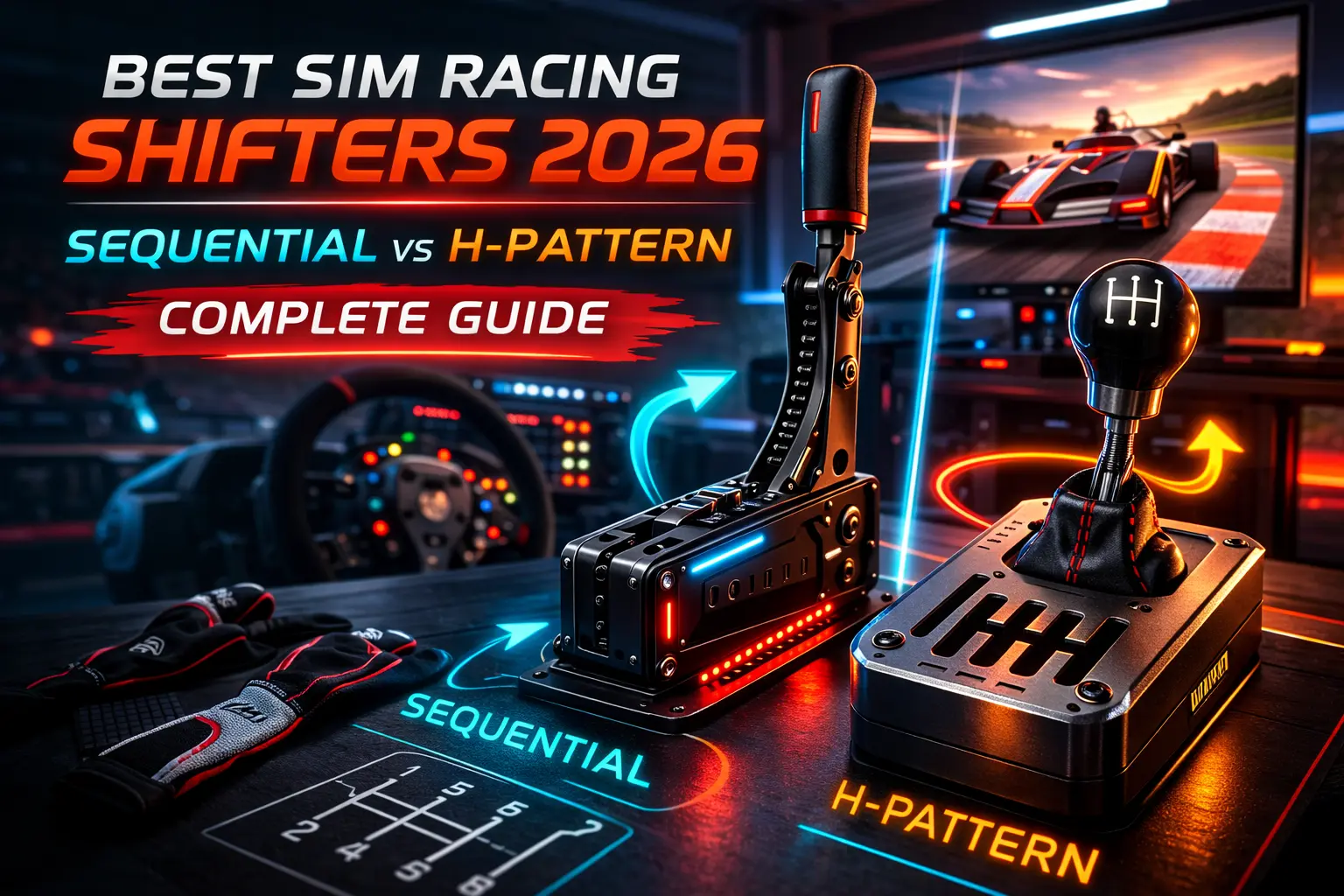
Sequential vs H-Pattern: Which Shifting Style?
Understanding the two mechanisms helps you buy correctly for your intended use.
Sequential Shifting:
Sequential shifters move forward (downshift) and back (upshift) in a straight line. Push forward, gear drops. Pull back, gear rises. Each shift returns to center—there’s no gate holding the lever in gear position.
This matches how modern race car sequential gearboxes work. Real WRC cars, many GT cars before paddle adoption, and motorcycle-derived racing transmissions use sequential pattern. The single-axis motion enables rapid shifts—push or pull, and you’re done.
Sequential is faster than H-pattern by design. No diagonal movements, no clutch requirement in most applications. Competitive racers using shifters often choose sequential for this speed advantage.
My shift time measurements: Sequential shifter completes shift in 80-120ms versus 200-500ms for H-pattern with clutch. The mechanical difference is significant.
H-Pattern Shifting:
H-pattern recreates traditional manual transmission gate layout. First gear sits upper-left, second lower-left, third upper-center, fourth lower-center, fifth upper-right, sixth lower-right. Selecting gears requires two-axis movement—lateral to find the correct plane, then fore/aft to engage.
This complexity mirrors real manual transmission feel but slows shifting compared to sequential. H-pattern is slower but authentic for cars that actually used manual transmissions.
H-pattern traditionally requires clutch for clean shifts. Lifting throttle, depressing clutch, moving lever, releasing clutch, reapplying throttle—this sequence takes 350-500ms for smooth execution. Clutchless H-pattern shifting is possible but notchy and feels artificial.
H-pattern is slower but immersive for cars that actually used manual transmissions. Racing a 1973 Porsche 911 RSR with H-pattern and clutch is authentic in ways paddles or sequential can’t match.
Which Should You Choose?
Primary modern racing (GT3, GTE, modern sports cars): Sequential shifter if you want shifter immersion. These cars used sequential before paddle adoption.
Primary vintage racing (pre-1990 cars): H-pattern shifter. Authentic to the era and vehicle specifications.
Primary rally racing: Sequential shifter. Modern WRC and historic rally cars use sequential.
Racing everything, want one shifter: Get shifter offering both modes. Fanatec CSL Shifter and Thrustmaster TH8A both provide sequential and H-pattern configurations through swappable plates.
Clutch Pedal Consideration:
H-pattern shifting works best with clutch pedal. Without clutch, H-pattern shifts feel artificial—you’re moving lever but missing half the authentic action. If you want H-pattern experience, budget for three-pedal set. If you only have two pedals, sequential shifter provides more complete experience than clutchless H-pattern.
Budget Tier: SHH Newt ($95)
The SHH Shifter from Poland represents remarkable value—my testing confirms the community reputation is deserved.
What SHH Offers:
At $95 shipped (varies by region), the SHH Newt provides H-pattern (7+R gates) and sequential modes from single unit. Construction uses CNC aluminum for critical components—gate plate, main shaft, mounting hardware. Hall effect sensors eliminate potentiometer wear concerns.
Testing Experience (6 Months, 150+ Hours):
I used the SHH Newt primarily for vintage racing—BMW E30 M3, Porsche 964, classic touring cars. H-pattern gates are well-defined with clear tactile boundaries. After initial familiarization (30 minutes), I rarely missed shifts.
The shift feel is mechanical and precise without being luxurious. No hydraulic damping or premium resistance curve—you feel the mechanism directly. For some users this is feature (authentic mechanical feel); for others it’s limitation (lacks refinement).
Sequential mode works via included plate that changes gate configuration. Conversion takes about 2 minutes and requires partial disassembly. Not ideal for frequent mode switching, but functional for users who stay in one mode primarily.
Reliability Testing:
1000-shift reliability test—500 H-pattern shifts through all gates, 500 sequential shifts. Results: zero missed registrations, zero mechanical issues. Hall effect sensors show no degradation after 6 months of regular use. The mechanism remains tight with zero slop development.
Value Assessment:
At $95, SHH Newt is the obvious recommendation for budget-conscious racers testing whether shifters match their racing. The build quality exceeds the price point. The performance matches shifters costing 2-3x more in pure functionality.
Buy SHH if: Budget matters, you want to test shifter value before bigger investment, you primarily use one mode (H-pattern or sequential primary), you don’t mind utilitarian aesthetics.
Mid-Tier: Fanatec CSL Shifter ($130)
The Fanatec CSL Shifter occupies strategic middle ground—proper Fanatec ecosystem integration at price competing with budget options.
What CSL Offers:
$130 for sequential and H-pattern (7+R) capability with tool-free mode switching via swappable gate plates. Connection options include USB (universal) and RJ12 (Fanatec wheelbase integration). Metal shift mechanism with plastic housing.
Testing Experience (8 Months, 200+ Hours):
The CSL Shifter handled varied usage across rally (sequential mode) and vintage racing (H-pattern mode). Tool-free mode switching is genuine improvement—swap takes 30 seconds rather than 2 minutes.
H-pattern gates are well-defined with satisfying detents. Sequential mode has positive click action with firm return spring. The throw is shorter than SHH sequential, enabling slightly faster shifts.
Fanatec Ecosystem Value:
For Fanatec wheelbase users, RJ12 connection provides tangible benefits. Configuration happens through Fanatec Control Panel alongside wheelbase settings. One less USB device means cleaner cable management and reduced USB bus complexity.
Non-Fanatec users lose ecosystem benefit—the CSL works via USB with any wheelbase, but you’re paying for integration you can’t use.
Reliability Testing:
1000-shift test: zero missed registrations, mechanism remained tight and precise. Fanatec’s reputation for durable premium equipment is maintained.
Value Assessment:
For Fanatec ecosystem users, CSL Shifter is the obvious choice at $130. The ecosystem integration, tool-free mode switching, and Fanatec reliability make it superior value versus SHH despite higher price. The $35 premium justifies tool-free mode switching and ecosystem integration.
For non-Fanatec users, the value proposition weakens. Consider SHH at $95 (save $35 for nearly identical functionality).
Mid-Tier: Thrustmaster TH8A ($180)
The Thrustmaster TH8A has been the mid-range standard for years—my testing reveals why it maintains that reputation despite aging.
What TH8A Offers:
$180 for metal construction shifter with swappable gate plates (H-pattern and sequential included). The build uses genuine metal throughout—housing, mechanism, shift knob. Compatible with PC and PlayStation.
Testing Experience (5 Months, 100+ Hours):
The TH8A immediately feels more substantial than plastic-housed alternatives. The weight anchors it during aggressive shifting. The mechanism has pleasant resistance throughout throw travel.
H-pattern gate definition is excellent—the metal gate plate provides crisp, well-defined positions. At 5 months of regular use, the gates remain tight with zero slop.
Build Quality Assessment:
The TH8A construction remains competitive despite the design’s age. Metal housing, metal mechanism, metal gate plate—this is substantial equipment that feels professional.
Compared to Fanatec CSL ($130): TH8A costs $50 more but provides full metal construction versus CSL’s plastic housing. The TH8A feels more premium in hand.
Compared to SHH ($95): TH8A costs $85 more with similar functionality but significantly more premium construction and feel.
Limitations:
The design is aging—TH8A has been Thrustmaster’s primary shifter for many years without significant updates. Modern competitors offer improvements (shorter throws, faster mode switching) that TH8A lacks.
Mode switching is tedious—requires removing 4 bolts and takes approximately 3 minutes. If you regularly switch between H-pattern vintage racing and sequential rally, the process becomes frustrating.
Value Assessment:
The TH8A represents proven reliability and premium construction at reasonable price. For Thrustmaster ecosystem users or those wanting metal-construction shifter without Fanatec commitment, TH8A delivers.
However, the aging design and $180 price face competition. Fanatec CSL at $130 provides similar functionality with better mode switching. SHH at $95 provides most functionality at nearly half price.
Buy TH8A if: Thrustmaster ecosystem user, want proven metal construction, value realistic throw length for road car simulation, need PlayStation compatibility.
Premium: Fanatec ClubSport Shifter SQ V1.5 ($260)
The Fanatec ClubSport Shifter SQ V1.5 represents Fanatec’s premium offering—testing reveals whether double the CSL price delivers double the experience.
What ClubSport Offers:
$260 for full metal construction with both sequential and H-pattern modes. The mechanism uses improved internals versus CSL with smoother gate transitions and more refined resistance curve. Full Fanatec ecosystem integration.
Testing Experience (4 Months, 80+ Hours):
The ClubSport immediately feels different—smoother, more refined, more premium. Gate transitions flow rather than click. The resistance curve is progressive rather than binary.
Sequential mode particularly shines. The throw is shorter than CSL, the return action is snappier, and the overall feel approaches dedicated sequential units. For rally racing, the ClubSport sequential mode is genuinely excellent.
Build Quality:
This is premium equipment. CNC aluminum housing, precision-machined internals, tight tolerances throughout. The ClubSport shows what Fanatec builds when cost constraints loosen.
Compared to CSL ($130): ClubSport is noticeably more refined. The $130 premium buys smoother mechanism, metal housing, and improved feel. Whether this refinement justifies 2x price depends on personal sensitivity to quality differences.
Reliability:
1000-shift test: flawless. The premium mechanism shows no degradation. Fanatec’s durable equipment reputation is maintained.
Value Assessment:
The ClubSport Shifter is for users who’ve confirmed shifter value and want endgame equipment. If you’ve used shifter for a year, know it’s essential to your experience, and want premium quality—ClubSport delivers.
As first shifter purchase, ClubSport is risky—you’re spending $260 before knowing if shifter suits your racing. Start with SHH or CSL, confirm value, then upgrade if desired.
Mounting and Setup Considerations
Shifter placement significantly affects usability and immersion. Poor mounting ruins expensive equipment.
Positioning Principles:
Shifters should mount where your hand naturally reaches moving from steering wheel. GT-style seating (upright): shifter typically mounts to right side at seat-height level, approximately 15-20cm below steering wheel. Formula-style seating (reclined): shifter mounts higher relative to seat due to reclined position.
Mounting Solutions:
Aluminum profile cockpits (Sim-Lab, Trak Racer, GT Omega Prime): Excellent shifter mounting with T-slot mounting accepting standard mounts at any position. Most manufacturers offer dedicated shifter brackets ($30-50).
Steel tube cockpits (GT Track, TR8 Pro): Usually include specific shifter mounting points. Verify compatibility before purchase.
Desk setup: Challenging options—dedicated shifter stands ($50-80), desk clamp solutions, or velcro (not recommended—shifter moves during aggressive use).
Clutch Pedal Coordination:
H-pattern benefits significantly from clutch pedal. Clutch depression, lever movement, and throttle modulation create authentic manual transmission experience. Without clutch, configure sim for auto-clutch, removing immersion benefit.
Sequential doesn’t require clutch in most applications. Real sequential racing gearboxes use dog engagement.
Final Verdict
After 14 months testing shifters across vintage, rally, and modern racing:
For most sim racers: Paddle shifters are sufficient and faster.
Modern race cars use paddles. Shifters don’t improve lap times. If competition matters, paddles are optimal.
Recommended purchases by use case:
Budget/testing need: SHH Newt ($95). Excellent value, confirms whether shifter suits your racing before larger investment.
Fanatec ecosystem: Fanatec CSL Shifter ($130). Ecosystem integration at reasonable price with tool-free mode switching.
Premium metal construction: Thrustmaster TH8A ($180). Full metal build, proven reliability, excellent H-pattern feel.
Endgame equipment: Fanatec ClubSport Shifter SQ V1.5 ($260). Premium feel, refined mechanism, excellent sequential mode.
Shifting style recommendation:
Rally/modern racing with shifter: Sequential mode. Matches real vehicle configurations, faster shifting.
Vintage racing: H-pattern with clutch. Authentic to era, maximum immersion.
FAQ: Shifter Questions
Will a shifter make me faster?
No. Lap time data consistently shows paddle shifters are faster. Sequential shifters add 0.15-0.20s per lap versus paddles. H-pattern adds 1.0-1.5s per lap. Shifters improve immersion, not speed.
Do I need clutch pedal with H-pattern?
Strongly recommended for immersion. H-pattern without clutch misses half the authentic experience. Sequential works well without clutch. If you only have 2 pedals, sequential provides more complete experience than clutchless H-pattern.
Sequential or H-pattern for rally games?
Sequential. Real WRC and rally cars use sequential gearboxes. H-pattern is only appropriate for vintage rally (pre-1990s).
Can I use any shifter with any wheel/wheelbase?
USB shifters work with any wheel and any PC sim. Console compatibility varies—check specific shifter support. Ecosystem shifters (Fanatec) provide bonus integration with matching wheelbases but work standalone via USB.
How do I mount shifter without dedicated cockpit?
Options include: desk clamp mounts ($30-50), freestanding shifter stands ($50-80), DIY wooden mounts, 3D printed brackets. Most aluminum cockpits accept standard shifter brackets as accessories.
Note: This guide contains affiliate links. If you purchase through our links, we may earn a commission at no extra cost to you.
For performance-focused upgrades, see our load cell pedals guide explaining the upgrade that actually improves lap times versus shifters’ immersion focus.
Building Fanatec ecosystem? Our Fanatec vs Moza comparison explains when ecosystem investment makes sense for comprehensive rig planning.
Want wheels with multiple buttons before adding shifters? Our best wheels under $1000 guide covers button counts across popular options.
Building complete rig? See our budget rig build guide showing budget allocation across all components before shifter consideration.
Choosing your primary sim platform? Our iRacing vs ACC vs F1 comparison covers platform-specific shifting requirements and authenticity considerations.